Wie Jinhong, Kim Byung Joo, Myeong Jongyun, Ha Kotdaji, Jeong Seung Joo, Yang Dongki, Kim Euiyong, Jeon Ju-Hong, So Insuk
a Department of Physiology ; Seoul National University College of Medicine ; Seoul , Republic of Korea.
Channels (Austin). 2015;9(4):186-95. doi: 10.1080/19336950.2015.1058454. Epub 2015 Jun 17.
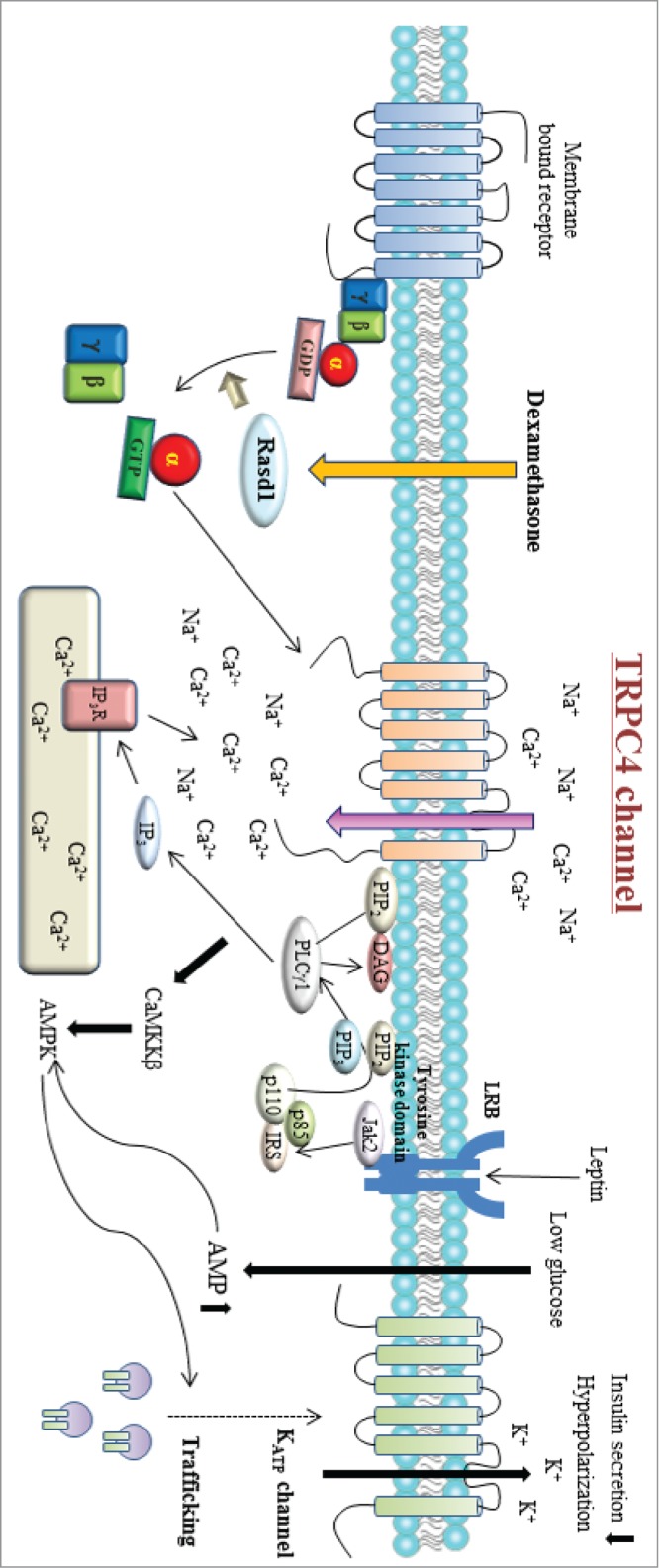
TRPC4 is important regulators of electrical excitability in gastrointestinal myocytes, pancreatic β-cells and neurons. Much is known regarding the assembly and function of these channels including TRPC1 as a homotetramer or a heteromultimer and the roles that their interacting proteins play in controlling these events. Further, they are one of the best-studied targets of G protein-coupled receptors and growth factors in general and Gαi/o and Gαq protein coupled receptor or epidermal growth factor and leptin in particular. However, our understanding of the roles of small G proteins and leptin on TRPC4 channels is still rudimentary. We discuss potential roles for Rasd1 small G protein and leptin in channel activation in addition to their known role in cellular signaling.
TRPC4是胃肠道肌细胞、胰腺β细胞和神经元电兴奋性的重要调节因子。关于这些通道的组装和功能,包括TRPC1作为同四聚体或异源多聚体以及它们的相互作用蛋白在控制这些事件中所起的作用,我们已经了解很多。此外,它们是一般G蛋白偶联受体和生长因子中研究得最好的靶点之一,特别是Gαi/o和Gαq蛋白偶联受体或表皮生长因子和瘦素。然而,我们对小G蛋白和瘦素在TRPC4通道上的作用的理解仍然很初步。除了它们在细胞信号传导中的已知作用外,我们还讨论了Rasd1小G蛋白和瘦素在通道激活中的潜在作用。