Prevost Shelley, Brooks Dina, Bwititi Phillip T
St Joseph's Hospital, Thunder Bay;
Department of Physical Therapy, University of Toronto, Ontario;
Can J Respir Ther. 2015 Spring;51(2):33-8.
The mechanical insufflator-exsufflator (MIE) is effective in assisting cough and in helping to avoid unplanned hospitalizations, tracheostomy and long-term ventilation in patients with neuromuscular disease or spinal cord injury. Despite this, the availability and usage of the device in Canada is unknown.
To investigate practice patterns and availability of the MIE in Ontario hospitals.
A cross-sectional, self-administered mail survey was sent to a random sample of 400 respiratory therapists practicing in 96 Ontario hospitals.
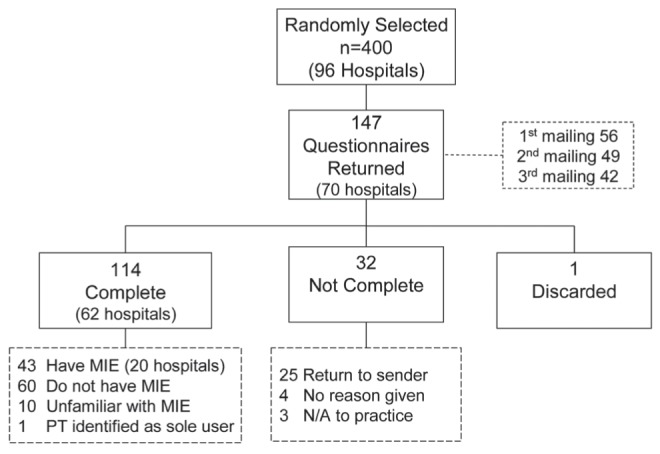
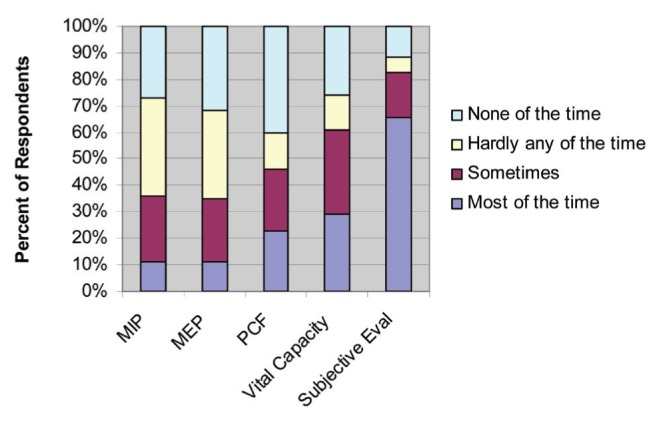
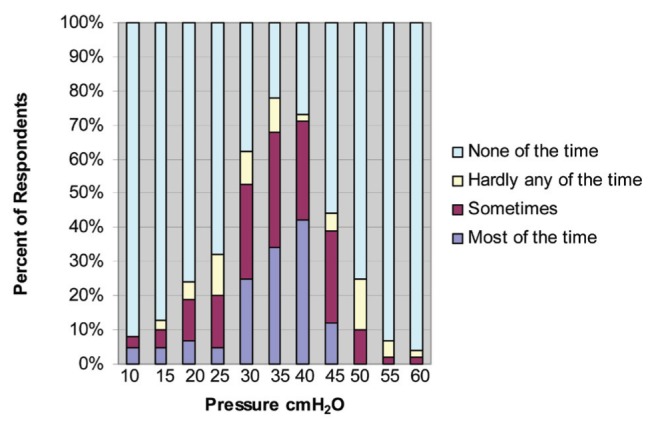
A total of 114 (28%) completed surveys were returned from 62 (65%) hospitals. Twenty (32%) hospitals had a MIE. The respiratory therapist was the predominant health care provider using the MIE. The device was most commonly used in the intensive care unit, and medical/surgical units in patients with neuromuscular diseases or spinal cord injuries. Optimal pressure spans of 35 cmH2O to 40 cmH2O were used by 54% of respondents. Fourteen of the 20 hospitals with an MIE had policies or guidelines in place, and four of these hospitals had established staff competencies. Measurements of peak cough flow, maximal inspiratory/expiratory pressure and vital capacity were reported to be infrequently performed.
The present study demonstrated that the MIE device is not widely available in Ontario hospitals and there are variations in how the devices are applied, possibly resulting in suboptimal therapy. A comprehensive educational program about MIE devices that incorporates best practices and a practical component is recommended for current providers as well as for inclusion in student curricula.
机械吸气-呼气装置(MIE)在辅助咳嗽以及帮助神经肌肉疾病或脊髓损伤患者避免计划外住院、气管切开术和长期通气方面有效。尽管如此,该设备在加拿大的可获得性和使用情况尚不清楚。
调查安大略省医院中MIE的使用模式和可获得性。
向在安大略省96家医院执业的400名呼吸治疗师随机抽取样本发送一份横断面的自填式邮件调查问卷。
共收到来自62家(65%)医院的114份(28%)完成的调查问卷。20家(32%)医院拥有一台MIE。呼吸治疗师是使用MIE的主要医疗服务提供者。该设备最常用于重症监护病房以及患有神经肌肉疾病或脊髓损伤患者的内科/外科病房。54%的受访者使用35 cmH₂O至40 cmH₂O的最佳压力范围。拥有MIE的20家医院中有14家制定了政策或指南,其中4家医院确定了工作人员的能力。据报告,很少进行峰值咳嗽流量、最大吸气/呼气压力和肺活量的测量。
本研究表明,MIE设备在安大略省医院中并未广泛使用,并且设备的应用方式存在差异,这可能导致治疗效果欠佳。建议为当前的医疗服务提供者开展一项关于MIE设备的综合教育计划,该计划应纳入最佳实践和实践内容,并纳入学生课程。