
T( brachyury)蛋白:一种用于颅底脊索瘤的敏感标志物,但并非预后因素。
Brachyury: A sensitive marker, but not a prognostic factor, for skull base chordomas.
作者信息
Wang Ke, Tian Kaibing, Wang Liang, Wu Zhen, Ren Cong, Hao Shuyu, Feng Jie, Li Junhua, Wan Hong, Jia Guijun, Zhang Liwei, Zhang Junting
机构信息
Department of Neurosurgery, Skull Base and Brainstem Tumor Division, Beijing Tian Tan Hospital, Capital Medical University, China National Clinical Research Center for Neurological Diseases, Beijing 100050, P.R. China.
Beijing Neurosurgery Institute, Capital Medical University, Beijing 100050, P.R. China.
出版信息
Mol Med Rep. 2015 Sep;12(3):4298-4304. doi: 10.3892/mmr.2015.3976. Epub 2015 Jun 22.
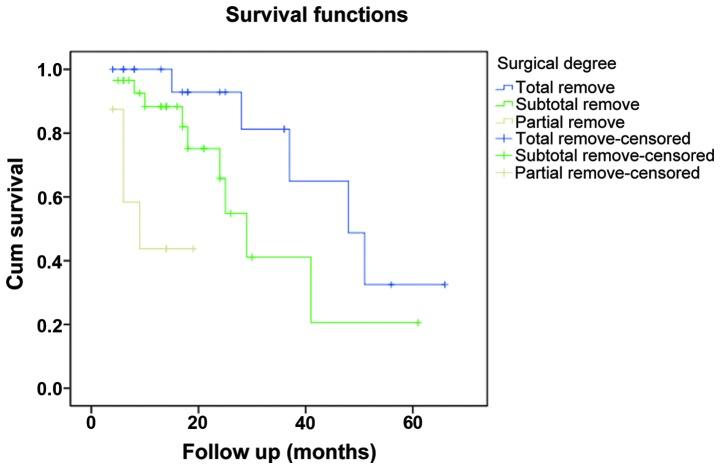
Patients with skull base chordomas have a poor prognosis, and the role of the protein expression of brachyury in chordomas remains to be fully elucidated. The present study used immunohistochemistry to analyze 57 cases of skull base chordoma, and analyzed the clinical data of the patients. The results demonstrated that the protein expression of brachyury was negative in 8.8% (5/57) of the cases. The weak/positive, positive and strong/positive rates were 5.3% (3/57), 21.1% (12/57) and 64.9% (37/57), respectively. The association between the expression of brachyury and recurrence was not statistically significant. Kaplan‑Meier analysis revealed that the degree of surgery, rather than the expression of brachyury, was associated with tumor recurrence (P=0.001). In conclusion, the results of the present study demonstrated that the expression of Brachyury offers a sensitive marker, but not a risk factor, for skull base chordomas, and radical surgery is recommended.
颅底脊索瘤患者预后较差,而短尾相关蛋白在脊索瘤中的蛋白表达作用仍有待充分阐明。本研究采用免疫组织化学方法分析了57例颅底脊索瘤病例,并分析了患者的临床资料。结果显示,短尾相关蛋白的蛋白表达在8.8%(5/57)的病例中为阴性。弱阳性、阳性和强阳性率分别为5.3%(3/57)、21.1%(12/57)和64.9%(37/57)。短尾相关蛋白表达与复发之间的关联无统计学意义。Kaplan-Meier分析显示,手术程度而非短尾相关蛋白的表达与肿瘤复发相关(P=0.001)。总之,本研究结果表明,短尾相关蛋白的表达是颅底脊索瘤的一个敏感标志物,但不是危险因素,建议进行根治性手术。


 Zotero 插件