Krishnan Preethi, Tripathi Rakesh, Schnell Gretja, Reisch Thomas, Beyer Jill, Irvin Michelle, Xie Wangang, Larsen Lois, Cohen Daniel, Podsadecki Thomas, Pilot-Matias Tami, Collins Christine
Research and Development, AbbVie Inc., North Chicago, Illinois, USA
Research and Development, AbbVie Inc., North Chicago, Illinois, USA.
Antimicrob Agents Chemother. 2015 Sep;59(9):5445-54. doi: 10.1128/AAC.00998-15. Epub 2015 Jun 22.
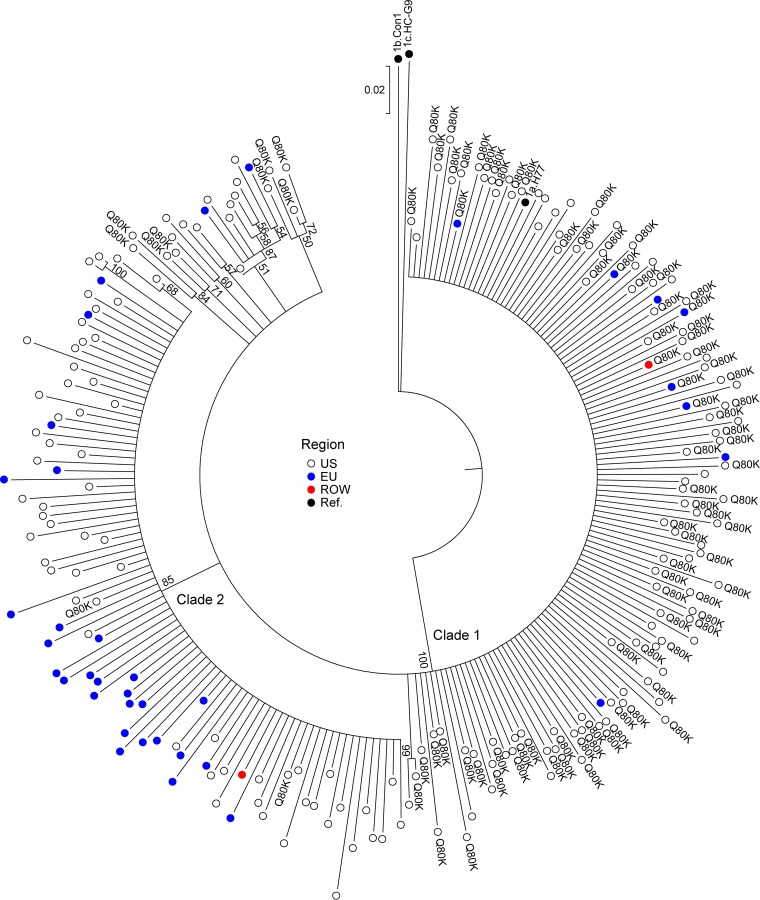
AVIATOR, a phase 2 clinical trial, evaluated ritonavir-boosted paritaprevir (a protease inhibitor), ombitasvir (an NS5A inhibitor), and dasabuvir (a nonnucleoside polymerase inhibitor) (the three-drug [3D] regimen) with or without ribavirin (RBV) for 8, 12, or 24 weeks in 406 HCV genotype 1 (GT1)-infected patients. The rate of sustained virologic response 24 weeks after treatment ranged from 88% to 100% across the arms of the 3D regimen with or without RBV; 20 GT1a-infected patients and 1 GT1b-infected patient experienced virologic failure (5.2%). Baseline resistance-conferring variants in NS3 were rare. M28V in GT1a and Y93H in GT1b were the most prevalent preexisting variants in NS5A, and C316N in GT1b and S556G in both GT1a and GT1b were the most prevalent variants in NS5B. Interestingly, all the GT1a sequences encoding M28V in NS5A were from the United States, while GT1b sequences encoding C316N and S556G in NS5B were predominant in the European Union. Variants preexisting at baseline had no significant impact on treatment outcome. The most prevalent treatment-emergent resistance-associated variants (RAVs) in GT1a were R155K and D168V in NS3, M28T and Q30R in NS5A, and S556G in NS5B. The single GT1b-infected patient experiencing virologic failure had no RAVs in any target. A paritaprevir-ritonavir dose of 150/100 mg was more efficacious in suppressing R155K in NS3 than a 100/100-mg dose. In patients who failed after receiving 12 or more weeks of treatment, RAVs were selected in all 3 targets, while most patients who relapsed after 8 weeks of treatment did so without any detectable RAVs. Results from this study guided the selection of the optimal treatment regimen, treatment duration, and paritaprevir dose for further development of the 3D regimen. (This study has been registered at ClinicalTrials.gov under registration number NCT01464827.).
“飞行员”(AVIATOR)是一项2期临床试验,在406例丙型肝炎病毒1型(GT1)感染患者中,评估了利托那韦增强的帕立普韦(一种蛋白酶抑制剂)、奥比他韦(一种NS5A抑制剂)和达沙布韦(一种非核苷聚合酶抑制剂)(三联疗法)联合或不联合利巴韦林(RBV)治疗8周、12周或24周的疗效。在三联疗法联合或不联合RBV的各个治疗组中,治疗24周后的持续病毒学应答率在88%至100%之间;20例GT1a感染患者和1例GT1b感染患者出现病毒学失败(5.2%)。NS3中基线时赋予耐药性的变异罕见。GT1a中的M28V和GT1b中的Y93H是NS5A中最常见的预先存在的变异,GT1b中的C316N以及GT1a和GT1b中的S556G是NS5B中最常见的变异。有趣的是,所有编码NS5A中M28V的GT1a序列均来自美国,而编码NS5B中C316N和S556G的GT1b序列在欧盟最为常见。基线时预先存在的变异对治疗结果无显著影响。GT1a中最常见的治疗中出现的耐药相关变异(RAV)是NS3中的R155K和D168V、NS5A中的M28T和Q30R以及NS5B中的S556G。那例出现病毒学失败的GT1b感染患者在任何靶点均未出现RAV。150/100 mg的帕立普韦 - 利托那韦剂量在抑制NS3中的R155K方面比100/100 mg剂量更有效。在接受12周或更长时间治疗后失败的患者中,所有3个靶点均出现了RAV,而大多数在8周治疗后复发的患者复发时未检测到任何RAV。本研究结果为三联疗法的进一步研发指导了最佳治疗方案、治疗疗程和帕立普韦剂量的选择。(本研究已在ClinicalTrials.gov注册,注册号为NCT01464827。)