
发育调控的心脏阻断蛋白,一种线粒体靶向的L18核糖体蛋白基因,是拟南芥细胞分裂、分化和种子发育所必需的。
Developmentally regulated HEART STOPPER, a mitochondrially targeted L18 ribosomal protein gene, is required for cell division, differentiation, and seed development in Arabidopsis.
作者信息
Zhang Hongyu, Luo Ming, Day Robert C, Talbot Mark J, Ivanova Aneta, Ashton Anthony R, Chaudhury Abed M, Macknight Richard C, Hrmova Maria, Koltunow Anna M
机构信息
Rice Research Institute of Sichuan Agricultural University, Chengdu, Sichuan 611130, PR China.
CSIRO Agriculture Flagship, PO Box 1600, ACT 2601, Australia
出版信息
J Exp Bot. 2015 Sep;66(19):5867-80. doi: 10.1093/jxb/erv296. Epub 2015 Jun 23.
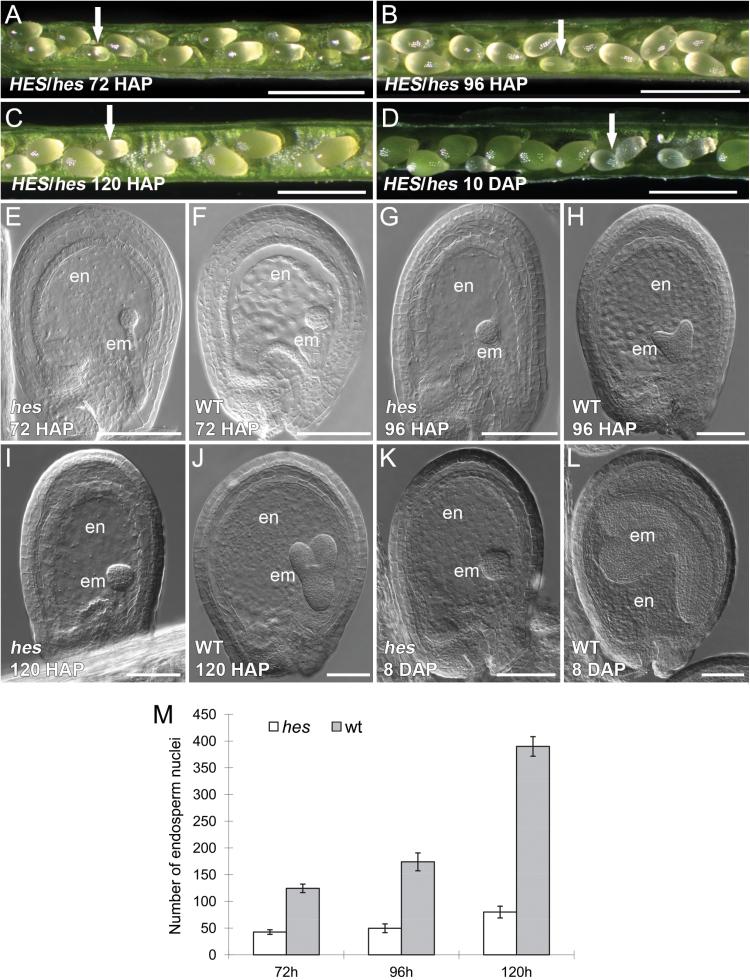
Evidence is presented for the role of a mitochondrial ribosomal (mitoribosomal) L18 protein in cell division, differentiation, and seed development after the characterization of a recessive mutant, heart stopper (hes). The hes mutant produced uncellularized endosperm and embryos arrested at the late globular stage. The mutant embryos differentiated partially on rescue medium with some forming callus. HES (At1g08845) encodes a mitochondrially targeted member of a highly diverged L18 ribosomal protein family. The substitution of a conserved amino residue in the hes mutant potentially perturbs mitoribosomal function via altered binding of 5S rRNA and/or influences the stability of the 50S ribosomal subunit, affecting mRNA binding and translation. Consistent with this, marker genes for mitochondrial dysfunction were up-regulated in the mutant. The slow growth of the endosperm and embryo indicates a defect in cell cycle progression, which is evidenced by the down-regulation of cell cycle genes. The down-regulation of other genes such as EMBRYO DEFECTIVE genes links the mitochondria to the regulation of many aspects of seed development. HES expression is developmentally regulated, being preferentially expressed in tissues with active cell division and differentiation, including developing embryos and the root tips. The divergence of the L18 family, the tissue type restricted expression of HES, and the failure of other L18 members to complement the hes phenotype suggest that the L18 proteins are involved in modulating development. This is likely via heterogeneous mitoribosomes containing different L18 members, which may result in differential mitochondrial functions in response to different physiological situations during development.
在对隐性突变体“心脏停止发育(hes)”进行表征后,有证据表明线粒体核糖体(mitoribosomal)L18蛋白在细胞分裂、分化和种子发育中发挥作用。hes突变体产生未细胞化的胚乳,胚胎在球形晚期停滞。突变体胚胎在拯救培养基上部分分化,一些形成愈伤组织。HES(At1g08845)编码高度分化的L18核糖体蛋白家族的线粒体靶向成员。hes突变体中一个保守氨基酸残基的取代可能通过改变5S rRNA的结合来扰乱线粒体核糖体功能和/或影响50S核糖体亚基的稳定性,从而影响mRNA结合和翻译。与此一致的是,线粒体功能障碍的标记基因在突变体中上调。胚乳和胚胎的生长缓慢表明细胞周期进程存在缺陷,这通过细胞周期基因的下调得到证明。其他基因如胚胎缺陷基因的下调将线粒体与种子发育的许多方面的调控联系起来。HES表达受发育调控,优先在具有活跃细胞分裂和分化的组织中表达,包括发育中的胚胎和根尖。L18家族的分化、HES在组织类型上的限制性表达以及其他L18成员无法互补hes表型表明L18蛋白参与调节发育。这可能是通过含有不同L18成员的异质性线粒体核糖体实现的,这可能导致在发育过程中对不同生理情况产生不同的线粒体功能。



 Zotero 插件