Poli Valeria, Camporeale Annalisa
Department of Molecular Biotechnology and Health Sciences, Molecular Biotechnology Center, University of Torino , Torino , Italy.
Front Oncol. 2015 Jun 8;5:121. doi: 10.3389/fonc.2015.00121. eCollection 2015.
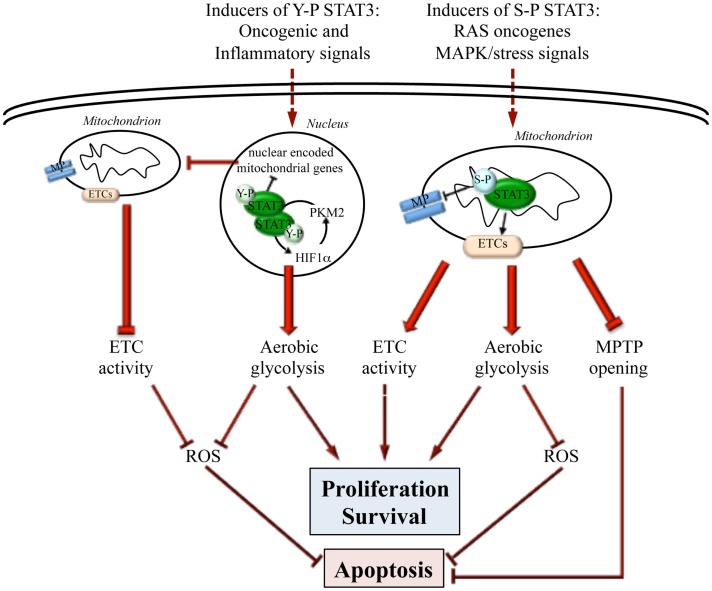
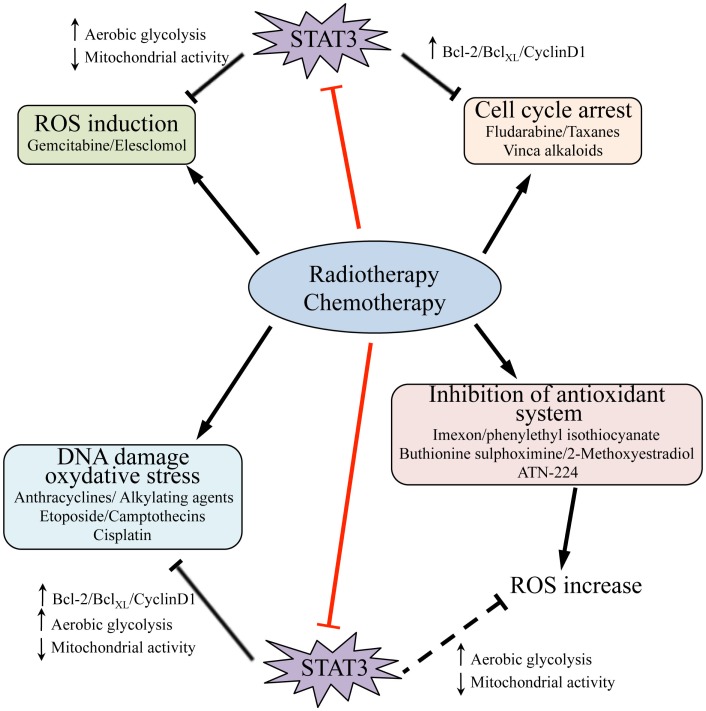
Signal transducer and activator of transcription (STAT)3 mediates the signaling downstream of cytokine and growth factor receptors, regulating the expression of target genes. It is constitutively phosphorylated on tyrosine (Y-P) in many tumors, where its transcriptional activity can induce a metabolic switch toward aerobic glycolysis and down-regulate mitochondrial activity, a prominent metabolic feature of most cancer cells, correlating with reduced production of ROS, delayed senescence, and protection from apoptosis. STAT3 can, however, also localize to mitochondria, where its serine-phosphorylated (S-P) form preserves mitochondrial oxidative phosphorylation and controls the opening of the mitochondrial permeability transition pore, also promoting survival and resistance to apoptosis in response to specific signals/oncogenes such as RAS. Thus, downstream of different signals, both nuclear, Y-P STAT3, and mitochondrial, S-P STAT3, can act by promoting cell survival and reducing ROS production. Here, we discuss these properties in the light of potential connections between STAT3-driven alterations of mitochondrial metabolism and the development of drug resistance in cancer patients.
信号转导与转录激活因子(STAT)3介导细胞因子和生长因子受体下游的信号传导,调控靶基因的表达。在许多肿瘤中,它在酪氨酸位点(Y-P)发生组成型磷酸化,其转录活性可诱导代谢转向有氧糖酵解并下调线粒体活性,这是大多数癌细胞的一个显著代谢特征,与活性氧生成减少、衰老延迟和抗凋亡保护相关。然而,STAT3也可定位于线粒体,其丝氨酸磷酸化(S-P)形式可维持线粒体氧化磷酸化并控制线粒体通透性转换孔的开放,还可响应特定信号/癌基因(如RAS)促进细胞存活和抗凋亡。因此,在不同信号的下游,细胞核中的Y-P STAT3和线粒体中的S-P STAT3均可通过促进细胞存活和减少活性氧生成发挥作用。在此,我们根据STAT3驱动的线粒体代谢改变与癌症患者耐药性发展之间的潜在联系来讨论这些特性。