Hatchwell Luke, Collison Adam, Girkin Jason, Parsons Kristy, Li Junyao, Zhang Jie, Phipps Simon, Knight Darryl, Bartlett Nathan W, Johnston Sebastian L, Foster Paul S, Wark Peter A B, Mattes Joerg
Department of Experimental & Translational Respiratory Medicine, Hunter Medical Research Institute, University of Newcastle, Newcastle, New South Wales, Australia Priority Research Centre for Asthma and Respiratory Diseases, Hunter Medical Research Institute, University of Newcastle, Newcastle, New South Wales, Australia.
Priority Research Centre for Asthma and Respiratory Diseases, Hunter Medical Research Institute, University of Newcastle, Newcastle, New South Wales, Australia Department of Respiratory and Sleep Medicine, John Hunter Hospital, Newcastle, New South Wales, Australia.
Thorax. 2015 Sep;70(9):854-61. doi: 10.1136/thoraxjnl-2014-205465. Epub 2015 Jun 24.
Asthma exacerbations represent a significant disease burden and are commonly caused by rhinovirus (RV), which is sensed by Toll-like receptors (TLR) such as TLR7. Some asthmatics have impaired interferon (IFN) responses to RV, but the underlying mechanisms of this clinically relevant observation are poorly understood.
To investigate the importance of intact TLR7 signalling in vivo during RV exacerbation using mouse models of house dust mite (HDM)-induced allergic airways disease exacerbated by a superimposed RV infection.
Wild-type and TLR7-deficient (Tlr7(-/-)) BALB/c mice were intranasally sensitised and challenged with HDM prior to infection with RV1B. In some experiments, mice were administered recombinant IFN or adoptively transferred with plasmacytoid dendritic cells (pDC).
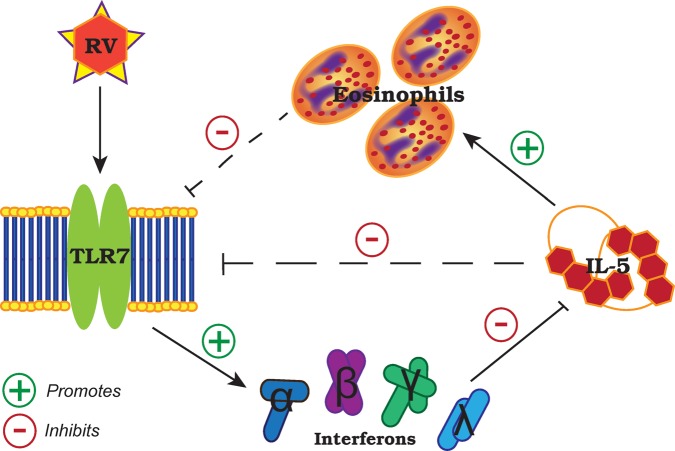
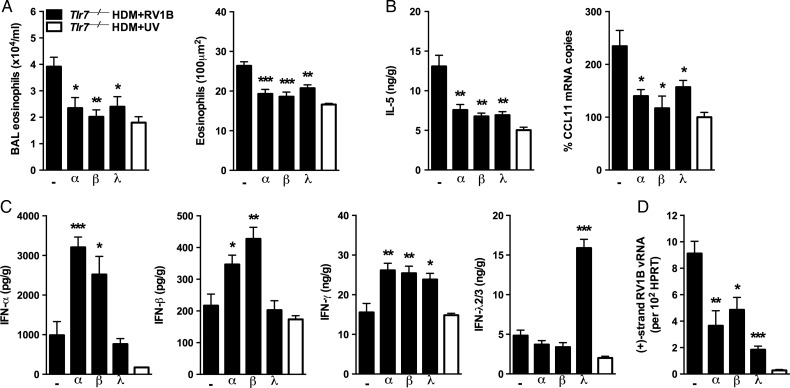
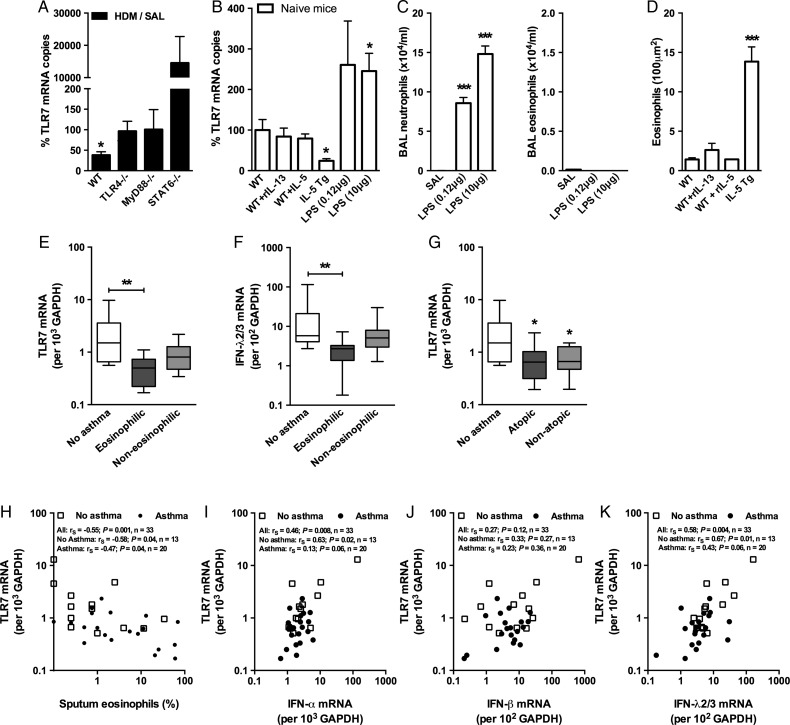
Allergic Tlr7(-/-) mice displayed impaired IFN release upon RV1B infection, increased virus replication and exaggerated eosinophilic inflammation and airways hyper reactivity. Treatment with exogenous IFN or adoptive transfer of TLR7-competent pDCs blocked these exaggerated inflammatory responses and boosted IFNγ release in the absence of host TLR7 signalling. TLR7 expression in the lungs was suppressed by allergic inflammation and by interleukin (IL)-5-induced eosinophilia in the absence of allergy. Subjects with moderate-to-severe asthma and eosinophilic but not neutrophilic airways inflammation, despite inhaled steroids, showed reduced TLR7 and IFNλ2/3 expression in endobronchial biopsies. Furthermore, TLR7 expression inversely correlated with percentage of sputum eosinophils.
This implicates IL-5-induced airways eosinophilia as a negative regulator of TLR7 expression and antiviral responses, which provides a molecular mechanism underpinning the effect of eosinophil-targeting treatments for the prevention of asthma exacerbations.
哮喘急性发作代表着重大的疾病负担,通常由鼻病毒(RV)引起,RV可被Toll样受体(TLR)如TLR7识别。一些哮喘患者对RV的干扰素(IFN)反应受损,但这一临床相关观察结果的潜在机制尚不清楚。
利用屋尘螨(HDM)诱导的过敏性气道疾病叠加RV感染加重的小鼠模型,研究在RV加重期间完整的TLR7信号在体内的重要性。
野生型和TLR7缺陷(Tlr7(-/-))BALB/c小鼠在感染RV1B之前,经鼻致敏并接受HDM攻击。在一些实验中,给小鼠注射重组IFN或用浆细胞样树突状细胞(pDC)进行过继转移。
过敏性Tlr7(-/-)小鼠在感染RV1B后IFN释放受损,病毒复制增加,嗜酸性粒细胞炎症和气道高反应性加剧。外源性IFN治疗或具有TLR7功能的pDC过继转移可阻断这些过度的炎症反应,并在缺乏宿主TLR7信号的情况下促进IFNγ释放。在无过敏时,过敏性炎症和白细胞介素(IL)-5诱导的嗜酸性粒细胞增多可抑制肺组织中TLR7的表达。尽管使用了吸入性类固醇,但患有中度至重度哮喘且气道炎症为嗜酸性而非中性粒细胞性的受试者,其支气管活检中TLR7和IFNλ2/3的表达降低。此外,TLR7表达与痰液嗜酸性粒细胞百分比呈负相关。
这表明IL-5诱导的气道嗜酸性粒细胞增多是TLR7表达和抗病毒反应的负调节因子,这为靶向嗜酸性粒细胞治疗预防哮喘急性发作的作用提供了分子机制。