Che Zhiping, Liu Shengming, Tian Yuee, Hu Zhenjie, Chen Yingwu, Chen Genqiang
Laboratory of Pharmaceutical Design & Synthesis, Department of Plant Protection, College of Forestry, Henan University of Science and Technology, Luoyang 471003, Henan, China.
Pharmaceuticals (Basel). 2015 May 8;8(2):221-9. doi: 10.3390/ph8020221.
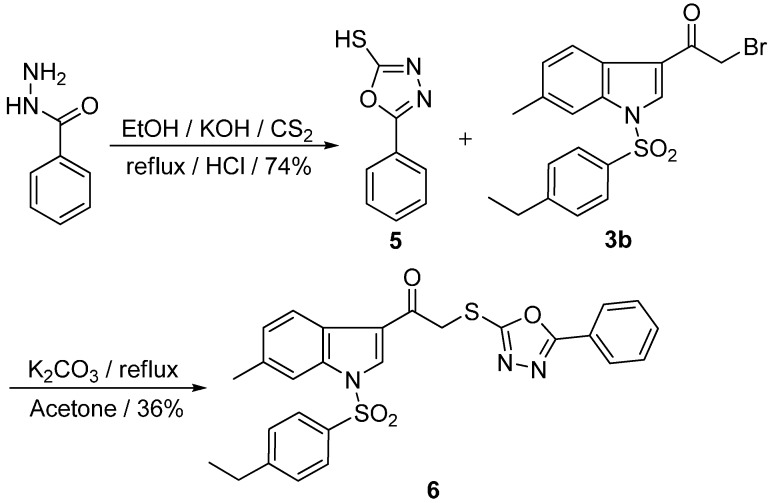
Seven novel N-arylsulfonyl-3-(2-yl-ethanone)-6-methylindole derivatives 4a-f and 6 were readily synthesized and have been identified as inhibitors of human immunodeficiency virus type-1 (HIV-1) replication. Initial biological studies indicated that among these derivatives, N-(p-ethyl)phenylsulfonyl-3-[2-morpholinoethanone]-6-methylindole (4f) and N-(p-ethyl)phenylsulfonyl-3-[2-(5-phenyl-1,3,4-oxadiazole-2-yl-thio)ethanone]-6-methylindole (6) showed the most promising activity against HIV-1 replication. The effective concentration (EC50) and therapeutic index (TI) values of 4f and 6 were 9.42/4.62 μM, and >49.77/66.95, respectively. The cytotoxicity of these compounds has also been assessed. No significant cytotoxicities were found for any of these compounds.
七种新型的N-芳基磺酰基-3-(2-基-乙酮)-6-甲基吲哚衍生物4a-f和6很容易合成,并且已被鉴定为人类免疫缺陷病毒1型(HIV-1)复制的抑制剂。初步生物学研究表明,在这些衍生物中,N-(对-乙基)苯基磺酰基-3-[2-吗啉代乙酮]-6-甲基吲哚(4f)和N-(对-乙基)苯基磺酰基-3-[2-(5-苯基-1,3,4-恶二唑-2-基-硫代)乙酮]-6-甲基吲哚(6)对HIV-1复制显示出最有前景的活性。4f和6的有效浓度(EC50)和治疗指数(TI)值分别为9.42/4.62 μM和>49.77/66.95。还评估了这些化合物的细胞毒性。这些化合物中任何一种都未发现明显的细胞毒性。