
小腿肌肉力量训练改变突然踝关节内翻时的足部行为。
Shank Muscle Strength Training Changes Foot Behaviour during a Sudden Ankle Supination.
作者信息
Hagen Marco, Lescher Stephanie, Gerhardt Andreas, Lahner Matthias, Felber Stephan, Hennig Ewald M
机构信息
Biomechanics Laboratory, Institute of Sport and Movement Sciences, University Duisburg Essen, Essen, Germany.
Institute of Neuroradiology, University of Frankfurt, Frankfurt, Germany.
出版信息
PLoS One. 2015 Jun 25;10(6):e0130290. doi: 10.1371/journal.pone.0130290. eCollection 2015.
BACKGROUND
The peroneal muscles are the most effective lateral stabilisers whose tension braces the ankle joint complex against excessive supination. The purpose of this study was to identify the morphological and biomechanical effects of two machine-based shank muscle training methods.
METHODS
Twenty-two healthy male recreationally active sports students performed ten weeks of single-set high resistance strength training with 3 training sessions per week. The subjects conducted subtalar pronator/supinator muscle training (ST) with the right leg by using a custom-made apparatus; the left foot muscles were exercised with machine-based talocrural plantar and dorsiflexor training (TT). Muscle strength (MVIC), muscle volume and foot biomechanics (rearfoot motion, ground reaction forces, muscle reaction times) during a sudden ankle supination were recorded before and after the intervention.
RESULTS
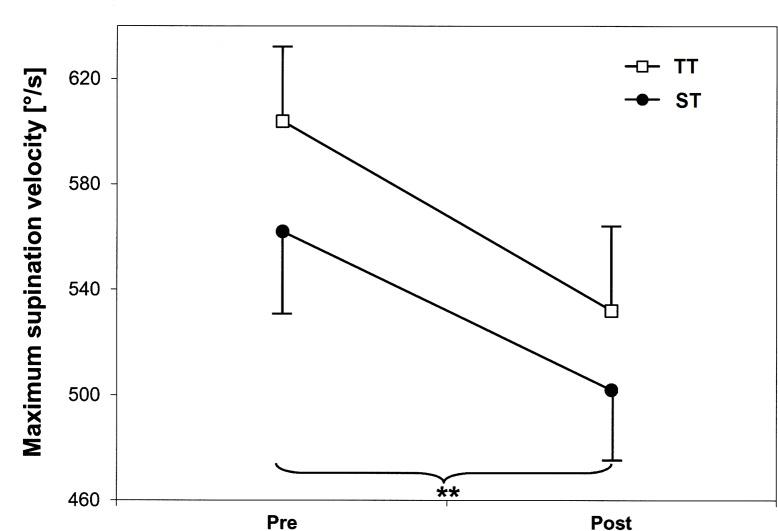
Compared to TT, ST resulted in significantly higher pronator (14% vs. 8%, P<0.01) and supinator MVIC (25% vs. 12%, P<0.01). During sudden foot inversions, both ST and TT resulted in reduced supination velocity (-12%; P<0.01). The muscle reaction onset time was faster after the training in peroneus longus (PL) (P<0.01). Muscle volume of PL (P<0.01) and TA (P<0.01) increased significantly after both ST and TT.
CONCLUSION
After both ST and TT, the ankle joint complex is mechanically more stabilised against sudden supinations due to the muscle volume increase of PL and TA. As the reduced supination velocities indicate, the strength training effects are already present during free-fall. According to a sudden ankle supination in standing position, both machine-based dorsiflexor and pronator strength training is recommended for enhancing the mechanical stability of the ankle.
背景
腓骨肌是最有效的外侧稳定肌,其张力可防止踝关节复合体过度内旋。本研究的目的是确定两种基于器械的小腿肌肉训练方法的形态学和生物力学效应。
方法
22名健康、有休闲运动习惯的男性体育专业学生进行了为期十周的单组高阻力力量训练,每周训练三次。受试者使用定制器械对右腿进行距下关节旋前/旋后肌训练(ST);左脚肌肉通过基于器械的胫距关节跖屈和背屈训练(TT)进行锻炼。在干预前后记录突然踝关节内旋时的肌肉力量(MVIC)、肌肉体积和足部生物力学(后足运动、地面反作用力、肌肉反应时间)。
结果
与TT相比,ST导致旋前肌MVIC显著更高(14%对8%,P<0.01)和旋后肌MVIC显著更高(25%对12%,P<0.01)。在突然足部内翻期间,ST和TT均导致内旋速度降低(-12%;P<0.01)。训练后,腓骨长肌(PL)的肌肉反应起始时间更快(P<0.01)。ST和TT后,PL(P<0.01)和趾长伸肌(TA)的肌肉体积均显著增加。
结论
ST和TT后,由于PL和TA的肌肉体积增加,踝关节复合体在机械上对突然内旋更稳定。由于内旋速度降低表明,在自由落体期间已经存在力量训练效果。根据站立位突然踝关节内旋的情况,建议进行基于器械的背屈肌和旋前肌力量训练以增强踝关节的机械稳定性。



 Zotero 插件