Kim En Hyung, Park Mi-Jin, Park Sun, Lee Eun-So
Department of Dermatology, Ajou University School of Medicine, 164 Worldcup-ro, Yeongtong-Gu, Suwon, 443-380 South Korea ; Present address: Department of Dermatology, Cheil General Hospital and Women's Healthcare Center, Dankook University College of Medicine, Cheonan, South Korea.
Department of Dermatology, Ajou University School of Medicine, 164 Worldcup-ro, Yeongtong-Gu, Suwon, 443-380 South Korea.
J Inflamm (Lond). 2015 Jul 2;12:41. doi: 10.1186/s12950-015-0086-z. eCollection 2015.
Behçet's disease (BD) is a systemic inflammatory disease with manifestations including recurrent oral and genital ulcerations, and vasculitis involving the skin, mucosa, joints, eyes, veins, arteries, nervous and gastrointestinal systems. BD is seen as a disease at the crossroad between autoimmune and autoinflammatory syndromes, possibly triggered by an aberrant response to infectious stimuli. The relevance of Gram negative bacteria-mediated oral inflammation with the increased expression of NACHT, LRR, and PYD domains-containing protein 3 (NLRP3), leading to systemic inflammation, prompted us to investigate the expression of NLRP3 inflammasome components and its link with IL-1β hypersecretion.
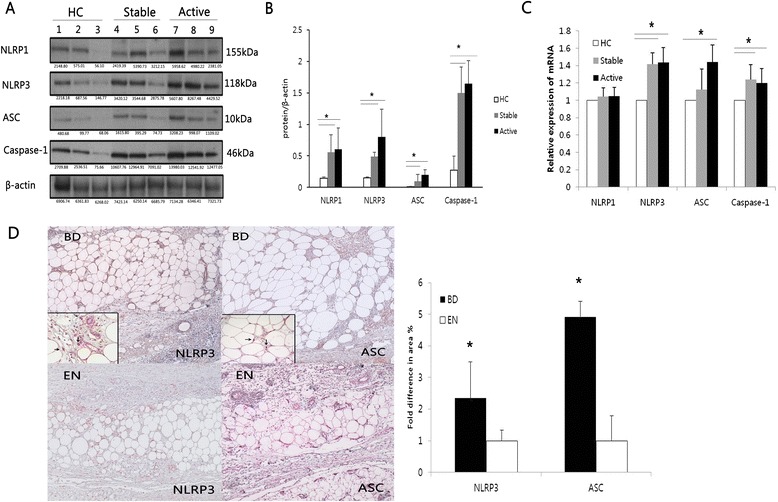
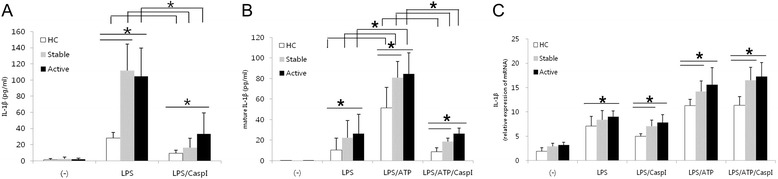
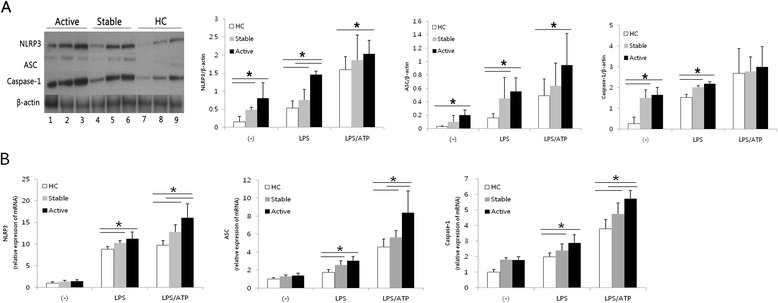
When peripheral blood mononuclear cells (PBMCs) from 15 active, 15 stable BD patients and 15 healthy volunteers were stimulated, the basal and LPS-induced expressions of NLRP3 inflammasome components were significantly increased at both mRNA and protein levels in BD patients compared to healthy controls. Also, increased expression of NLRP3 and ASC was observed in 25 BD skin lesions compared to 25 erythema nodosum patients. Compatible with this, secretion of IL-1β by PBMCs stimulated with LPS alone or LPS plus ATP was increased in BD compared to healthy controls, which was suppressed by caspase-1 inhibitor.
Our findings suggest the possible link between increased IL-1β secretion and increased expression of NLRP3 inflammasome components in BD patients with skin manifestations.
白塞病(BD)是一种全身性炎症性疾病,其表现包括复发性口腔和生殖器溃疡,以及累及皮肤、黏膜、关节、眼睛、静脉、动脉、神经和胃肠道系统的血管炎。BD被视为自身免疫性和自身炎症性综合征之间的一种疾病,可能由对感染刺激的异常反应引发。革兰氏阴性菌介导的口腔炎症与含NACHT、LRR和PYD结构域的蛋白3(NLRP3)表达增加相关,进而导致全身炎症,这促使我们研究NLRP3炎性小体成分的表达及其与白细胞介素-1β(IL-1β)分泌过多的联系。
当刺激15例活动期、15例稳定期BD患者及15名健康志愿者的外周血单个核细胞(PBMC)时,与健康对照相比,BD患者中NLRP3炎性小体成分在mRNA和蛋白水平的基础表达及脂多糖(LPS)诱导的表达均显著增加。此外,与25例结节性红斑患者相比,在25例BD皮肤病变中观察到NLRP3和凋亡相关斑点样蛋白(ASC)表达增加。与此相符的是,与健康对照相比,单独用LPS或LPS加三磷酸腺苷(ATP)刺激的PBMC分泌的IL-1β在BD患者中增加,而这被半胱天冬酶-1抑制剂所抑制。
我们的研究结果提示,有皮肤表现的BD患者中IL-1β分泌增加与NLRP3炎性小体成分表达增加之间可能存在联系。