
经颅电刺激肌肉诱发电位(TcE-MsEPs)术中神经生理监测对预测颈椎椎板成形术后节段性上肢运动麻痹的疗效
The Efficacy of Intraoperative Neurophysiological Monitoring Using Transcranial Electrically Stimulated Muscle-evoked Potentials (TcE-MsEPs) for Predicting Postoperative Segmental Upper Extremity Motor Paresis After Cervical Laminoplasty.
作者信息
Fujiwara Yasushi, Manabe Hideki, Izumi Bunichiro, Tanaka Hiroyuki, Kawai Kazumi, Tanaka Nobuhiro
机构信息
Departments of *Orthopedic Surgery†Anesthesia and Intensive Care, Hiroshima City Asa Hospital‡Department of Orthopaedic Surgery, Institute of Biomedical & Health Sciences, Hiroshima University, Hiroshima City, Japan.
出版信息
Clin Spine Surg. 2016 May;29(4):E188-95. doi: 10.1097/BSD.0000000000000311.
STUDY DESIGN
Prospective study.
OBJECTIVE
To investigate the efficacy of transcranial electrically stimulated muscle-evoked potentials (TcE-MsEPs) for predicting postoperative segmental upper extremity palsy following cervical laminoplasty.
SUMMARY OF BACKGROUND DATA
Postoperative segmental upper extremity palsy, especially in the deltoid and biceps (so-called C5 palsy), is the most common complication following cervical laminoplasty. Some papers have reported that postoperative C5 palsy cannot be predicted by TcE-MsEPs, although others have reported that it can be predicted.
METHODS
This study included 160 consecutive cases that underwent open-door laminoplasty, and TcE-MsEP monitoring was performed in the biceps brachii, triceps brachii, abductor digiti minimi, tibialis anterior, and abductor hallucis. A >50% decrease in the wave amplitude was defined as an alarm point. According to the monitoring alarm, interventions were performed, which include steroid administration, foraminotomies, etc.
RESULTS
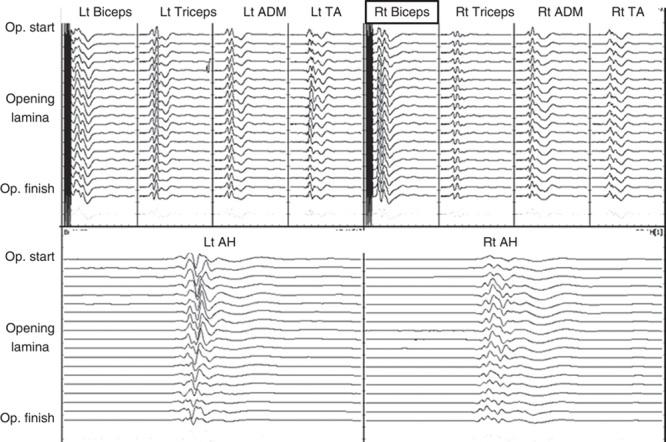
Postoperative deltoid and biceps palsy occurred in 5 cases. Among the 155 cases without segmental upper extremity palsy, there were no monitoring alarms. Among the 5 deltoid and biceps palsy cases, 3 had significant wave amplitude decreases in the biceps during surgery, and palsy occurred when the patients awoke from anesthesia (acute type). In the other 2 cases in which the palsy occurred 2 days after the operation (delayed type), there were no significant wave decreases. In all of the cases, the palsy was completely resolved within 6 months.
DISCUSSION
The majority of C5 palsies have been reported to occur several days after surgery, but some of them have been reported to occur immediately after surgery. Our results demonstrated that TcE-MsEPs can predict the acute type, whereas the delayed type cannot be predicted.
CONCLUSIONS
A >50% wave amplitude decrease in the biceps is useful to predict acute-type segmental upper extremity palsy. Further examination about the interventions for monitoring alarm will be essential for preventing palsy.
研究设计
前瞻性研究。
目的
探讨经颅电刺激肌肉诱发电位(TcE-MsEPs)预测颈椎板成形术后节段性上肢麻痹的有效性。
背景资料总结
术后节段性上肢麻痹,尤其是三角肌和肱二头肌麻痹(所谓的C5麻痹),是颈椎板成形术后最常见的并发症。一些论文报道,TcE-MsEPs无法预测术后C5麻痹,而其他论文则报道可以预测。
方法
本研究纳入160例连续接受开门式椎板成形术的病例,并对肱二头肌、肱三头肌、小指展肌、胫骨前肌和拇短展肌进行TcE-MsEP监测。波幅下降>50%被定义为警报点。根据监测警报进行干预,包括给予类固醇、椎间孔切开术等。
结果
5例出现术后三角肌和肱二头肌麻痹。在155例无节段性上肢麻痹的病例中,无监测警报。在5例三角肌和肱二头肌麻痹病例中,3例在手术期间肱二头肌波幅显著下降,且患者麻醉苏醒时出现麻痹(急性型)。另外2例在术后2天出现麻痹(迟发型),波幅无显著下降。所有病例的麻痹均在6个月内完全恢复。
讨论
大多数C5麻痹据报道发生在术后数天,但也有一些据报道在术后立即发生。我们的结果表明,TcE-MsEPs可以预测急性型,而迟发型无法预测。
结论
肱二头肌波幅下降>50%有助于预测急性型节段性上肢麻痹。进一步研究监测警报的干预措施对于预防麻痹至关重要。


 Zotero 插件