Jing Linkai, Fan Jixing, Wang Yang, Li Haiyun, Wang Shengzhang, Yang Xinjian, Zhang Ying
Department of Interventional Neuroradiology, Beijing Neurosurgical Institute, Beijing Tiantan Hospital, Capital Medical University, Beijing, China.
Department of Biomedical Engineering, Capital Medical University, Beijing, China.
PLoS One. 2015 Jul 6;10(7):e0132494. doi: 10.1371/journal.pone.0132494. eCollection 2015.
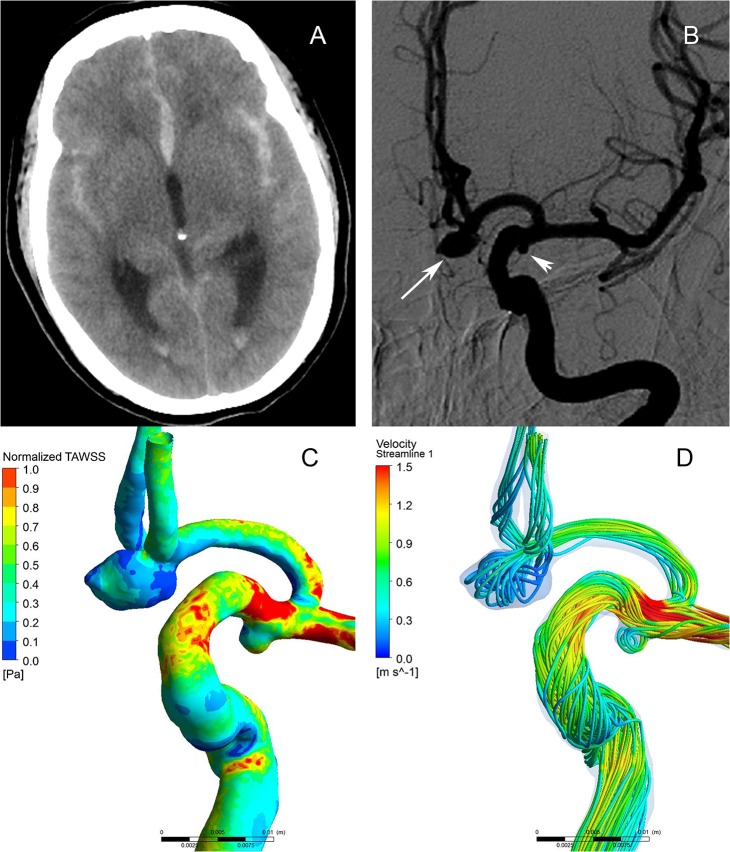
The authors evaluated the impact of morphologic and hemodynamic factors on multiple intracranial aneurysms and aimed to identify which parameters can be reliable indexes as one aneurysm ruptured, and the others did not.
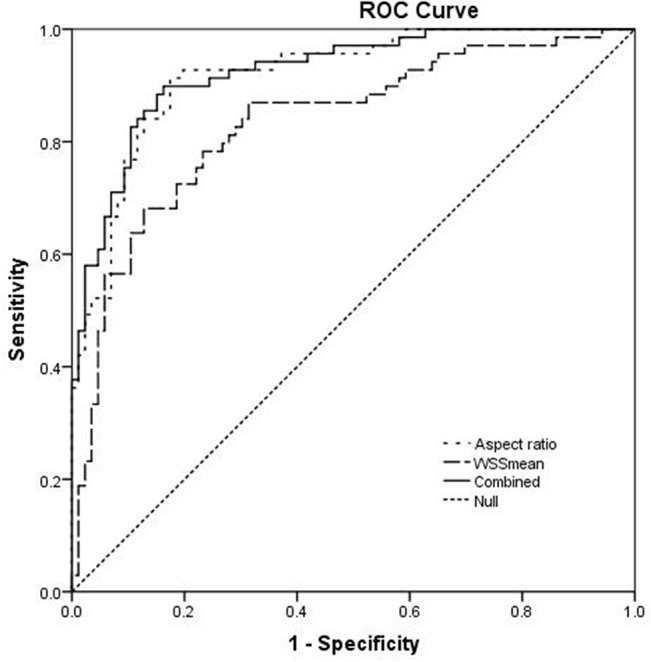
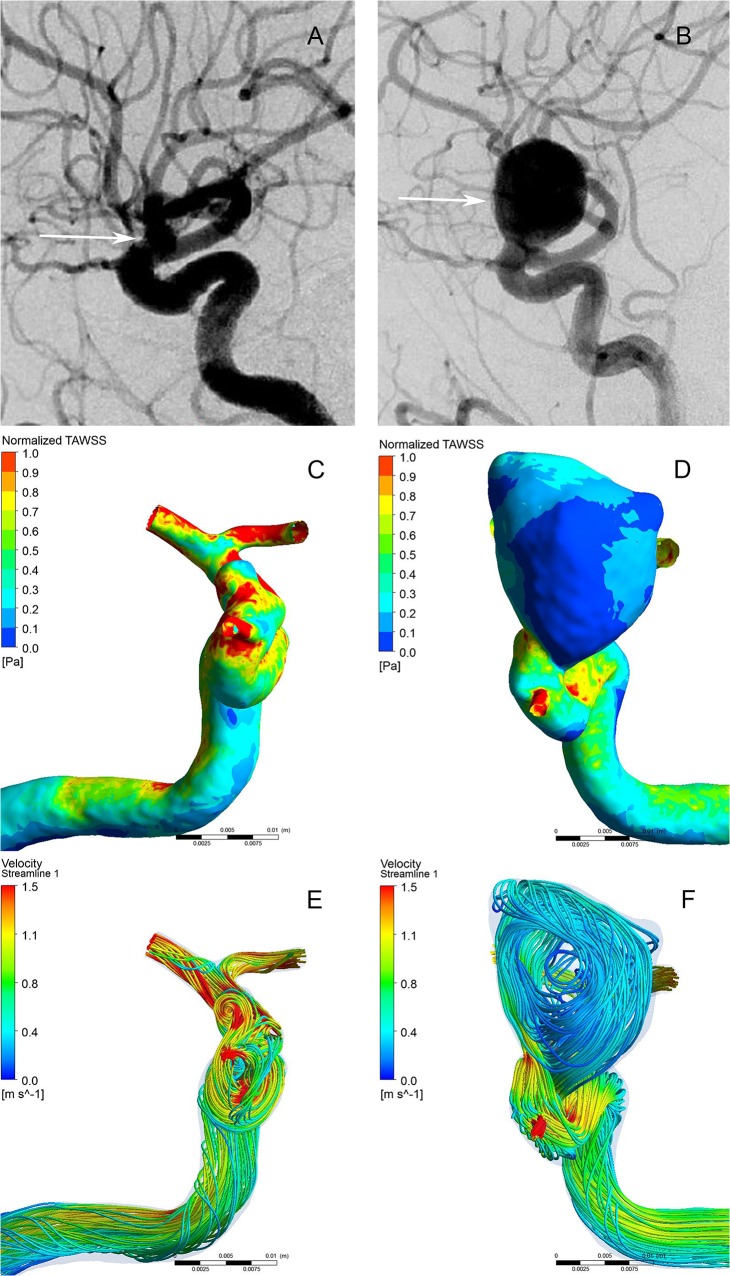
Between June 2011 and May 2014, 69 patients harboring multiple intracranial aneurysms (69 ruptured and 86 unruptured) were analyzed from 3D-digital subtraction angiography (DSA) images and computational fluid dynamics (CFD). Morphologic and hemodynamic parameters were evaluated for significance with respect to rupture. Receiver operating characteristic (ROC) analysis identified area under the curve (AUC) and optimal thresholds separating ruptured from unruptured intracranial aneurysms for each parameter. Significant parameters were examined by binary logistic regression analysis to identify independent discriminators.
Nine morphologic (size, neck width, surface area, volume, diameter of parent arteries, aspect ratio, size ratio, lateral/bifurcation type and regular/irregular type) and 6 hemodynamic (WSSmean, WSSmin, OSI, LSA, flow stability and flow complexity) parameters achieved statistical significance (p<0.05). Six morphologic (size, surface area, volume, aspect ratio, size ratio and regular/irregular type) and five hemodynamic (WSSmean, WSSmin, LSA, flow stability and flow complexity) parameters had high AUC values (AUC>0.7). By binary logistic regression analysis, large aspect ratio and low WSSmean were the independently significant rupture factors (AUC, 0.924; 95% CI, 0.883-0.965).
Large aspect ratio and low WSSmean were independently associated with the rupture status of multiple intracranial aneurysms.
作者评估了形态学和血流动力学因素对多发性颅内动脉瘤的影响,旨在确定当一个动脉瘤破裂而其他动脉瘤未破裂时,哪些参数可作为可靠指标。
在2011年6月至2014年5月期间,从3D数字减影血管造影(DSA)图像和计算流体动力学(CFD)分析了69例患有多发性颅内动脉瘤(69个破裂和86个未破裂)的患者。评估形态学和血流动力学参数与破裂的相关性。采用受试者操作特征(ROC)分析确定每个参数的曲线下面积(AUC)以及区分破裂与未破裂颅内动脉瘤的最佳阈值。通过二元逻辑回归分析检验显著参数以确定独立的判别因素。
九个形态学参数(大小、颈部宽度、表面积、体积、载瘤动脉直径、纵横比、大小比、侧方/分叉类型和规则/不规则类型)和六个血流动力学参数(平均壁面切应力、最小壁面切应力、振荡剪切指数、侧向剪切力、血流稳定性和血流复杂性)具有统计学意义(p<0.05)。六个形态学参数(大小、表面积、体积、纵横比、大小比和规则/不规则类型)和五个血流动力学参数(平均壁面切应力、最小壁面切应力、侧向剪切力、血流稳定性和血流复杂性)具有较高的AUC值(AUC>0.7)。通过二元逻辑回归分析,大纵横比和低平均壁面切应力是独立的显著破裂因素(AUC,0.924;95%可信区间,0.883-0.965)。
大纵横比和低平均壁面切应力与多发性颅内动脉瘤的破裂状态独立相关。