Chen Wei, Pu Fang, Yang Yang, Yao Jie, Wang Lizhen, Liu Hong, Fan Yubo
From the Key Laboratory of Rehabilitation Technical Aids, Ministry of Civil Affair, School of Biological Science and Medical Engineering, Beihang University (WC, FP, YY, JY, LW, YF); State Key Laboratory of Virtual Reality Technology and Systems, Beihang University (FP, YF); National Research Center for Rehabilitation Technical Aids (YF); and Rokab Pedorthic Center, Beijing, P. R. China (HL).
Medicine (Baltimore). 2015 Jul;94(28):e1004. doi: 10.1097/MD.0000000000001004.
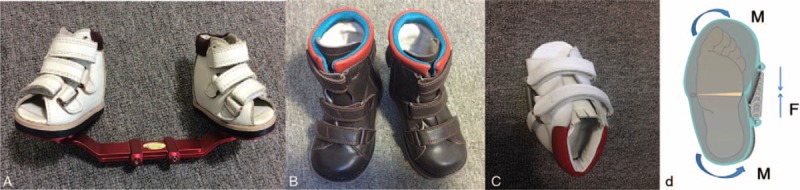
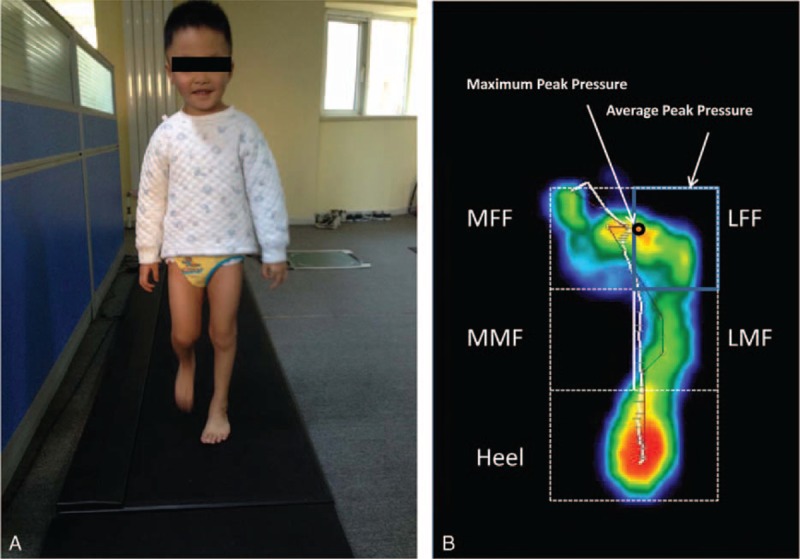
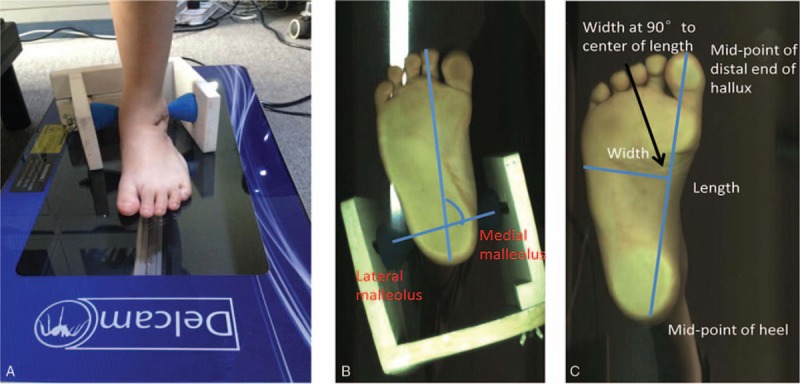
Equinus, varus, cavus, and adduction are typical signs of congenital talipes equinovarus (CTEV). Forefoot adduction remains a difficulty from using previous corrective methods. This study aims to develop a corrective method to reduce the severity of forefoot adduction of CTEV children with moderate deformities during their walking age. The devised method was compared with 2 other common corrective methods to evaluate its effectiveness. A Dennis Brown (DB) splint, DB splint with orthopedic shoes (OS), and forefoot abduct shoes (FAS) with OS were, respectively, applied to 15, 20, and 18 CTEV children with moderate deformities who were scored at their first visit according to the Diméglio classification. The mean follow-up was 44 months and the orthoses were changed as the children grew. A 3D scanner and a high-resolution pedobarograph were used to record morphological characteristics and plantar pressure distribution. One-way MAVONA analysis was used to compare the bimalleolar angle, bean-shape ratio, and pressure ratios in each study group. There were significant differences in the FAS+OS group compared to the DB and DB+OS groups (P < 0.05) for most measurements. The most salient differences were as follows: the FAS+OS group had a significantly greater bimalleolar angle (P < 0.05) and lower bean-shape ratio (P < 0.01) than the other groups; the DB+OS and FAS+OS groups had higher heel/forefoot and heel/LMF ratios (P < 0.01 and P < 0.001) than the DB group. FAS are critical for correcting improper forefoot adduction and OS are important for the correction of equinus and varus in moderately afflicted CTEV children. This study suggests that the use of FAS+OS may improve treatment outcomes for moderate CTEV children who do not show signs of serious torsional deformity.
马蹄足、内翻足、高弓足和内收是先天性马蹄内翻足(CTEV)的典型体征。使用先前的矫正方法时,前足内收仍然是一个难题。本研究旨在开发一种矫正方法,以减轻步行年龄阶段中重度畸形的CTEV儿童前足内收的严重程度。将所设计的方法与其他两种常见矫正方法进行比较,以评估其有效性。分别对15例、20例和18例中重度畸形的CTEV儿童应用丹尼斯·布朗(DB)夹板、带矫形鞋(OS)的DB夹板和带OS的前足外展鞋(FAS),这些儿童在首次就诊时根据迪梅廖分类法进行评分。平均随访44个月,随着儿童生长更换矫形器。使用三维扫描仪和高分辨率足底压力仪记录形态特征和足底压力分布。采用单向MAVONA分析比较各研究组双踝角、豆形比和压力比。在大多数测量中,FAS+OS组与DB组和DB+OS组相比存在显著差异(P<0.05)。最显著的差异如下:FAS+OS组的双踝角明显大于其他组(P<0.05),豆形比低于其他组(P<0.01);DB+OS组和FAS+OS组的足跟/前足和足跟/LMF比值高于DB组(P<0.01和P<0.001)。FAS对于纠正不当的前足内收至关重要,而OS对于中度受累的CTEV儿童矫正马蹄足和内翻足很重要。本研究表明,对于未表现出严重扭转畸形迹象的中度CTEV儿童,使用FAS+OS可能会改善治疗效果。