Takekuma Munetaka, Kuji Shiho, Tanaka Aki, Takahashi Nobutaka, Abe Masakazu, Hirashima Yasuyuki
Department of Gynecology, Shizuoka Cancer Center Hospital, Sunto, Japan.
J Gynecol Oncol. 2015 Jul;26(3):185-92. doi: 10.3802/jgo.2015.26.3.185.
The concept of platinum sensitivity and cross-resistance among platinum agents are widely known in the management of recurrent ovarian cancer. The aim of this study was to evaluate two hypotheses regarding the validity of the concept of platinum sensitivity and non-cross-resistance of cisplatin analogue with cisplatin in recurrent cervical cancer.
In this retrospective study, the clinical data of patients with recurrent cervical cancer, who had a history of receiving cisplatin based chemotherapy (including concurrent chemoradiotherapy [CCRT] with cisplatin) and who received second-line chemotherapy at the time of recurrence between April 2004 and July 2012 were reviewed.
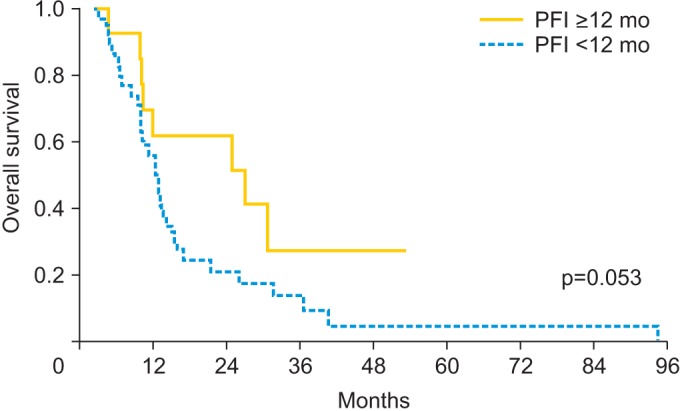
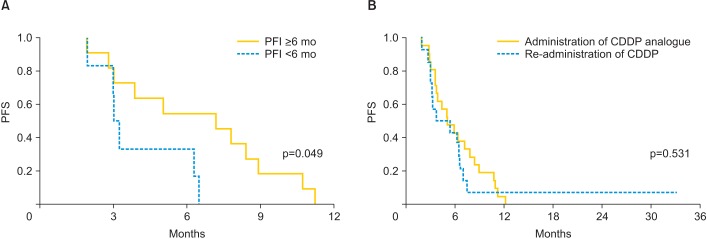
In total, 49 patients--34 squamous cell carcinomas (69.4%) and 15 non-squamous cell carcinomas (30.6%)--were enrolled. The median age was 53 years (range, 26 to 79 years). Univariate and multivariate analysis showed that a platinum free interval (PFI) of 12 months has a strong relationship with the response rate to second-line chemotherapy. Upon multivariate analysis of survival after second-line platinum-based chemotherapy, a PFI of 12 months significantly influenced both progression-free survival (hazard ratio [HR], 0.349; 95% confidence interval [CI], 0.140 to 0.871; p=0.024) and overall survival (HR, 0.322; 95% CI, 0.123 to 0.842; p=0.021). In patients with a PFI of less than 6 months, the difference of progression-free survival between patients with re-administration of cisplatin (3.0 months) and administration of cisplatin analogue (7.2 months) as second-line chemotherapy was statistically significant (p=0.049, log-rank test).
The concept of platinum sensitivity could be applied to recurrent cervical cancer and there is a possibility of noncross-resistance of cisplatin analogue with cisplatin.
在复发性卵巢癌的治疗中,铂类药物的敏感性及交叉耐药性概念广为人知。本研究旨在评估关于顺铂类似物在复发性宫颈癌中铂敏感性及与顺铂无交叉耐药性概念有效性的两种假说。
在这项回顾性研究中,对2004年4月至2012年7月期间复发的宫颈癌患者的临床资料进行了回顾,这些患者既往有接受以顺铂为基础的化疗史(包括顺铂同步放化疗[CCRT]),且在复发时接受了二线化疗。
共纳入49例患者,其中34例为鳞状细胞癌(69.4%),15例为非鳞状细胞癌(30.6%)。中位年龄为53岁(范围26至79岁)。单因素和多因素分析显示,无铂间期(PFI)为12个月与二线化疗的缓解率密切相关。在对二线铂类化疗后的生存情况进行多因素分析时,PFI为12个月对无进展生存期(风险比[HR],0.349;95%置信区间[CI],0.140至0.871;p = 0.024)和总生存期(HR,0.322;95% CI,0.123至0.842;p = 0.021)均有显著影响。在PFI小于6个月的患者中,二线化疗再次使用顺铂(3.0个月)与使用顺铂类似物(7.2个月)的患者的无进展生存期差异具有统计学意义(p = 0.049,对数秩检验)。
铂敏感性概念可应用于复发性宫颈癌,且顺铂类似物与顺铂存在无交叉耐药的可能性。