Burdelski Christoph, Menan Devi, Tsourlakis Maria Christina, Kluth Martina, Hube-Magg Claudia, Melling Nathaniel, Minner Sarah, Koop Christina, Graefen Markus, Heinzer Hans, Wittmer Corinna, Sauter Guido, Simon Ronald, Schlomm Thorsten, Steurer Stefan, Krech Till
General, Visceral and Thoracic Surgery Department and Clinic, University Medical Center Hamburg-Eppendorf, Hamburg, Germany.
Institute of Pathology, University Medical Center Hamburg-Eppendorf, Hamburg, Germany.
BMC Cancer. 2015 Jul 23;15:538. doi: 10.1186/s12885-015-1555-8.
Posttranscriptional protein modification by SUMOylation plays an important role in tumor development and progression. In the current study we analyzed prevalence and prognostic impact of the de-SUMOylation enzyme SENP1 in prostate cancer.
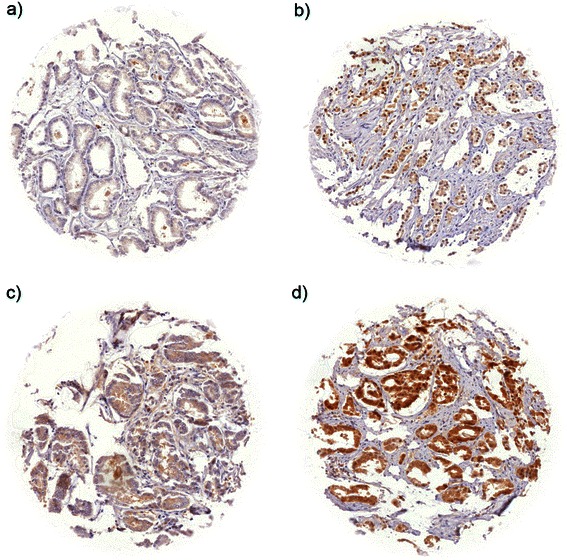
SENP1 expression was analyzed by immunohistochemistry on a tissue microarray containing more than 12,400 prostate cancer specimens. Results were compared to tumor phenotype, ERG status, genomic deletions of 3p, 5q, 6q and PTEN, and biochemical recurrence.
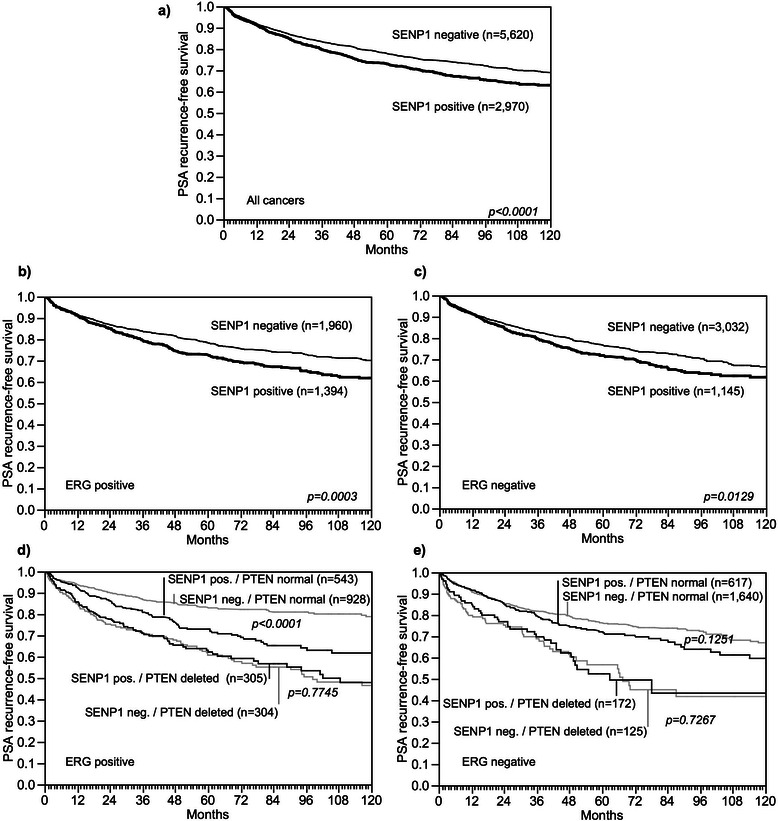
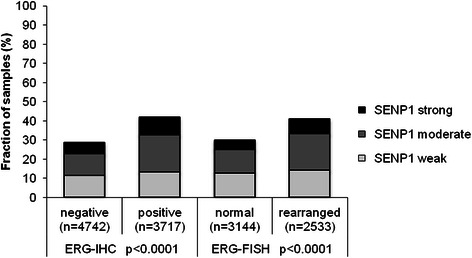
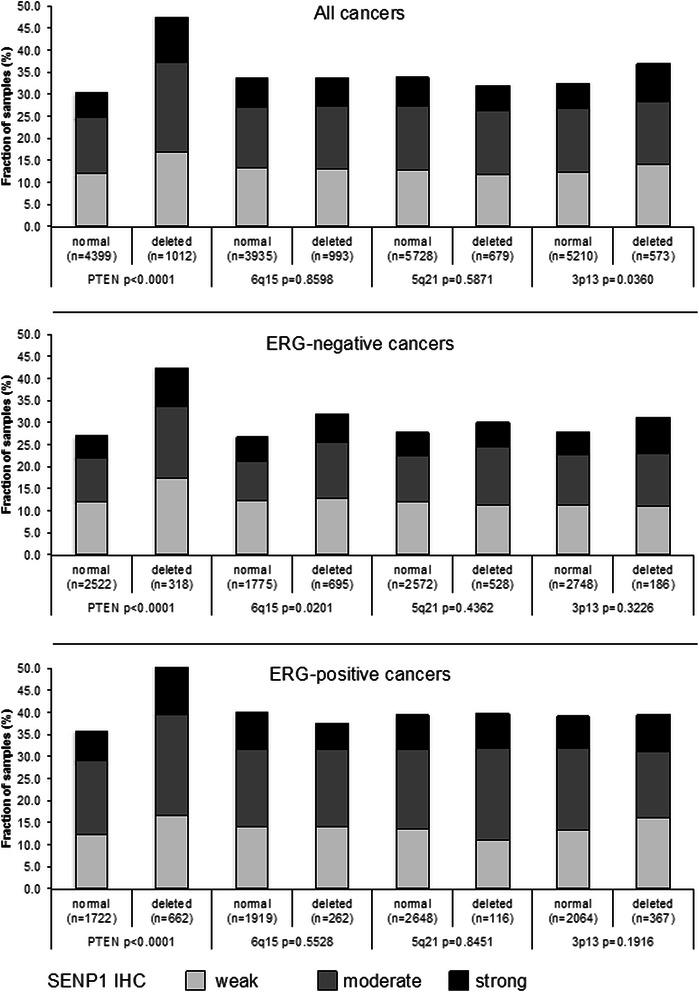
SENP1 immunostaining was detectable in 34.5 % of 9,516 interpretable cancers and considered strong in 7.3 %, moderate in 14.9 % and weak in 12.3 % of cases. Strong SENP1 expression was linked to advanced pT stage (p < 0.0001), high Gleason grade (p < 0.0001), positive lymph node status (p = 0.0019), high pre-operative PSA levels (p = 0.0037), and PSA recurrence (p < 0.0001). SENP1 expression was strongly associated with positive ERG fusion status as determined by both in situ hybridization (FISH) and immunohistochemistry as well as with PTEN deletions. Detectable SENP1 immunostaining was found in 41 % of ERG positive and in 47 % of PTEN deleted cancers but in only 30 % of ERG negative and 30 % of PTEN non-deleted cancers (p < 0.0001 each). Deletions of 3p, 5q, and 6q were unrelated to SENP1 expression. Subset analyses revealed that the prognostic impact of SENP1 expression was solely driven by the subgroup of ERG positive, PTEN undeleted cancers. In this subgroup, the prognostic role of SENP1 expression was independent of the preoperative PSA level, tumor stage, Gleason grade, and the status of the resection margin.
SENP1 expression has strong prognostic impact in a molecularly defined subset of cancers. This is per se not surprising as the biologic impact of each individual molecular event is likely to be dependent on its cellular environment. However, such findings challenge the concept of finding clinically relevant molecular signatures that are equally applicable to all prostate cancers.
SUMO化修饰的转录后蛋白质修饰在肿瘤发生和发展中起重要作用。在本研究中,我们分析了去SUMO化酶SENP1在前列腺癌中的发生率及其预后影响。
通过免疫组织化学对包含超过12400例前列腺癌标本的组织芯片进行SENP1表达分析。将结果与肿瘤表型、ERG状态、3p、5q、6q和PTEN的基因组缺失以及生化复发情况进行比较。
在9516例可解释的癌症中,34.5%可检测到SENP1免疫染色,其中7.3%为强阳性,14.9%为中度阳性,12.3%为弱阳性。SENP1强表达与晚期pT分期(p<0.0001)、高Gleason分级(p<0.0001)、阳性淋巴结状态(p=0.0019)、术前高PSA水平(p=0.0037)以及PSA复发(p<0.0001)相关。通过原位杂交(FISH)和免疫组织化学确定,SENP1表达与阳性ERG融合状态以及PTEN缺失密切相关。在41%的ERG阳性和47%的PTEN缺失癌症中可检测到SENP1免疫染色,但在仅30%的ERG阴性和30%的PTEN未缺失癌症中可检测到(各p<0.0001)。3p、5q和6q的缺失与SENP1表达无关。亚组分析显示SENP1表达的预后影响仅由ERG阳性、PTEN未缺失癌症亚组驱动。在该亚组中,SENP1表达的预后作用独立于术前PSA水平、肿瘤分期、Gleason分级和切缘状态。
SENP1表达在分子定义的癌症亚组中具有强烈的预后影响。就其本身而言,这并不奇怪,因为每个分子事件的生物学影响可能取决于其细胞环境。然而,这些发现挑战了寻找适用于所有前列腺癌的临床相关分子特征的概念。