Niemiec Tomasz, Lachowicz-Tabaczek Kinga
Institute of Psychology, University of Wroclaw, ul. Dawida 1, 50-527 Wrocław, Poland.
Motiv Emot. 2015;39(4):498-505. doi: 10.1007/s11031-014-9469-3.
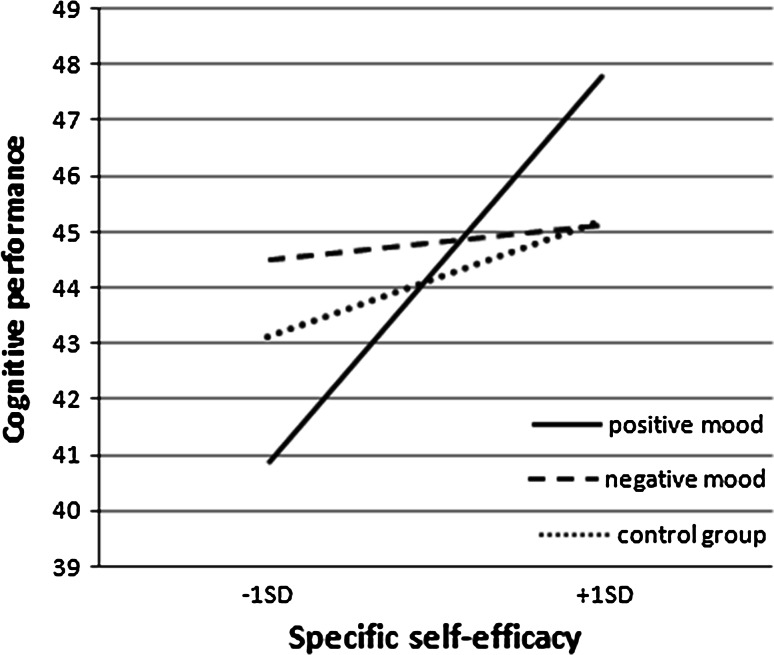
Research concerning the impact of positive mood on cognitive performance is inconsistent. We suggest that specific self-efficacy moderates this relationship. The current study proposed that participants in a positive mood with a high level of specific self-efficacy would anticipate mood-maintaining success on a task. Hence, they would be more strongly motivated, and perform better on the task, than individuals in other moods. Conversely, participants in a positive mood with low specific self-efficacy should expect mood-threatening failure. Thus, these individuals should be less motivated and perform more poorly than individuals in other moods. The current study included 139 participants with different levels of specific self-efficacy performing a comprehension task in either a positive or negative mood or a control condition. Results confirmed our hypothesis whereby specific self-efficacy affects cognitive performance but only during a positive mood. These findings support the role of specific self-efficacy in maintaining positive mood by regulating task activity.
关于积极情绪对认知表现影响的研究结果并不一致。我们认为特定自我效能会调节这种关系。当前研究提出,具有高特定自我效能的积极情绪参与者会预期在一项任务上保持情绪成功。因此,与处于其他情绪状态的个体相比,他们会更有动力,并且在任务上表现得更好。相反,具有低特定自我效能的积极情绪参与者应该预期会出现威胁情绪的失败。因此,与处于其他情绪状态的个体相比,这些个体的动力应该更小,表现也更差。当前研究包括139名具有不同特定自我效能水平的参与者,他们在积极或消极情绪或控制条件下执行一项理解任务。结果证实了我们的假设,即特定自我效能会影响认知表现,但仅在积极情绪期间。这些发现支持了特定自我效能通过调节任务活动来维持积极情绪的作用。