Piper Brian J, Telku Hassenet M, Lambert Drew A
Department of Basic Pharmaceutical Sciences, Husson University School of Pharmacy, Bangor, Maine, 04401, United States of America.
Department of Pharmacy Practice, Husson University School of Pharmacy, Bangor, Maine, 04401, United States of America.
PLoS One. 2015 Jul 27;10(7):e0133261. doi: 10.1371/journal.pone.0133261. eCollection 2015.
Disclosure of potential conflicts of interest (CoI) is a standard practice for many biomedical journals but not for educational materials. The goal of this investigation was to determine whether the authors of pharmacology textbooks have undisclosed financial CoIs and to identify author characteristics associated with CoIs.
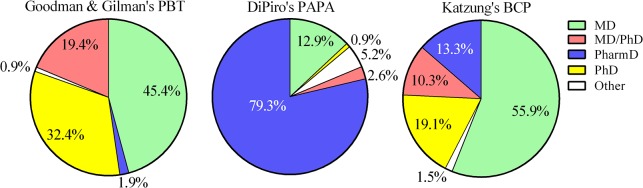
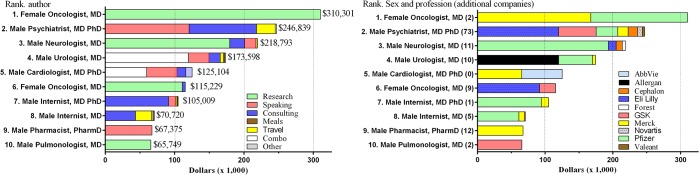
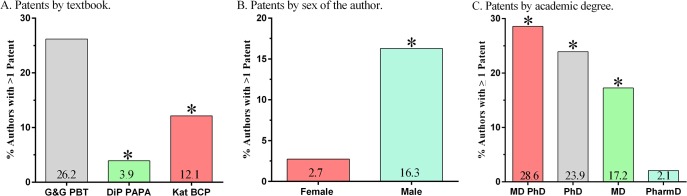
The presence of potential CoIs was evaluated by submitting author names (N = 403; 36.3% female) to a patent database (Google Scholar) as well as a database that reports on the compensation ($USD) received from 15 pharmaceutical companies (ProPublica's Dollars for Docs). All publications (N = 410) of the ten highest compensated authors from 2009 to 2013 and indexed in Pubmed were also examined for disclosure of additional companies that the authors received research support, consulted, or served on speaker's bureaus. A total of 134 patents had been awarded (Maximum = 18/author) to textbook authors. Relative to DiPiro's Pharmacotherapy: A Pathophysiologic Approach, contributors to Goodman and Gilman's Pharmacological Basis of Therapeutics and Katzung's Basic and Clinical Pharmacology were more frequently patent holders (OR = 6.45, P < .0005). Female authors were less likely than males to have > 1 patent (OR = 0.15, P < .0005). A total of $2,411,080 USD (28.3% for speaking, 27.0% for consulting, and 23.9% for research), was received by 53 authors (Range = $299 to $310,000/author). Highly compensated authors were from multiple fields including oncology, psychiatry, neurology, and urology. The maximum number of additional companies, not currently indexed in the Dollars for Docs database, for which an author had potential CoIs was 73.
Financial CoIs are common among the authors of pharmacology and pharmacotherapy textbooks. Full transparency of potential CoIs, particularly patents, should become standard procedure for future editions of educational materials in pharmacology.
披露潜在利益冲突是许多生物医学期刊的标准做法,但教育材料并非如此。本调查的目的是确定药理学教科书的作者是否存在未披露的财务利益冲突,并确定与利益冲突相关的作者特征。
通过将作者姓名(N = 403;36.3%为女性)提交到专利数据库(谷歌学术)以及一个报告从15家制药公司获得的报酬(美元)的数据库(ProPublica的“医生薪酬”)来评估潜在利益冲突的存在情况。还检查了2009年至2013年报酬最高的十位作者在PubMed上索引的所有出版物(N = 410),以了解作者从哪些额外的公司获得研究支持、咨询或在演讲局任职的披露情况。教科书作者共获得了134项专利(每位作者最多18项)。相对于《迪皮罗药物治疗学:病理生理学方法》,《古德曼和吉尔曼治疗学的药理学基础》以及《卡茨ung基础与临床药理学》的撰稿人更常拥有专利(OR = 6.45,P <.0005)。女性作者拥有超过1项专利的可能性低于男性(OR = 0.15,P <.0005)。53位作者共获得2,411,080美元(演讲占28.3%,咨询占27.0%,研究占23.9%)(范围为每位作者299美元至310,000美元)。高报酬作者来自多个领域,包括肿瘤学、精神病学、神经病学和泌尿学。作者存在潜在利益冲突但目前未在“医生薪酬”数据库中索引的额外公司的最大数量为73家。
财务利益冲突在药理学和药物治疗学教科书的作者中很常见。潜在利益冲突的完全透明度,特别是专利,应成为未来药理学教育材料版本的标准程序。