Ito Hiroyuki, Uchida Tokujiro, Makita Koshi
Department of Anesthesiology, Graduate School of Medical and Dental Sciences, Tokyo Medical and Dental University, 1-5-45 Yushima, Bunkyo-ku, Tokyo, 113-8519, Japan,
Intensive Care Med Exp. 2015 Dec;3(1):53. doi: 10.1186/s40635-015-0053-2. Epub 2015 May 24.
Bone marrow-derived mesenchymal stem cells (BMSCs) reduced the severity of acute lung injury after transplantation in multiple experimental studies, and several paracrine soluble factors secreted by the cells likely contribute to their therapeutic effect. The direct interactions between BMSCs and alveolar epithelial cells (AECs) may be an important part of their beneficial effects. Therefore, we assessed the interactions between BMSCs and AECs using a co-culture model of these two cell types from rats.
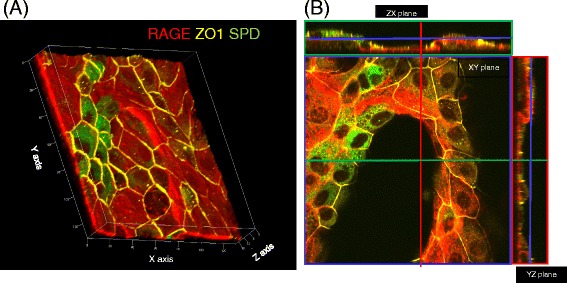
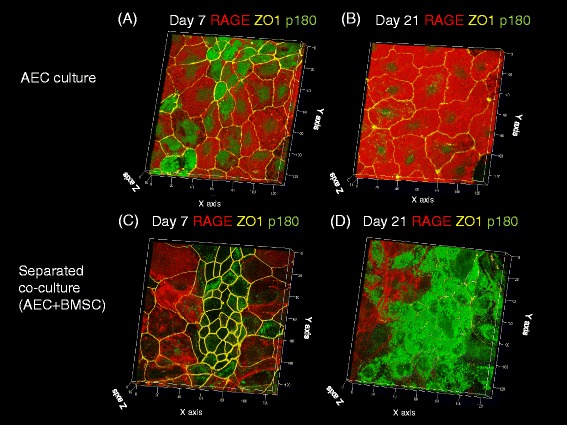
BMSCs and AECs were co-cultured using a Transwell system under the following conditions: (1) separated co-culture-AECs seeded on the insert and BMSCs in the base of the well; and (2) mixed co-culture-AECs on top of the monolayer of BMSCs on the culture insert and no cells in the base of the well. After 21 days of culture, the cells on the membrane of the culture insert were fixed and stained with antibodies against the receptor for advanced glycation end-products (RAGE), surfactant protein D (SP-D), and zona occludens protein-1, and then analyzed by confocal microscopy.
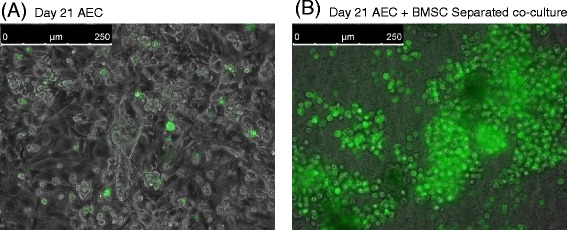
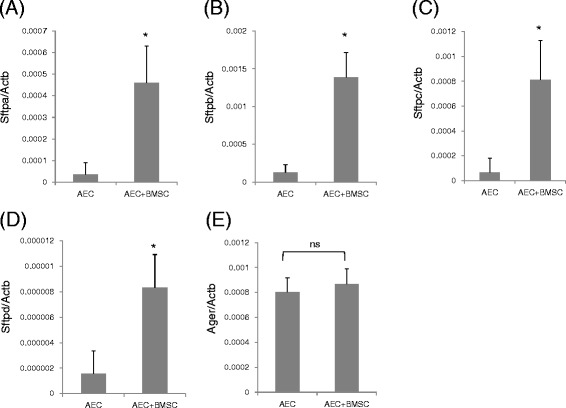
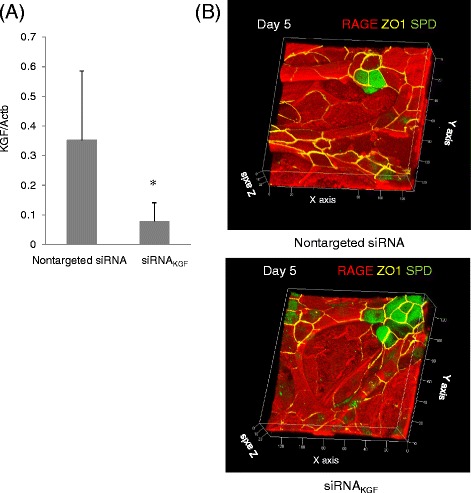
In the separated co-culture condition, the phenotype of the AECs was maintained for 21 days, and cluster formation of SP-D-positive cells was induced in the AEC monolayer. We also found cluster formations of phospholipid-positive cells covered with RAGE-positive epithelial cells. In the mixed co-culture condition, the BMSCs induced alveolar-like structures covered with an epithelial cell layer. To determine the effect of keratinocyte growth factor (KGF) on this three-dimensional structure formation, we treated the mixed co-cultures with siRNA for KGF. While KGF siRNA treatment induced a significant reduction in surfactant protein transcript expression, formation of the alveolar-like structure was unaffected. We also assessed whether Gap26, a functional inhibitor of connexin-43, could mitigate the effect of the BMSCs on the AECs. However, even at 300 μM, Gap26 did not inhibit formation of the alveolar-like structure.
BMSCs release soluble factors that help maintain and sustain the AEC phenotype for 21 days, and direct interaction between these two cell types can induce a cyst-like, three-dimensional structure covered with AECs.
在多项实验研究中,骨髓间充质干细胞(BMSCs)移植后可减轻急性肺损伤的严重程度,细胞分泌的几种旁分泌可溶性因子可能有助于其治疗效果。BMSCs与肺泡上皮细胞(AECs)之间的直接相互作用可能是其有益作用的重要组成部分。因此,我们使用大鼠的这两种细胞类型的共培养模型评估了BMSCs与AECs之间的相互作用。
使用Transwell系统在以下条件下对BMSCs和AECs进行共培养:(1)分离共培养——AECs接种在小室插入物上,BMSCs接种在孔底部;(2)混合共培养——AECs接种在培养插入物上BMSCs单层的顶部,孔底部无细胞。培养21天后,将培养插入物膜上的细胞固定,并用抗晚期糖基化终产物受体(RAGE)、表面活性蛋白D(SP-D)和紧密连接蛋白-1的抗体染色,然后通过共聚焦显微镜分析。
在分离共培养条件下,AECs的表型维持21天,AEC单层中诱导形成了SP-D阳性细胞簇。我们还发现了被RAGE阳性上皮细胞覆盖的磷脂阳性细胞簇。在混合共培养条件下,BMSCs诱导形成了覆盖有上皮细胞层的肺泡样结构。为了确定角质形成细胞生长因子(KGF)对这种三维结构形成的影响,我们用KGF的siRNA处理混合共培养物。虽然KGF siRNA处理导致表面活性蛋白转录物表达显著降低,但肺泡样结构的形成未受影响。我们还评估了连接蛋白-43的功能抑制剂Gap26是否可以减轻BMSCs对AECs的影响。然而,即使在300μM时,Gap26也未抑制肺泡样结构的形成。
BMSCs释放可溶性因子,有助于维持AECs表型21天,这两种细胞类型之间的直接相互作用可诱导形成覆盖有AECs的囊肿样三维结构。