Watermann I, Schmitt B, Stellmacher F, Müller J, Gaber R, Kugler Ch, Reinmuth N, Huber R M, Thomas M, Zabel P, Rabe K F, Jonigk D, Warth A, Vollmer E, Reck M, Goldmann T
Clinical and Experimental Pathology, Research Center Borstel, Borstel, Germany.
LungenClinic Grosshansdorf, Grosshansdorf, Germany.
Diagn Pathol. 2015 Jul 28;10:130. doi: 10.1186/s13000-015-0362-5.
Several c-MET targeting inhibitory molecules have already shown promising results in the treatment of patients with Non-small Cell Lung Cancer (NSCLC). Combination of EGFR- and c-MET-specific molecules may overcome EGFR tyrosine kinase inhibitor (TKI) resistance. The aim of this study was to allow for the identification of patients who might benefit from TKI treatments targeting MET and to narrow in on the diagnostic assessment of MET.
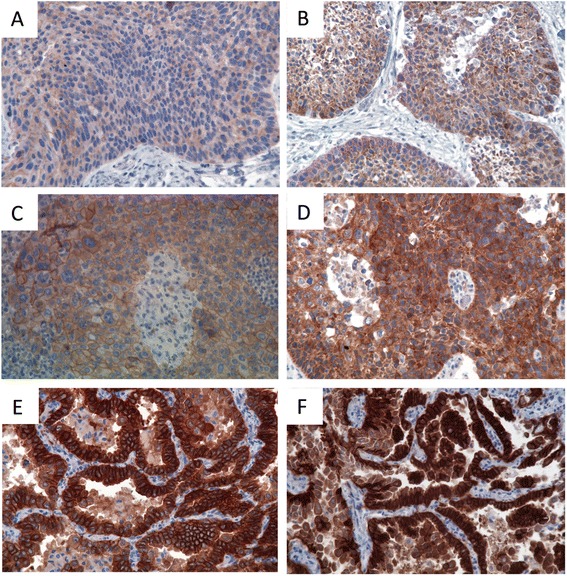
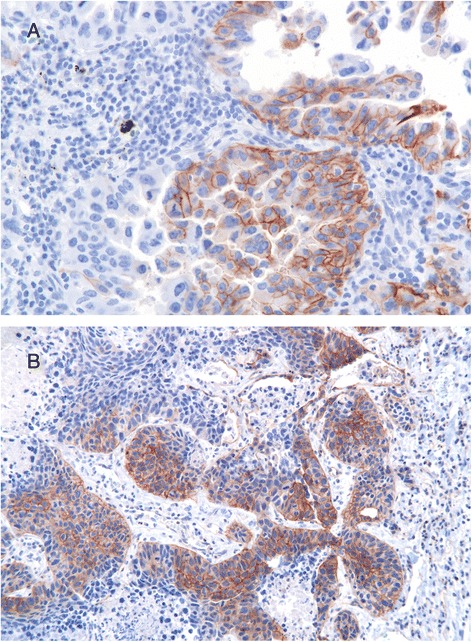
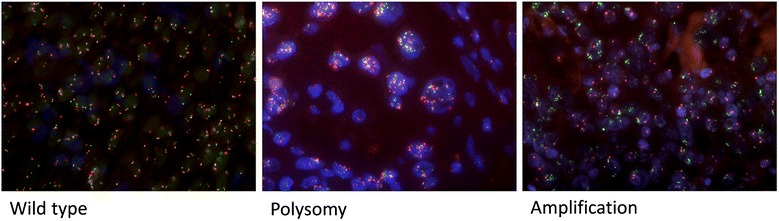
222 tumor tissues of patients with NSCLC were analyzed concerning c-MET expression and activation in terms of phosphorylation (Y1234/1235 and Y1349) using a microarray format employing immunohistochemistry (IHC). Furthermore, protein expression and MET activation was correlated with the amplification status by Fluorescence in Situ Hybridization (FISH).
Correlation was observed between phosphorylation of c-MET at Y1234/1235 and Y1349 (spearman correlation coefficient rs = 0.41; p < 0.0001). No significant correlation was shown between MET expression and phosphorylation (p > 0.05). c-MET gene amplification was detected in eight of 214 patients (3.7%). No significant association was observed between c-MET amplification, c-MET protein expression and phosphorylation.
Our data indicate, that neither expression of c-MET nor the gene amplification status might be the best way to select patients for MET targeting therapies, since no correlation with the activation status of MET was observed. We propose to take into account analyzing the phosphorylation status of MET by IHC to select patients for MET targeting therapies. Signaling of the receptor and the activation of downstream molecules might be more crucial for the benefit of therapeutics targeting MET receptor tyrosine kinases than expression levels alone.
几种靶向c-MET的抑制性分子已在非小细胞肺癌(NSCLC)患者的治疗中显示出有前景的结果。表皮生长因子受体(EGFR)特异性分子与c-MET特异性分子联合使用可能克服EGFR酪氨酸激酶抑制剂(TKI)耐药性。本研究的目的是确定可能从靶向MET的TKI治疗中获益的患者,并聚焦于MET的诊断评估。
采用免疫组织化学(IHC)微阵列形式,分析222例NSCLC患者肿瘤组织中c-MET的表达及磷酸化(Y1234/1235和Y1349)方面的激活情况。此外,通过荧光原位杂交(FISH)将蛋白质表达和MET激活与扩增状态相关联。
观察到c-MET在Y1234/1235和Y1349位点的磷酸化之间存在相关性(斯皮尔曼相关系数rs = 0.41;p < 0.0001)。MET表达与磷酸化之间未显示出显著相关性(p > 0.05)。在214例患者中的8例(3.7%)检测到c-MET基因扩增。未观察到c-MET扩增、c-MET蛋白表达与磷酸化之间存在显著关联。
我们的数据表明,c-MET的表达或基因扩增状态可能都不是选择接受MET靶向治疗患者的最佳方式,因为未观察到与MET激活状态的相关性。我们建议通过IHC分析MET的磷酸化状态来选择接受MET靶向治疗的患者。对于靶向MET受体酪氨酸激酶的治疗益处而言,受体信号传导和下游分子的激活可能比单独的表达水平更为关键。