Moon Jae Young, Hwang Hong Pil, Kwak Hyo Sung, Han Young Min, Yu Hee Chul
Department of Surgery, Chonbuk National University Hospital, Chonbuk National University Medical School, Jeonju ; Biomedical Research Institute, Chonbuk National University Hospital, Jeonju.
Department of Radiology, Chonbuk National University Hospital, Chonbuk National University Medical School, Jeonju ; Biomedical Research Institute, Chonbuk National University Hospital, Jeonju ; Research Institute of Clinical Medicine, Chonbuk National University, Jeonju, Korea.
Vasc Specialist Int. 2015 Mar;31(1):15-9. doi: 10.5758/vsi.2015.31.1.15. Epub 2015 Mar 31.
Kissing stent reconstruction is a widely used technique for the management of aortoiliac occlusive disease involving the aortic bifurcation or proximal common iliac arteries. The purpose of this study was to evaluate the results of self-expandable kissing stents in the aortic bifurcation.
We reviewed medical records of the patients treated with a kissing stent retrospectively from January 2007 to December 2012. The primary and secondary patencies were determined with Kaplan-Meier analysis, and Cox regression was used to determine the factors associated with patency.
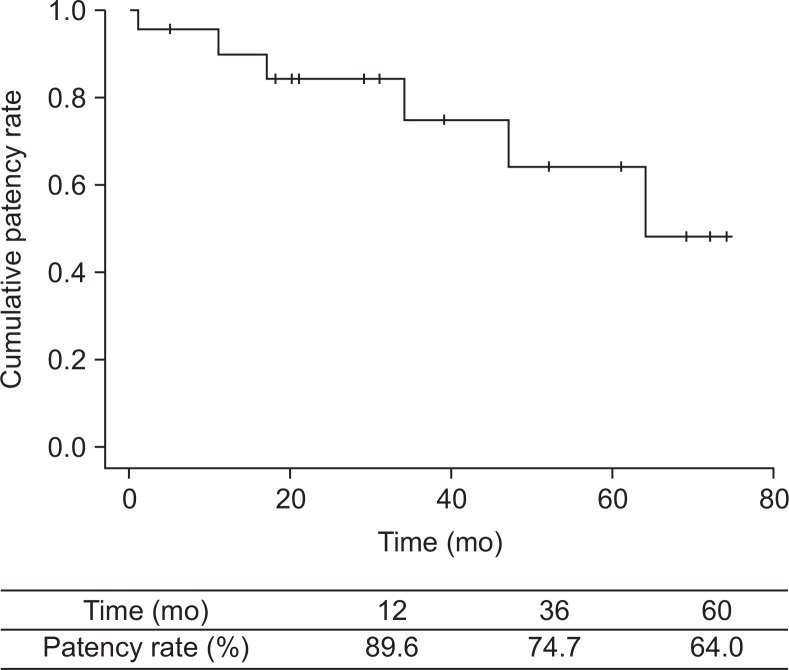
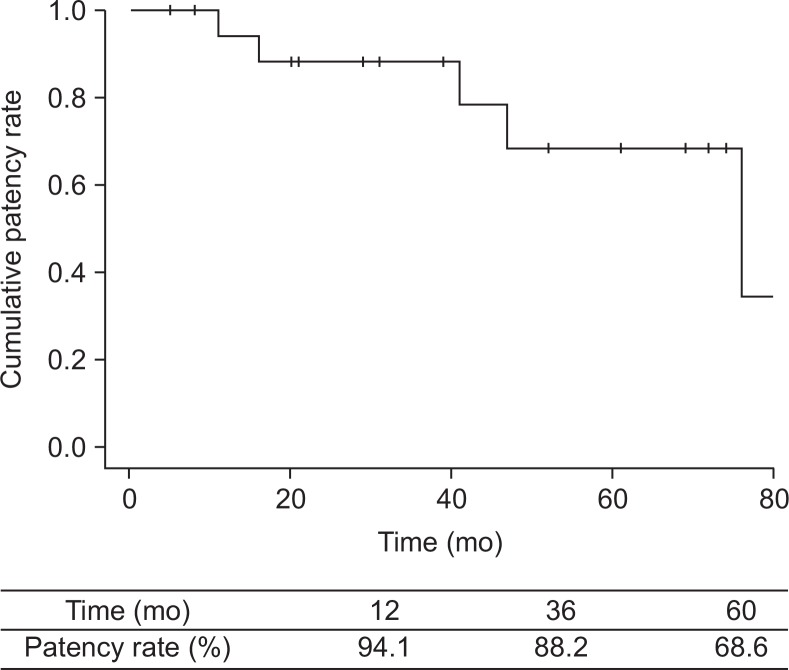
A total of 21 patients were included, and all were male (median age 53±15 years, range 48-78 years). Major symptoms were claudication (n=16, 61.9%), rest pain (n=5, 23.8%) and gangrene (n=5, 23.8%). Tans-Atlantic Inter-Society Consensus for the Management of Peripheral Arterial Disease (TASC) II classification was A 2 (9.5%), B 5 (23.8%), C 7 (33.3%) and D 8 (38%). The mean follow-up was 40.7 months. Major complication occurred in only one case which consisted of distal limb ischemia by emboli. Six patients developed symptomatic restenosis or occlusion. There was no major amputation, but minor amputation occurred in 3 patients. There were 2 mortalities not associated with the procedure (lung cancer and intracranial hemorrhage). Primary patency was 89.6% at 1 year, 74.7% at 3 years and 64.0% at 5 years. Secondary patency was 94.1% at 1 year, 88.2% at 3 years and 68.6% at 5 years. No risk factors for restenosis or occlusion were identified.
Self-expandable kissing stents can be used successfully with comparable patency for endovascular treatment of symptomatic atherosclerotic occlusive lesions in the aortic bifurcation area.
吻合法支架重建术是治疗累及主动脉分叉或近端髂总动脉的主髂动脉闭塞性疾病广泛应用的技术。本研究的目的是评估主动脉分叉处自膨式吻合法支架的治疗效果。
我们回顾性分析了2007年1月至2012年12月期间接受吻合法支架治疗患者的病历。采用Kaplan-Meier分析确定一期和二期通畅率,并使用Cox回归分析确定与通畅率相关的因素。
共纳入21例患者,均为男性(中位年龄53±15岁,范围48 - 78岁)。主要症状为间歇性跛行(n = 16,61.9%)、静息痛(n = 5,23.8%)和坏疽(n = 5,23.8%)。跨大西洋血管外科学会(TASC)II分级为A2(9.5%)、B5(23.8%)、C7(33.3%)和D8(38%)。平均随访时间为40.7个月。仅1例发生主要并发症,为栓子导致的远端肢体缺血。6例患者出现有症状的再狭窄或闭塞。无大截肢病例,但3例患者发生小截肢。有2例死亡与手术无关(肺癌和颅内出血)。1年时一期通畅率为89.6%,3年时为74.7%,5年时为64.0%。二期通畅率1年时为94.1%,3年时为88.2%,5年时为68.6%。未发现再狭窄或闭塞的危险因素。
自膨式吻合法支架可成功用于主动脉分叉区域有症状的动脉粥样硬化闭塞性病变的血管内治疗,其通畅率相当。