Malsy Manuela, Gebhardt Kristina, Gruber Michael, Wiese Christoph, Graf Bernhard, Bundscherer Anika
Department of Anesthesiology, University of Regensburg, Franz Josef Strauss Allee 11, 93053, Regensburg, Germany.
BMC Anesthesiol. 2015 Jul 29;15:111. doi: 10.1186/s12871-015-0076-y.
Adenocarcinoma of the pancreas is one of the most aggressive cancer diseases affecting the human body. The oncogenic potential of this type of cancer is mainly characterized by its extreme growth rate triggered by the activation of signaling cascades. Modern oncological treatment strategies aim at efficiently modulating specific signaling and transcriptional pathways. Recently, anti-tumoral potential has been proven for several substances that are not primarily used in cancer treatment. In some tumor entities, for example, administration of glutamate antagonists inhibits cell proliferation, cell cycle arrest, and finally cell death. To attain endogenic proof of NMDA receptor type expression in the pancreatic cancer cell lines PaTu8988t and Panc-1 and to investigate the impact of ketamine, s-ketamine, and the NMDA receptor antagonist MK 801 on proliferation, apoptosis, and necrosis in pancreatic carcinoma.
Cell proliferation was measured by means of the ELISA BrdU assay, and the apoptosis rate was analyzed by annexin V staining. Immunoblotting were also used.
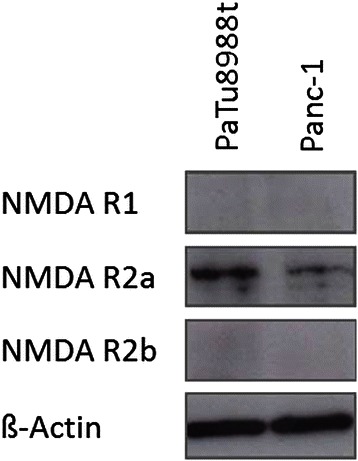
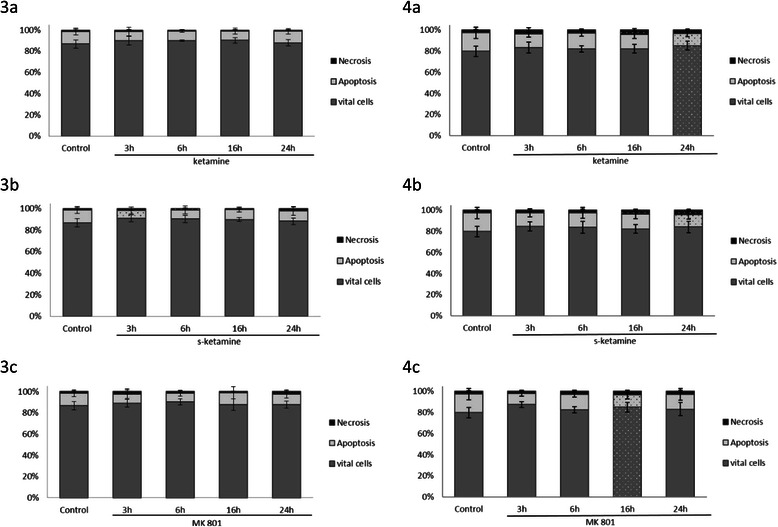
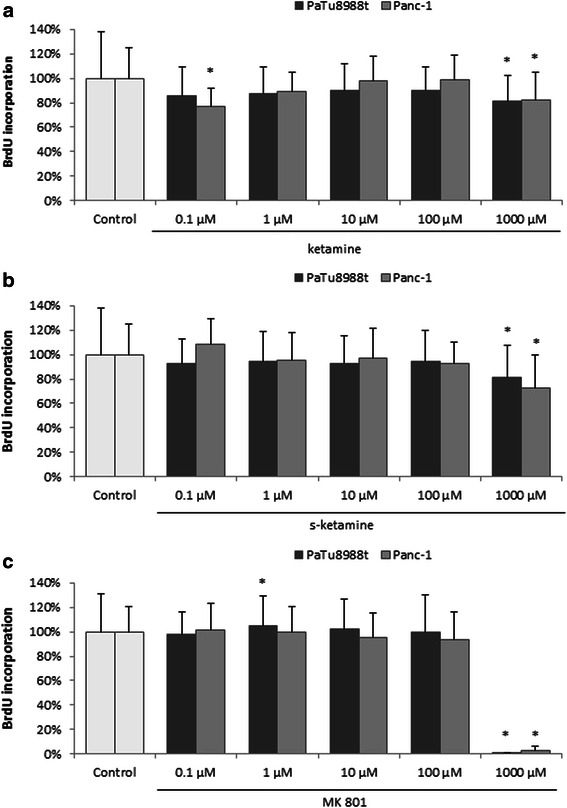
The NMDA receptor type R2a was expressed in both pancreatic carcinoma cell lines. Furthermore, ketamine, s-ketamine, and MK 801 significantly inhibited proliferation and apoptosis.
In this study, we showed the expression of the NMDA receptor type R2a in pancreatic cancer cells. The NMDA antagonists ketamine, s-ketamine, and MK 801 inhibited cell proliferation and cell death. Further clinical studies are warranted to identify the impact of these agents on the treatment of cancer patients.
胰腺腺癌是侵袭人体的最具侵袭性的癌症疾病之一。这类癌症的致癌潜力主要表现为信号级联激活引发的极高生长速率。现代肿瘤治疗策略旨在有效调节特定的信号传导和转录途径。最近,已证实几种并非主要用于癌症治疗的物质具有抗肿瘤潜力。例如,在某些肿瘤实体中,给予谷氨酸拮抗剂可抑制细胞增殖、使细胞周期停滞并最终导致细胞死亡。为了在胰腺癌细胞系PaTu8988t和Panc - 1中获得内源性N - 甲基 - D - 天冬氨酸(NMDA)受体类型表达的证据,并研究氯胺酮、s - 氯胺酮和NMDA受体拮抗剂MK 801对胰腺癌增殖、凋亡和坏死的影响。
通过酶联免疫吸附测定法(ELISA)检测BrdU来测量细胞增殖,并通过膜联蛋白V染色分析凋亡率。还采用了免疫印迹法。
两种胰腺癌细胞系均表达NMDA受体R2a型。此外,氯胺酮、s - 氯胺酮和MK 801显著抑制增殖和凋亡。
在本研究中,我们展示了NMDA受体R2a型在胰腺癌细胞中的表达。NMDA拮抗剂氯胺酮、s - 氯胺酮和MK 801抑制细胞增殖和细胞死亡。有必要进行进一步的临床研究以确定这些药物对癌症患者治疗的影响。