Humbert Marc, Ghofrani Hossein-Ardeschir
Service de Pneumologie, DHU Thorax Innovation, Assistance Publique-Hôpitaux de Paris, Hôpital Bicêtre, Paris, France Université Paris-Sud, Laboratoire d'Excellence en Recherche sur le Médicament et Innovation Thérapeutique, Paris, France INSERM Unité 999, Le Kremlin-Bicêtre, Paris, France.
University of Giessen and Marburg Lung Center (UGMLC), member of the German Center of Lung Research (DZL), Giessen, Germany Department of Medicine, Imperial College London, London, UK.
Thorax. 2016 Jan;71(1):73-83. doi: 10.1136/thoraxjnl-2015-207170. Epub 2015 Jul 28.
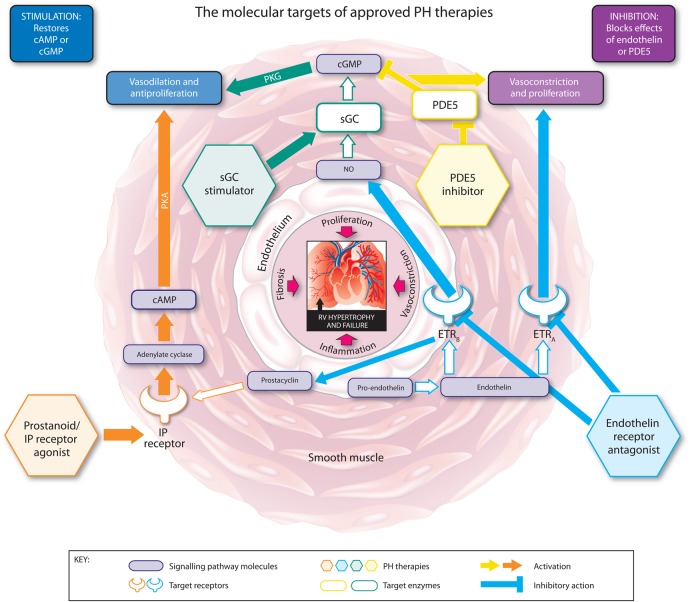
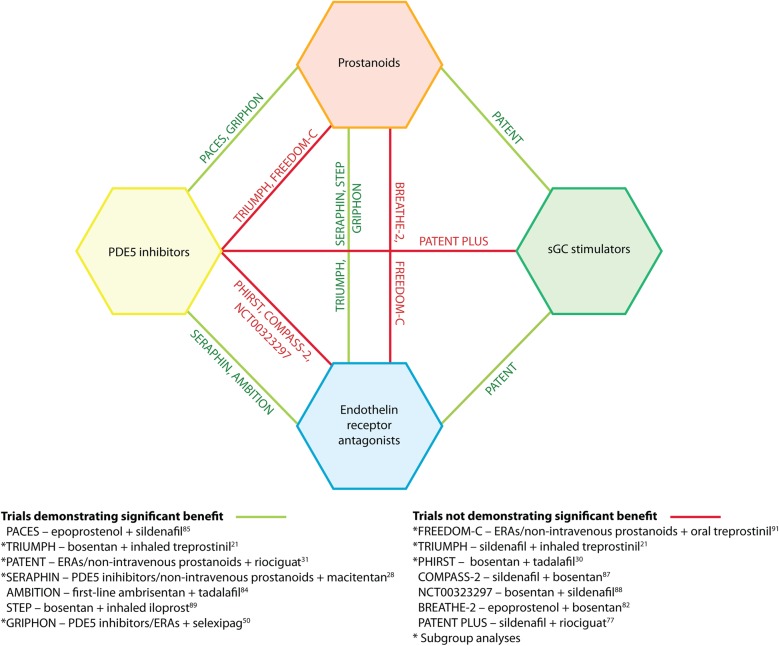
Until recently, three classes of medical therapy were available for the treatment of pulmonary arterial hypertension (PAH)--prostanoids, endothelin receptor antagonists and phosphodiesterase type 5 (PDE5) inhibitors. With the approval of the soluble guanylate cyclase stimulator riociguat, an additional drug class has become available targeting a distinct molecular target in the same pathway as PDE5 inhibitors. Treatment recommendations currently include the use of all four drug classes to treat PAH, but there is a lack of comparative data for these therapies. Therefore, an understanding of the mechanistic differences between these agents is critical when making treatment decisions. Combination therapy is often used to treat PAH and it is therefore important that physicians understand how the modes of action of these drugs may interact to work as complementary partners, or potentially with unwanted consequences. Furthermore, different patient phenotypes mean that patients respond differently to treatment; while a certain monotherapy may be adequate for some patients, for others it will be important to consider alternating or combining compounds with different molecular targets. This review describes how the four currently approved drug classes target the complex pathobiology of PAH and will consider the distinct target molecules of each drug class, their modes of action, and review the pivotal clinical trial data supporting their use. It will also discuss the rationale for combining drugs (or not) from the different classes, and review the clinical data from studies on combination therapy.
直到最近,有三类药物可用于治疗肺动脉高压(PAH)——前列环素类、内皮素受体拮抗剂和5型磷酸二酯酶(PDE5)抑制剂。随着可溶性鸟苷酸环化酶刺激剂利奥西呱的获批,又增加了一类药物,其作用于与PDE5抑制剂相同途径中的一个不同分子靶点。目前的治疗建议包括使用所有这四类药物来治疗PAH,但缺乏这些疗法的比较数据。因此,在做出治疗决策时,了解这些药物之间的机制差异至关重要。联合治疗常用于治疗PAH,因此医生了解这些药物的作用方式如何相互作用,以作为互补搭档发挥作用,或者可能产生不良后果,这一点很重要。此外,不同的患者表型意味着患者对治疗的反应不同;虽然某种单一疗法可能对一些患者足够,但对另一些患者来说,考虑交替使用或联合使用具有不同分子靶点的化合物很重要。这篇综述描述了目前获批的四类药物如何针对PAH复杂的病理生物学,并将考虑每类药物独特的靶点分子、它们的作用方式,并回顾支持其使用的关键临床试验数据。它还将讨论联合使用(或不联合使用)不同类别药物的基本原理,并回顾联合治疗研究的临床数据。