Chi Wei, Chen Hongrui, Li Fei, Zhu Yingting, Yin Wei, Zhuo Yehong
State Key Laboratory of Ophthalmology, Zhongshan Ophthalmic Center, Sun Yat-sen University, 3#925 Xianlienan Road, Guangzhou, 510060, China.
Zhongshan medical college, Sun Yat-sen University, Guangzhou, 510030, China.
J Neuroinflammation. 2015 Jul 30;12:137. doi: 10.1186/s12974-015-0360-2.
Acute glaucoma is a significantly sight-threatening cause of irreversible blindness in the world characterized by a sudden and substantial intraocular pressure (IOP) increase and subsequent retinal ganglion cell (RGC) death. This study aims to explore the role of high-mobility group box 1 (HMGB1) in an acute glaucoma mouse model.
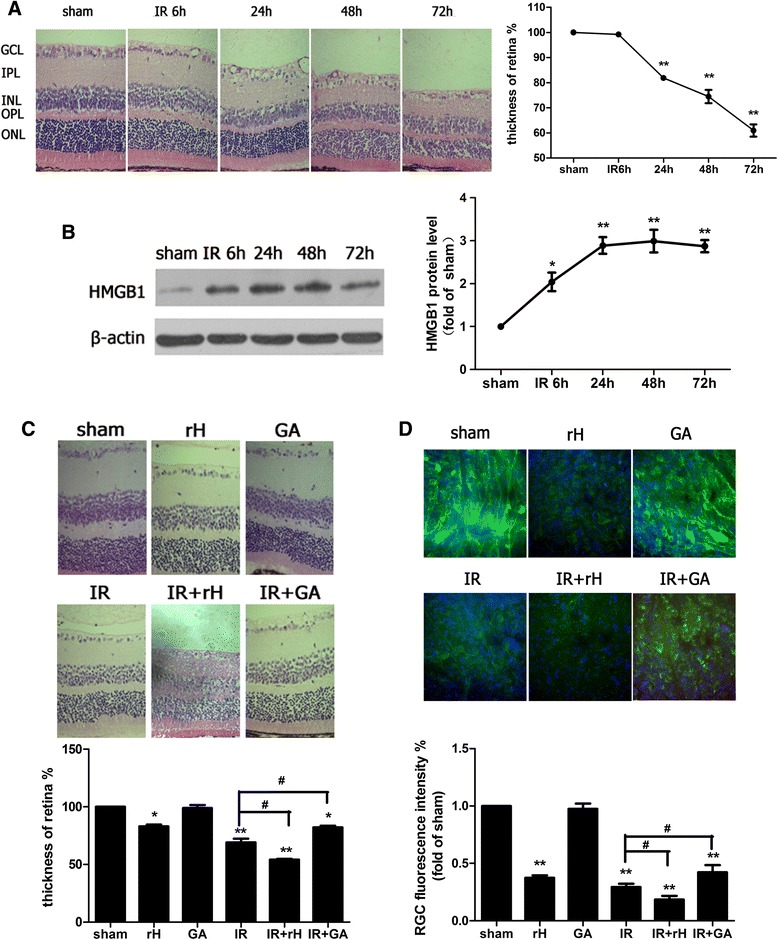
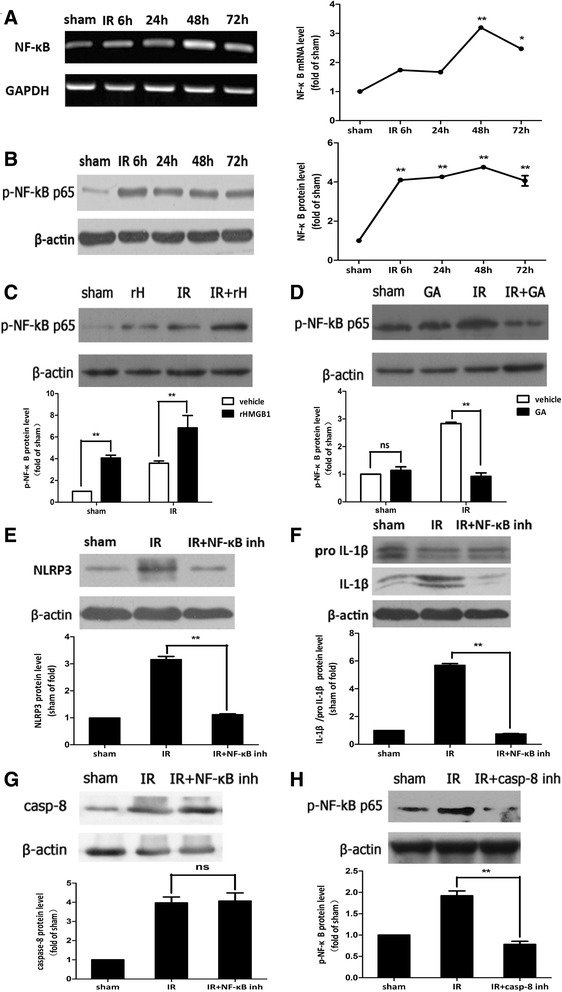
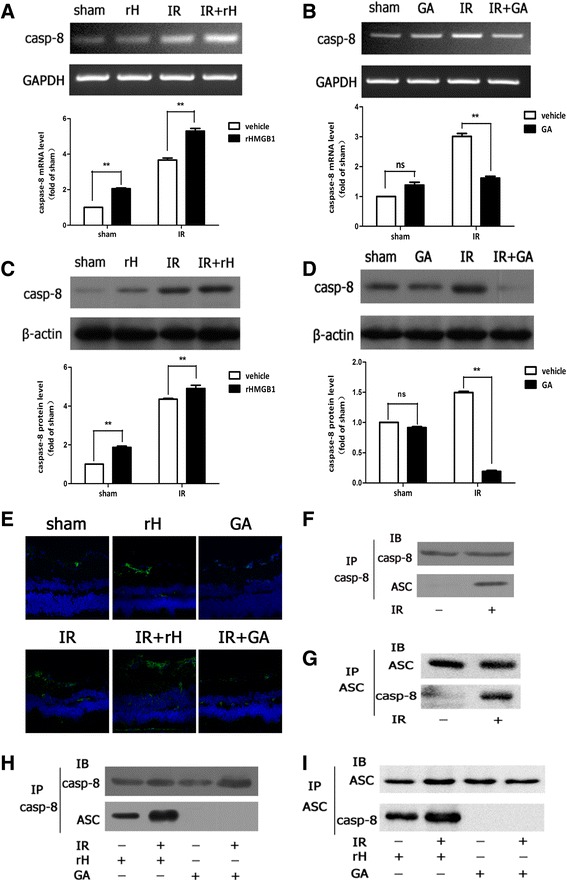
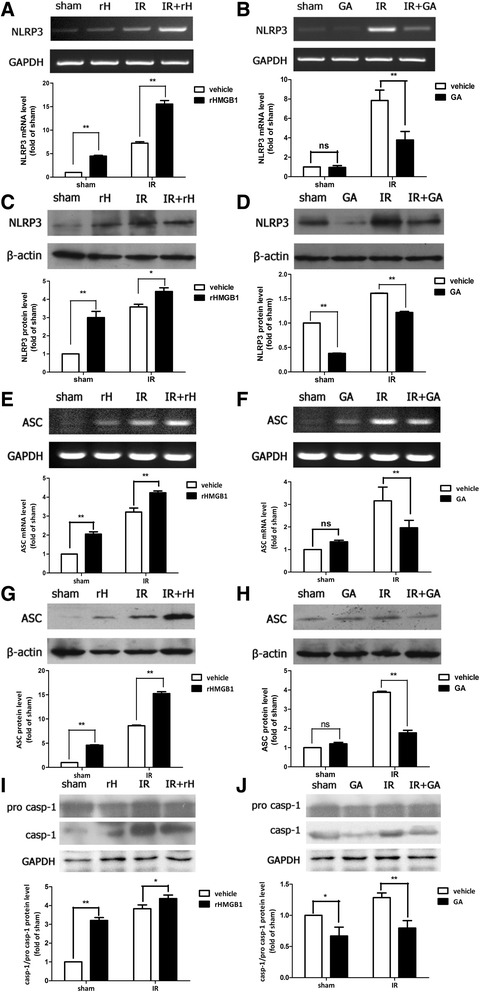
An acute glaucoma model was induced by a rapid and substantial increase IOP to 70 mmHg for 60 min via anterior chamber punctured and affused with Balance Salt Solution in C57BL/6 mice. Retinal tissue ischemic damage and loss of RGCs were assessed at 6, 24, 48, 72 h after high IOP treatment, and at 48 h, group with or without recombinant high-mobility group box 1 (rHMGB1), the HMGB1 inhibitor, glycyrrhizic acid (GA), and by HE and immunofluorescent staining. The nuclear factor κB (NF-κB) inhibitor, JSH-23, and caspase-8 inhibitor, Z-IETD-fmk, were injected into vitreous. Reverse transcription and semi-quantitative reverse transcription polymerase chain reaction (RT-PCR), western blotting, and immunoprecipitation were performed to evaluate the expression level of nucleotide-binding domain, leucine-rich repeat containing protein 3 (NLRP3), phosphor-NF-κB p65, caspase-8, caspase-1, apoptosis-associated speck-like protein containing a CARD (ASC), and interleukin-1β (IL-1β).
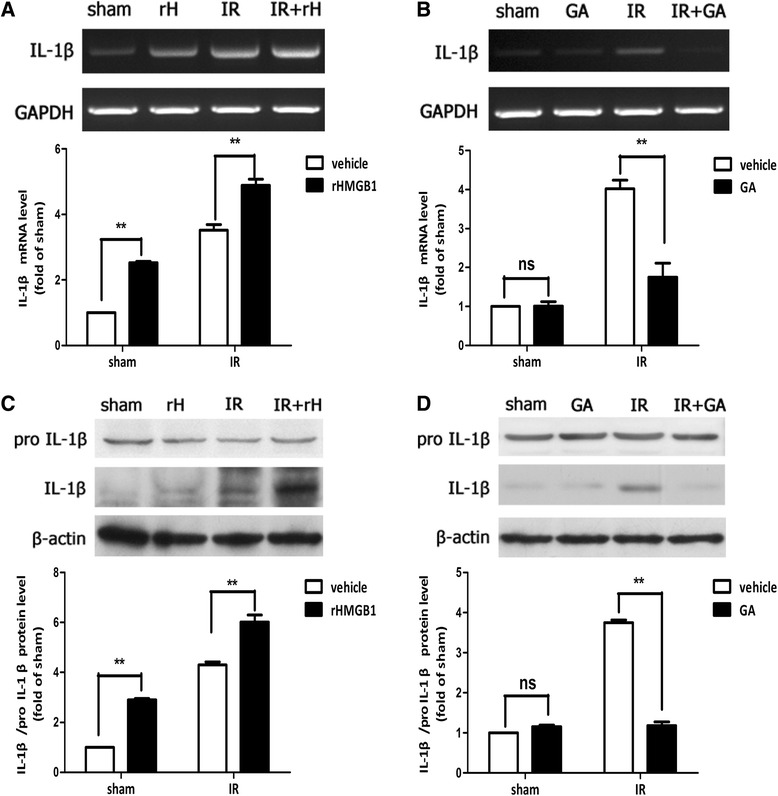
HMGB1 was increased in ischemic retinal tissue during acute glaucoma as early as 6 h after rapid IOP elevation. Exogenous HMGB1 exacerbated retinal ischemic damage, RGC loss, and inhibition of endogenous HMGB1 significantly reduced the severity of disease. HMGB1 significantly induced the elevation of canonical NLRP3, ASC, caspase-1, and non-canonical capase-8-ASC inflammasome and promoted the processing of IL-1β. Furthermore, the effect of HMGB1 on NLRP3 inflammasome activation and IL-1β production was dependent on NF-κB pathway. Thus, HMGB1/caspase-8 pathway promoted the processing of IL-1β via NF-κB pathway.
The findings of this study identified a novel signaling pathway in which HMGB1, in response to acutely elevated intraocular pressure, activated the canonical NLRP3 and non-canonical caspase-8 inflammasomes and production of IL-1β during acute glaucoma development. These results provide new insights to the understanding of the innate response that contributes to pathogenesis of acute glaucoma.
急性青光眼是全球范围内导致不可逆失明的重要致盲原因,其特征为眼内压(IOP)突然大幅升高以及随后的视网膜神经节细胞(RGC)死亡。本研究旨在探讨高迁移率族蛋白B1(HMGB1)在急性青光眼小鼠模型中的作用。
通过对C57BL/6小鼠前房穿刺并注入平衡盐溶液,使IOP迅速大幅升高至70 mmHg并维持60分钟,从而诱导建立急性青光眼模型。在高眼压处理后的6、24、48、72小时评估视网膜组织缺血损伤和RGC丢失情况,并在48小时时,对有或无重组高迁移率族蛋白B1(rHMGB1)、HMGB1抑制剂甘草酸(GA)的组进行HE和免疫荧光染色。将核因子κB(NF-κB)抑制剂JSH-23和半胱天冬酶-8抑制剂Z-IETD-fmk注入玻璃体。进行逆转录和半定量逆转录聚合酶链反应(RT-PCR)、蛋白质印迹法以及免疫沉淀法,以评估核苷酸结合寡聚化结构域样受体蛋白3(NLRP3)、磷酸化-NF-κB p65、半胱天冬酶-8、半胱天冬酶-1、含半胱天冬酶激活和招募结构域的凋亡相关斑点样蛋白(ASC)以及白细胞介素-1β(IL-1β)的表达水平。
在急性青光眼期间,早在IOP快速升高后的6小时,缺血视网膜组织中的HMGB1就升高。外源性HMGB1加剧了视网膜缺血损伤、RGC丢失,而抑制内源性HMGB1可显著降低疾病严重程度。HMGB1显著诱导经典NLRP3、ASC、半胱天冬酶-1以及非经典半胱天冬酶-8-ASC炎性小体升高,并促进IL-1β的加工处理。此外,HMGB1对NLRP3炎性小体激活和IL-1β产生的作用依赖于NF-κB途径。因此,HMGB1/半胱天冬酶-8途径通过NF-κB途径促进IL-1β的加工处理。
本研究结果确定了一条新的信号通路,即HMGB1在急性青光眼发展过程中,响应急性升高的眼内压,激活经典NLRP3和非经典半胱天冬酶-8炎性小体并产生IL-1β。这些结果为理解促成急性青光眼发病机制的固有反应提供了新的见解。