Baumann Nils, Arnold Thuro, Lonschinski Martin
Helmholtz-Zentrum Dresden-Rossendorf, Institute of Radiochemistry, 01328 Dresden, Germany.
Friedrich-Schiller University, Institute of Geosciences, 07743 Jena, Germany.
J Radioanal Nucl Chem. 2012;291(3):673-679. doi: 10.1007/s10967-011-1389-z. Epub 2011 Aug 26.
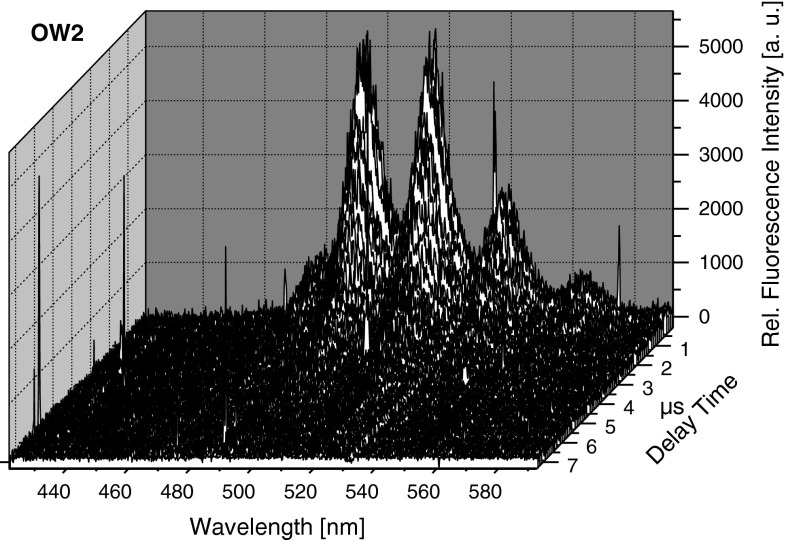
In situ leaching of uranium ores with sulfuric acid during active uranium mining activity on the Gessenheap has caused longstanding environmental problems of acid mine drainage and elevated concentrations of uranium. To study there remediation measures the test site Gessenwiese, a recultivated former uranium mining heap near Ronnenburg/East Thuringia/Germany, was installed as a part of a research program of the Friedrich-Schiller University Jena to study, among other techniques, the phytoremediation capacity of native and selected plants towards uranium. In the first step the uranium speciation in surface seepage and soil pore waters from Gessenwiese, ranging in pH from 3.2 to 4.0, were studied by time-resolved laser-induced fluorescence spectroscopy (TRLFS). Both types of water samples showed mono-exponential luminescence decay, indicating the presence of only one major species. The detected emission bands were found at 477.5, 491.8, 513.0, 537.2, 562.3, and 590.7 nm in case of the surface water samples, and were found at 477.2, 493.2, 513.8, 537.0, 562.4, and 590.0 nm in case of the soil water samples. These characteristic peak maxima together with the observed mono-exponential decay indicated that the uranium speciation in the seepage and soil pore waters is dominated by the uranium (VI) sulfate species UOSO. Due to the presence of luminescence quenchers in the natural water samples the measured luminescence lifetimes of the UOSO species of 1.0-2.6 μs were reduced in comparison to pure uranium sulfate solutions, which show a luminescence lifetime of 4.7 μs. These results convincingly show that in the pH range of 3.2-4.0 TRLFS is a suitable and very useful technique to study the uranium speciation in naturally occurring water samples.
在德国图林根州东部罗嫩堡附近一个已复垦的前铀矿堆——格森维泽试验场,作为耶拿弗里德里希 - 席勒大学研究项目的一部分而设立,旨在研究包括天然植物和选定植物对铀的植物修复能力等多种技术。在格森堆进行的活跃铀矿开采活动中,用硫酸原地浸出铀矿石,导致了长期存在的酸性矿山排水和铀浓度升高的环境问题。第一步,通过时间分辨激光诱导荧光光谱法(TRLFS)研究了格森维泽地表渗流和土壤孔隙水(pH值范围为3.2至4.0)中的铀形态。两种水样均呈现单指数发光衰减,表明仅存在一种主要物种。地表水样品中检测到的发射带位于477.5、491.8、513.0、537.2、562.3和590.7纳米处,土壤水样中检测到的发射带位于477.2、493.2、513.8、537.0、562.4和590.0纳米处。这些特征峰最大值以及观察到的单指数衰减表明,渗流和土壤孔隙水中的铀形态主要由硫酸铀(VI)物种UOSO主导。由于天然水样中存在发光猝灭剂,与纯硫酸铀溶液相比,UOSO物种测得的发光寿命为1.0 - 2.6微秒,而纯硫酸铀溶液的发光寿命为4.7微秒。这些结果令人信服地表明,在3.2 - 4.0的pH范围内,TRLFS是研究天然水样中铀形态的一种合适且非常有用的技术。