Nelson E C, Agrawal A, Heath A C, Bogdan R, Sherva R, Zhang B, Al-Hasani R, Bruchas M R, Chou Y-L, Demers C H, Carey C E, Conley E D, Fakira A K, Farrer L A, Goate A, Gordon S, Henders A K, Hesselbrock V, Kapoor M, Lynskey M T, Madden P A F, Moron J A, Rice J P, Saccone N L, Schwab S G, Shand F L, Todorov A A, Wallace L, Wang T, Wray N R, Zhou X, Degenhardt L, Martin N G, Hariri A R, Kranzler H R, Gelernter J, Bierut L J, Clark D J, Montgomery G W
Department of Psychiatry, Washington University, St Louis, MO, USA.
Boston University School of Medicine, Boston, MA, USA.
Mol Psychiatry. 2016 May;21(5):608-14. doi: 10.1038/mp.2015.102. Epub 2015 Aug 4.
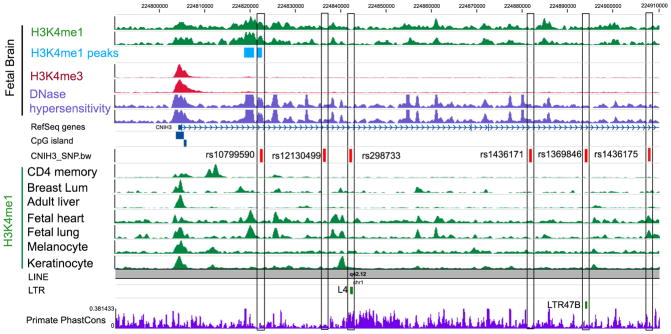
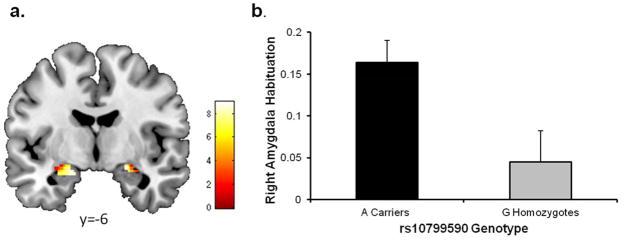
Opioid dependence, a severe addictive disorder and major societal problem, has been demonstrated to be moderately heritable. We conducted a genome-wide association study in Comorbidity and Trauma Study data comparing opioid-dependent daily injectors (N=1167) with opioid misusers who never progressed to daily injection (N=161). The strongest associations, observed for CNIH3 single-nucleotide polymorphisms (SNPs), were confirmed in two independent samples, the Yale-Penn genetic studies of opioid, cocaine and alcohol dependence and the Study of Addiction: Genetics and Environment, which both contain non-dependent opioid misusers and opioid-dependent individuals. Meta-analyses found five genome-wide significant CNIH3 SNPs. The A allele of rs10799590, the most highly associated SNP, was robustly protective (P=4.30E-9; odds ratio 0.64 (95% confidence interval 0.55-0.74)). Epigenetic annotation predicts that this SNP is functional in fetal brain. Neuroimaging data from the Duke Neurogenetics Study (N=312) provide evidence of this SNP's in vivo functionality; rs10799590 A allele carriers displayed significantly greater right amygdala habituation to threat-related facial expressions, a phenotype associated with resilience to psychopathology. Computational genetic analyses of physical dependence on morphine across 23 mouse strains yielded significant correlations for haplotypes in CNIH3 and functionally related genes. These convergent findings support CNIH3 involvement in the pathophysiology of opioid dependence, complementing prior studies implicating the α-amino-3-hydroxy-5-methyl-4-isoxazolepropionic acid (AMPA) glutamate system.
阿片类药物依赖是一种严重的成瘾性疾病和主要的社会问题,已被证明具有中度遗传性。我们在共病与创伤研究数据中进行了一项全基因组关联研究,比较了每日注射阿片类药物依赖者(N = 1167)和从未发展到每日注射的阿片类药物滥用者(N = 161)。在CNIH3单核苷酸多态性(SNP)中观察到的最强关联在两个独立样本中得到了证实,即耶鲁-宾夕法尼亚阿片类药物、可卡因和酒精依赖的遗传研究以及成瘾:遗传学与环境研究,这两个样本都包含非依赖阿片类药物滥用者和阿片类药物依赖个体。荟萃分析发现了5个全基因组显著的CNIH3 SNP。关联度最高的SNP rs10799590的A等位基因具有强大的保护作用(P = 4.30E - 9;优势比0.64(95%置信区间0.55 - 0.74))。表观遗传注释预测该SNP在胎儿大脑中具有功能。来自杜克神经遗传学研究(N = 312)的神经影像学数据为该SNP的体内功能提供了证据;rs10799590 A等位基因携带者对与威胁相关的面部表情表现出明显更强的右侧杏仁核习惯化,这是一种与对精神病理学的复原力相关的表型。对23种小鼠品系对吗啡身体依赖的计算遗传分析得出,CNIH3和功能相关基因的单倍型具有显著相关性。这些趋同的发现支持CNIH3参与阿片类药物依赖的病理生理学,补充了先前涉及α-氨基-3-羟基-5-甲基-4-异恶唑丙酸(AMPA)谷氨酸系统的研究。