Lord Janice M
Botany Department, University of Otago, PO Box 56, Dunedin 9054, New Zealand
AoB Plants. 2015 Aug 17;7:plv095. doi: 10.1093/aobpla/plv095.
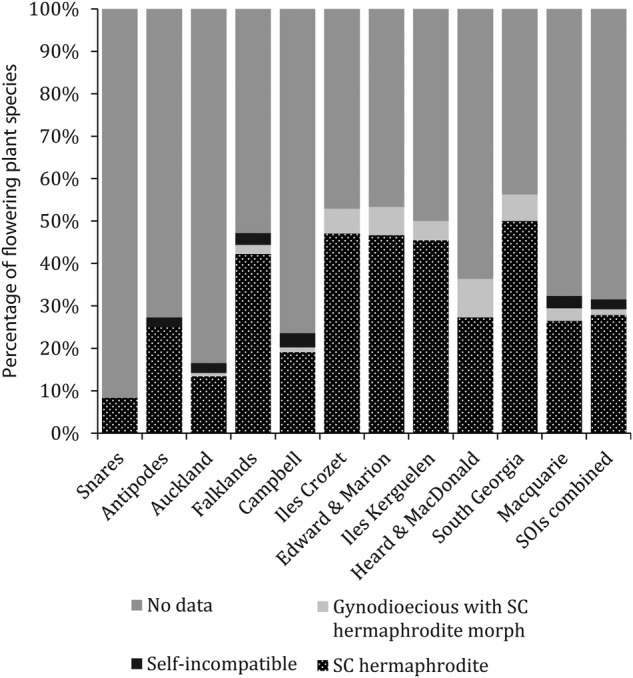
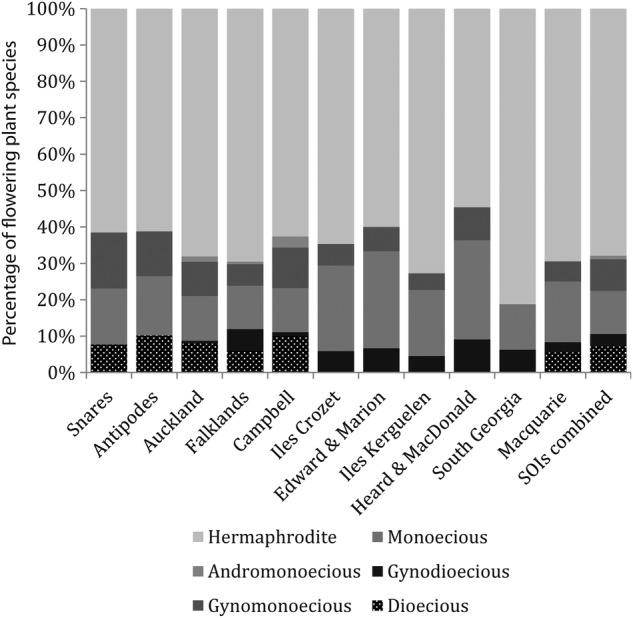
The harsh climatic conditions and paucity of potential pollinators on Southern Ocean Islands (SOIs; latitude 46°S-55°S) lead to the expectation that anemophily or self-fertilization are the dominant modes of plant sexual reproduction. However, at least some species have showy inflorescences suggesting biotic pollination or dimorphic breeding systems necessitating cross-pollination. This study investigates whether anemophily and self-compatibility are common on SOIs, whether species or genera with these traits are more widespread or frequent at higher latitudes, and whether gender dimorphy is correlated with anemophily, as might occur if reliance on pollinators was a disadvantage. Of the 321 flowering plant species in the SOI region, 34.3 % possessed floral traits consistent with anemophily. Compatibility information was located for 94 potentially self-fertilizing species, of which 92.6 % were recorded as partially or fully self-compatible. Dioecy occurred in 7.1 % of species overall and up to 10.2 % of island floras, but has not clearly arisen in situ. Gynodioecy occurred in 3.4 % of species. The frequency of anemophily and gender dimorphy did not differ between the SOI flora and southern hemisphere temperate reference floras. At the species level, gender dimorphy was positively associated with fleshy fruit, but at the genus level it was associated with occurrence in New Zealand and a reduced regional distribution. Anemophily was more prevalent in genera occurring on subantarctic islands and the proportion of species with floral traits suggestive of biotic pollination was significantly higher on climatically milder, cool temperate islands. These results support the contention that reliance on biotic pollinators has constrained the distribution of species on SOIs; however, it is also clear that the reproductive biology of few SOI species has been studied in situ and many species likely employ a mixed mating strategy combining biotic pollination with self-fertilization.
南大洋岛屿(SOIs;南纬46°-55°)恶劣的气候条件以及潜在传粉者的匮乏,使得人们预期风媒传粉或自花受精是植物有性繁殖的主要方式。然而,至少有一些物种具有艳丽的花序,这表明存在生物传粉或需要异花授粉的二型繁育系统。本研究调查了风媒传粉和自交亲和性在南大洋岛屿上是否普遍,具有这些特征的物种或属在较高纬度地区是否分布更广或更为常见,以及性别二型性是否与风媒传粉相关,就像如果依赖传粉者是一种劣势时可能出现的情况那样。在南大洋岛屿地区的321种开花植物物种中,34.3%具有与风媒传粉一致的花部特征。找到了94种可能自花受精物种的亲和性信息,其中92.6%被记录为部分或完全自交亲和。雌雄异株在所有物种中占7.1%,在岛屿植物区系中高达10.2%,但并非明显就地起源。雌全异株在3.4%的物种中出现。南大洋岛屿植物区系与南半球温带参考植物区系在风媒传粉频率和性别二型性方面没有差异。在物种水平上,性别二型性与肉质果实呈正相关,但在属水平上,它与在新西兰的出现情况以及区域分布范围缩小有关。风媒传粉在亚南极岛屿上的属中更为普遍,而在气候较为温和的凉爽温带岛屿上,具有暗示生物传粉花部特征的物种比例显著更高。这些结果支持了这样的观点,即对生物传粉者的依赖限制了南大洋岛屿上物种的分布;然而,同样明显的是,很少有南大洋岛屿物种的生殖生物学是在原地进行研究的,而且许多物种可能采用了将生物传粉与自花受精相结合的混合交配策略。