Pagé Isabelle, Abboud Jacques, O Shaughnessy Julie, Laurencelle Louis, Descarreaux Martin
Département des sciences de l'activité physique, Université du Québec à Trois-Rivières (UQTR), Trois-Rivières, Québec, Canada.
Département d'anatomie, UQTR, Trois-Rivières, Québec, Canada.
BMC Musculoskelet Disord. 2015 Aug 19;16:201. doi: 10.1186/s12891-015-0669-0.
Stratification strategies based on identifying patient's prognosis in order to guide patient care constitute one of the most prominent and recent approach in low back pain research. The STarT Back Screening Tool (SBST) although promising, has not been studied in patients with chronic low back pain (cLBP). Considering how challenging it is to translate research into practice, the value of integrating a new tool should be thoroughly assessed. The purpose was therefore to assess associations between the short- and long-terms clinical status and two types of variables, physiologic measures and the SBST, in participants with cLBP. The ability of both types of variables to discriminate between participants with and without higher levels of disability, pain, fear of movement and patient's global impression of change was also investigated.
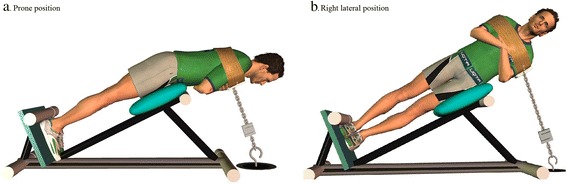
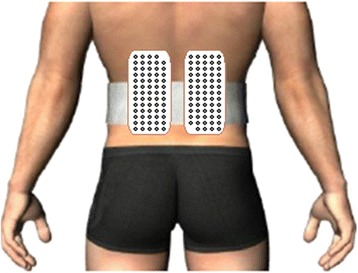
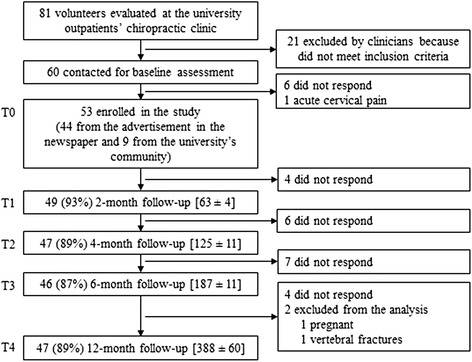
Fifty-three volunteers with cLBP participated in an initial evaluation and follow-ups at 2-, 4-, 6- and 12-month. Physiologic measures (maximal voluntary contraction, maximal endurance and muscle activity evaluated during prone and lateral isometric tasks) and the SBST were assessed at baseline. Disability (Oswestry Disability Index, ODI), pain intensity (101-point Numerical Rating Scale, NRS), fear of movement (Tampa Scale for Kinesiophobia, TSK) and patient's global impression of change (7-point scale, PGIC) were evaluated at baseline and at each follow-up. Aside the use of correlation analyses to assess potential associations; ROC curves were performed to evaluate the discriminative ability of physiologic measures and the SBST.
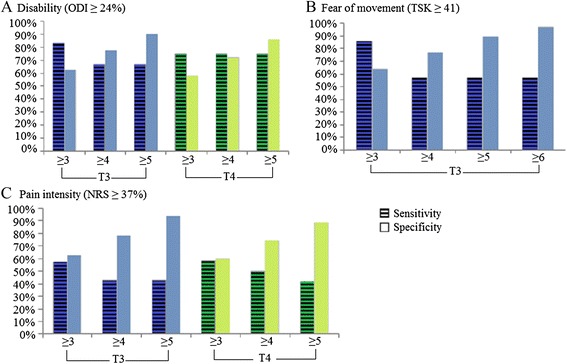
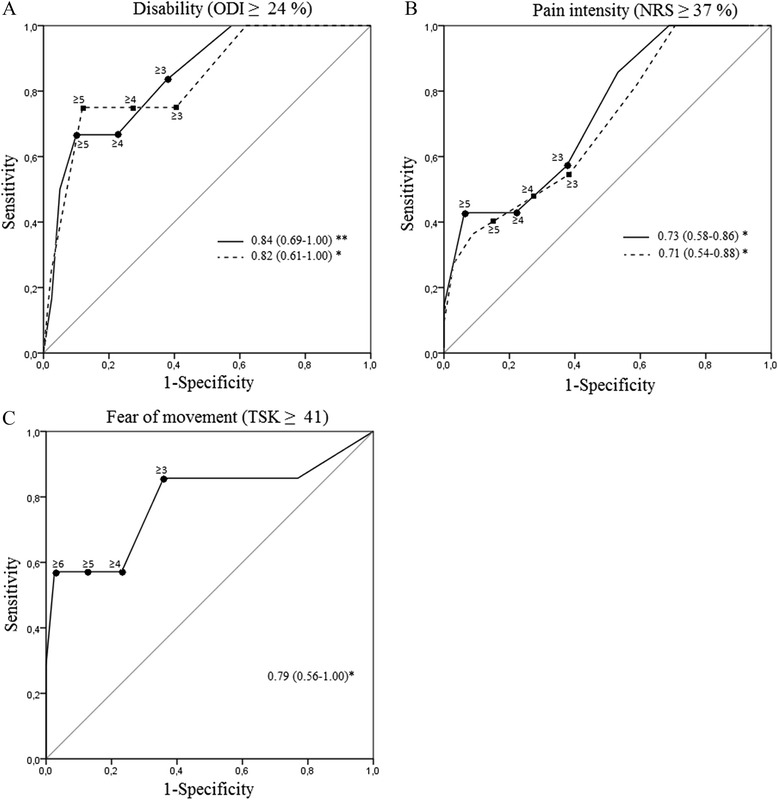
The SBST allowed for the identification of participants presenting higher levels of disability (ODI ≥24 %), pain (NRS ≥37 %) or fear of movement (TSK ≥41/68) over a 12-month period (AUC = 0.71 to 0.84, ps < 0.05). The SBST score was also correlated with disability at each follow-up (τ = 0.22 to 0.33, ps < 0.05) and with pain intensity and fear of movement at follow-ups. Among physiologic measures, only maximal voluntary contraction was correlated to disability, pain intensity or fear of movement during the follow-up (|τ| = 0.26 to 0.32, ps < 0.05) and none was able to identify participants presenting higher levels of outcomes (AUC ps > 0.05).
Physiologic measures obtained during prone and lateral tests have limited associations with the clinical status over a 12-month period in patients with nonspecific chronic low back pain. On the other hand, the STarT Back Screening Tool is useful for the identification of patients who will present higher levels of disability, pain intensity and fear of movement over a year.
Clinicaltrials.gov NCT02226692.
基于识别患者预后以指导患者护理的分层策略是腰痛研究中最突出且最新的方法之一。尽管“脊柱疼痛筛查工具(SBST)”很有前景,但尚未在慢性腰痛(cLBP)患者中进行研究。考虑到将研究转化为实践具有挑战性,应全面评估整合新工具的价值。因此,本研究旨在评估cLBP患者短期和长期临床状况与两类变量(生理指标和SBST)之间的关联。同时还研究了这两类变量区分残疾程度较高、疼痛、运动恐惧及患者整体变化印象的患者与未出现这些情况患者的能力。
53名cLBP志愿者参与了初始评估以及在2个月、4个月、6个月和12个月时的随访。在基线时评估生理指标(最大自主收缩、最大耐力以及在俯卧位和侧位等长任务期间的肌肉活动)和SBST。在基线和每次随访时评估残疾程度(Oswestry残疾指数,ODI)、疼痛强度(101点数字评分量表,NRS)、运动恐惧(坦帕运动恐惧量表,TSK)和患者整体变化印象(7点量表,PGIC)。除了使用相关性分析评估潜在关联外,还绘制ROC曲线以评估生理指标和SBST的判别能力。
SBST能够识别在12个月期间残疾程度较高(ODI≥24%)、疼痛(NRS≥37%)或运动恐惧程度较高(TSK≥41/68)的参与者(AUC = 0.71至0.84,P值<0.05)。SBST评分在每次随访时也与残疾程度相关(τ = 0.22至0.33,P值<0.05),并且在随访时与疼痛强度和运动恐惧相关。在生理指标中,只有最大自主收缩在随访期间与残疾程度、疼痛强度或运动恐惧相关(|τ| = 0.26至0.32,P值<0.05),且没有一项指标能够识别出结局水平较高的参与者(AUC,P值>0.05)。
在非特异性慢性腰痛患者中,俯卧位和侧位测试期间获得的生理指标在12个月期间与临床状况的关联有限。另一方面,“脊柱疼痛筛查工具”有助于识别在一年中残疾程度、疼痛强度和运动恐惧水平较高的患者。
Clinicaltrials.gov NCT02226692。