Tagliaferri Scott D, Angelova Maia, Zhao Xiaohui, Owen Patrick J, Miller Clint T, Wilkin Tim, Belavy Daniel L
Institute for Physical Activity and Nutrition (IPAN), School of Exercise and Nutrition Sciences, Deakin University, Geelong, VIC Australia.
School of Information Technology, Deakin University, Geelong, VIC Australia.
NPJ Digit Med. 2020 Jul 9;3:93. doi: 10.1038/s41746-020-0303-x. eCollection 2020.
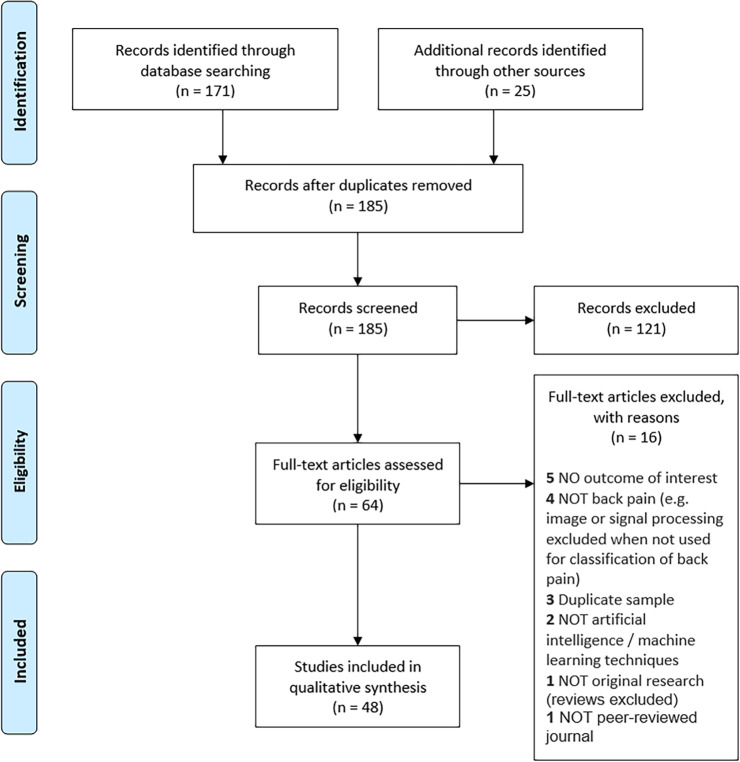
Artificial intelligence and machine learning (AI/ML) could enhance the ability to detect patterns of clinical characteristics in low-back pain (LBP) and guide treatment. We conducted three systematic reviews to address the following aims: (a) review the status of AI/ML research in LBP, (b) compare its status to that of two established LBP classification systems (STarT Back, McKenzie). AI/ML in LBP is in its infancy: 45 of 48 studies assessed sample sizes <1000 people, 19 of 48 studies used ≤5 parameters in models, 13 of 48 studies applied multiple models and attained high accuracy, 25 of 48 studies assessed the binary classification of LBP versus no-LBP only. Beyond the 48 studies using AI/ML for LBP classification, no studies examined use of AI/ML in prognosis prediction of specific sub-groups, and AI/ML techniques are yet to be implemented in guiding LBP treatment. In contrast, the STarT Back tool has been assessed for internal consistency, test-retest reliability, validity, pain and disability prognosis, and influence on pain and disability treatment outcomes. McKenzie has been assessed for inter- and intra-tester reliability, prognosis, and impact on pain and disability outcomes relative to other treatments. For AI/ML methods to contribute to the refinement of LBP (sub-)classification and guide treatment allocation, large data sets containing known and exploratory clinical features should be examined. There is also a need to establish reliability, validity, and prognostic capacity of AI/ML techniques in LBP as well as its ability to inform treatment allocation for improved patient outcomes and/or reduced healthcare costs.
人工智能和机器学习(AI/ML)可以提高检测腰痛(LBP)临床特征模式的能力并指导治疗。我们进行了三项系统评价,以实现以下目标:(a)回顾LBP中AI/ML的研究现状,(b)将其现状与两种已确立的LBP分类系统(STarT Back、麦肯齐)的现状进行比较。LBP领域的AI/ML尚处于起步阶段:48项研究中有45项评估的样本量小于1000人,48项研究中有19项在模型中使用了≤5个参数,48项研究中有13项应用了多种模型并获得了高精度,48项研究中有25项仅评估了LBP与非LBP的二元分类。除了这48项使用AI/ML进行LBP分类的研究外,没有研究考察AI/ML在特定亚组预后预测中的应用,并且AI/ML技术尚未在指导LBP治疗中得到应用。相比之下,STarT Back工具已在内部一致性、重测信度、效度、疼痛和残疾预后以及对疼痛和残疾治疗结果的影响方面得到评估。麦肯齐工具已在测试者间和测试者内信度、预后以及相对于其他治疗对疼痛和残疾结果的影响方面得到评估。为了使AI/ML方法有助于完善LBP(亚)分类并指导治疗分配,应检查包含已知和探索性临床特征的大数据集。还需要确定AI/ML技术在LBP中的信度、效度和预后能力,以及其为改善患者预后和/或降低医疗成本提供治疗分配信息的能力。