Bigelow Robin T, Semenov Yevgeniy R, Trevino Carolina, Ferrucci Luigi, Resnick Susan M, Simonsick Eleanor M, Xue Qian-Li, Agrawal Yuri
Department of Otolaryngology - Head and Neck Surgery, School of Medicine, Johns Hopkins University, Baltimore, Maryland.
Longitudinal Studies Section, Clinical Research Branch, National Institute on Aging, National Institutes of Health, Baltimore, Maryland.
J Am Geriatr Soc. 2015 Sep;63(9):1837-44. doi: 10.1111/jgs.13609. Epub 2015 Aug 27.
To investigate the relationship between vestibular loss associated with aging and age-related decline in visuospatial function.
Cross-sectional analysis within a prospective cohort study.
Baltimore Longitudinal Study of Aging (BLSA).
Community-dwelling BLSA participants with a mean age of 72 (range 26-91) (N = 183).
Vestibular function was measured using vestibular-evoked myogenic potentials. Visuospatial cognitive tests included Card Rotations, Purdue Pegboard, Benton Visual Retention Test, and Trail-Making Test Parts A and B. Tests of executive function, memory, and attention were also considered.
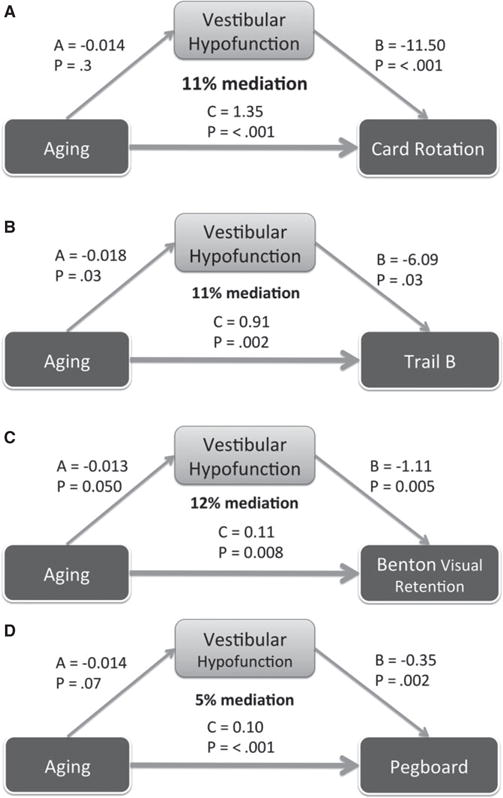
Participants underwent vestibular and cognitive function testing. In multiple linear regression analyses, poorer vestibular function was associated with poorer performance on Card Rotations (P = .001), Purdue Pegboard (P = .005), Benton Visual Retention Test (P = 0.008), and Trail-Making Test Part B (P = .04). Performance on tests of executive function and verbal memory were not significantly associated with vestibular function. Exploratory factor analyses in a subgroup of participants who underwent all cognitive tests identified three latent cognitive abilities: visuospatial ability, verbal memory, and working memory and attention. Vestibular loss was significantly associated with lower visuospatial and working memory and attention factor scores.
Significant consistent associations between vestibular function and tests of visuospatial ability were observed in a sample of community-dwelling adults. Impairment in visuospatial skills is often one of the first signs of dementia and Alzheimer's disease. Further longitudinal studies are needed to evaluate whether the relationship between vestibular function and visuospatial ability is causal.
研究与衰老相关的前庭功能丧失与视空间功能随年龄下降之间的关系。
前瞻性队列研究中的横断面分析。
巴尔的摩纵向衰老研究(BLSA)。
社区居住的BLSA参与者,平均年龄72岁(范围26 - 91岁)(N = 183)。
使用前庭诱发肌源性电位测量前庭功能。视空间认知测试包括卡片旋转测试、普渡钉板测试、本顿视觉保持测试以及连线测验A和B部分。还考虑了执行功能、记忆和注意力测试。
参与者接受了前庭和认知功能测试。在多元线性回归分析中,较差的前庭功能与卡片旋转测试(P = .001)、普渡钉板测试(P = .005)、本顿视觉保持测试(P = 0.008)和连线测验B部分(P = .04)的较差表现相关。执行功能测试和言语记忆测试的表现与前庭功能无显著关联。对所有认知测试均进行了的参与者亚组的探索性因素分析确定了三种潜在认知能力:视空间能力、言语记忆以及工作记忆和注意力。前庭功能丧失与较低的视空间、工作记忆和注意力因素得分显著相关。
在社区居住的成年人样本中观察到前庭功能与视空间能力测试之间存在显著且一致的关联。视空间技能受损通常是痴呆和阿尔茨海默病的首批症状之一。需要进一步的纵向研究来评估前庭功能与视空间能力之间的关系是否为因果关系。