Ross Jeffrey S, Wang Kai, Chmielecki Juliann, Gay Laurie, Johnson Adrienne, Chudnovsky Jacob, Yelensky Roman, Lipson Doron, Ali Siraj M, Elvin Julia A, Vergilio Jo-Anne, Roels Steven, Miller Vincent A, Nakamura Brooke N, Gray Adam, Wong Michael K, Stephens Philip J
Foundation Medicine, Inc., Cambridge, MA.
Department of Pathology and Laboratory Medicine, Albany Medical College, Albany, NY.
Int J Cancer. 2016 Feb 15;138(4):881-90. doi: 10.1002/ijc.29825. Epub 2015 Sep 8.
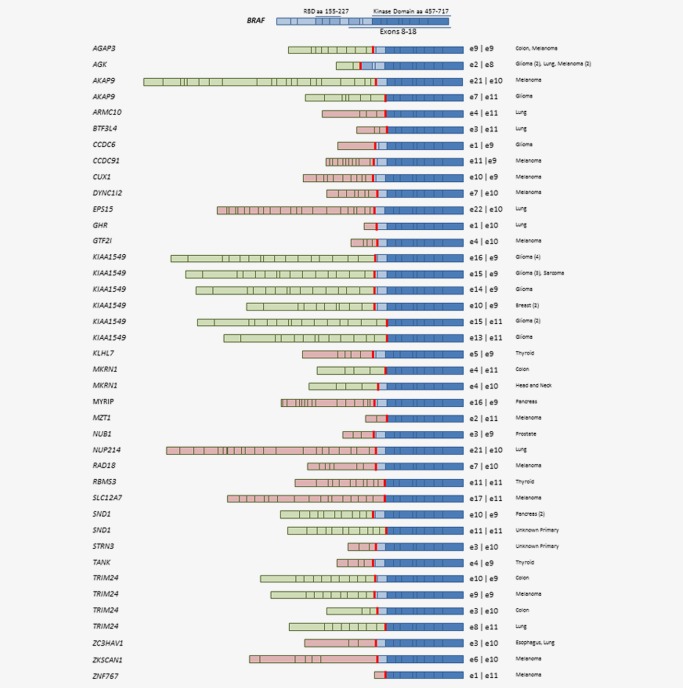
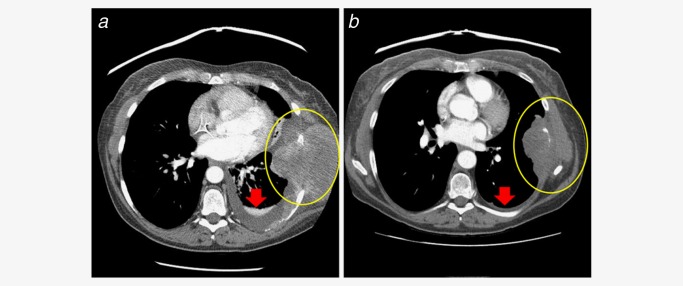
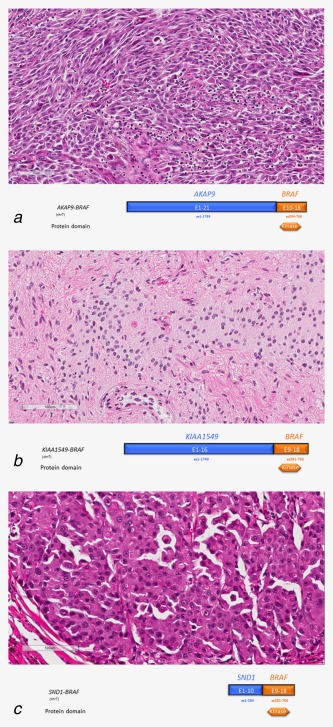
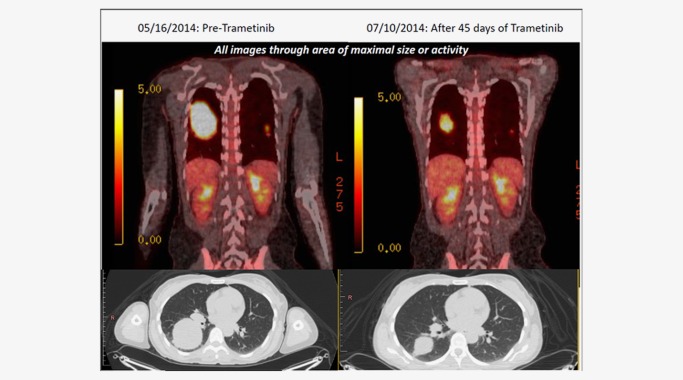
Although the BRAF V600E base substitution is an approved target for the BRAF inhibitors in melanoma, BRAF gene fusions have not been investigated as anticancer drug targets. In our study, a wide variety of tumors underwent comprehensive genomic profiling for hundreds of known cancer genes using the FoundationOne™ or FoundationOne Heme™ comprehensive genomic profiling assays. BRAF fusions involving the intact in-frame BRAF kinase domain were observed in 55 (0.3%) of 20,573 tumors, across 12 distinct tumor types, including 20 novel BRAF fusions. These comprised 29 unique 5' fusion partners, of which 31% (9) were known and 69% (20) were novel. BRAF fusions included 3% (14/531) of melanomas; 2% (15/701) of gliomas; 1.0% (3/294) of thyroid cancers; 0.3% (3/1,062) pancreatic carcinomas; 0.2% (8/4,013) nonsmall-cell lung cancers and 0.2% (4/2,154) of colorectal cancers, and were enriched in pilocytic (30%) vs. nonpilocytic gliomas (1%; p < 0.0001), Spitzoid (75%) vs. nonSpitzoid melanomas (1%; p = 0.0001), acinar (67%) vs. nonacinar pancreatic cancers (<1%; p < 0.0001) and papillary (3%) vs. nonpapillary thyroid cancers (0%; p < 0.03). Clinical responses to trametinib and sorafenib are presented. In conclusion, BRAF fusions are rare driver alterations in a wide variety of malignant neoplasms, but enriched in Spitzoid melanoma, pilocytic astrocytomas, pancreatic acinar and papillary thyroid cancers.
尽管BRAF V600E碱基替换是黑色素瘤中BRAF抑制剂的一个已获批准的靶点,但BRAF基因融合尚未作为抗癌药物靶点进行研究。在我们的研究中,使用FoundationOne™或FoundationOne Heme™综合基因组分析检测法,对多种肿瘤的数百个已知癌症基因进行了全面的基因组分析。在20573例肿瘤中的55例(0.3%)中观察到涉及完整读码框内BRAF激酶结构域的BRAF融合,分布于12种不同的肿瘤类型,包括20种新的BRAF融合。这些融合包含29个独特的5'融合伙伴,其中31%(9个)是已知的,69%(20个)是新的。BRAF融合包括3%(14/531)的黑色素瘤;2%(15/701)的神经胶质瘤;1.0%(3/294)的甲状腺癌;0.3%(3/1062)的胰腺癌;0.2%(8/4013)的非小细胞肺癌和0.2%(4/2154)的结直肠癌,并且在毛细胞型(30%)与非毛细胞型神经胶质瘤(1%;p<0.0001)、Spitzoid型(75%)与非Spitzoid型黑色素瘤(1%;p=0.0001)、腺泡型(67%)与非腺泡型胰腺癌(<1%;p<0.0001)以及乳头状(3%)与非乳头状甲状腺癌(0%;p<0.03)中更为富集。文中还展示了对曲美替尼和索拉非尼治疗的临床反应。总之,BRAF融合在多种恶性肿瘤中是罕见的驱动性改变,但在Spitzoid黑色素瘤、毛细胞型星形细胞瘤、胰腺腺泡癌和乳头状甲状腺癌中更为富集。