Madhivanan Purnima, NiranjanKumar Bhavana, Shaheen Reshma, Jaykrishna Poornima, Ravi Kavitha, Gowda Savitha, Srinivas Vijaya, Arun Anjali, Krupp Karl
Department of Epidemiology, Robert Stempel College of Public Health and Social Work, Florida International University, 11200 SW 8 Street, HLS 390W2, Miami, FL 33199, USA ; Public Health Research Institute of India, 89/B, 2nd Cross, 2nd Main, Yadavgiri, Mysore 560021, India.
Public Health Research Institute of India, 89/B, 2nd Cross, 2nd Main, Yadavgiri, Mysore 560021, India.
J Sex Transm Dis. 2013;2013:971458. doi: 10.1155/2013/971458. Epub 2013 Sep 1.
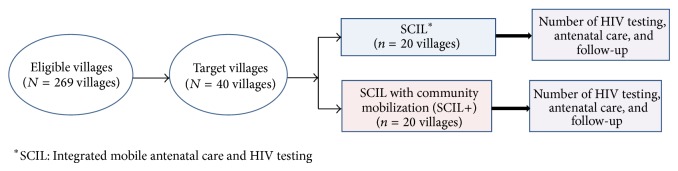
Background. We describe a one-year evaluation study comparing SCIL intervention of mobile provision of integrated ANC/ HIV testing with an enhanced (SCIL+) intervention of community mobilization strategy providing conditional cash transfers (CCT) to women's SHG for identifying and accompanying pregnant women to mobile clinics. Methods. Twenty pairs of villages matched on population, socioeconomic status, access to medical facilities, and distance from Mysore city were divided between SCIL and SCIL+ interventions. The primary study outcome was the proportion of total pregnancies in these villages who received ANC and HIV testing. Results. Between April 2011 and March 2012, 552 pregnant women participated in SCIL or SCIL+ interventions. Among women who were pregnant at the time of intervention delivery, 181 of 418 (43.3%) women pregnant at the time of intervention delivery received ANC in the SCIL arm, while 371 of 512 (72.5%) received ANC in the SCIL+ arm (P < 0.001); 175 (97%) in the SCIL and 366 (98.6%) in the SCIL+ arm consented to HIV testing (P < 0.001). HIV prevalence of 0.6% was detected among SCIL clinic, and 0.9% among attending SCIL+ clinic attendees. Conclusion. Provision of CCT to women's microeconomic SHG appears to significantly increase uptake of ANC/HIV testing services in rural Mysore villages.
背景。我们描述了一项为期一年的评估研究,该研究比较了移动提供综合产前护理/艾滋病毒检测的SCIL干预措施与强化(SCIL+)干预措施,后者采用社区动员策略,向妇女自助小组提供有条件现金转移(CCT),以识别孕妇并陪同她们前往移动诊所。方法。根据人口、社会经济地位、获得医疗设施的情况以及与迈索尔市的距离匹配的20对村庄被分配到SCIL和SCIL+干预措施中。主要研究结果是这些村庄中接受产前护理和艾滋病毒检测的总怀孕数的比例。结果。在2011年4月至2012年3月期间,552名孕妇参与了SCIL或SCIL+干预措施。在干预措施实施时怀孕的妇女中,SCIL组中418名怀孕妇女中的181名(43.3%)接受了产前护理,而SCIL+组中512名中的371名(72.5%)接受了产前护理(P<0.001);SCIL组中有175名(97%)和SCIL+组中有366名(98.6%)同意接受艾滋病毒检测(P<0.001)。在SCIL诊所检测到的艾滋病毒流行率为0.6%,在参加SCIL+诊所的人群中为0.9%。结论。向妇女微观经济自助小组提供有条件现金转移似乎显著提高了迈索尔农村村庄产前护理/艾滋病毒检测服务的利用率。