Tsai Houng-Wei, Taniguchi Saori, Samoza Jason, Ridder Aaron
Department of Biological Sciences, California State University Long Beach, Long Beach, CA 90840, USA.
Neurosci J. 2015;2015:525369. doi: 10.1155/2015/525369. Epub 2015 Feb 3.
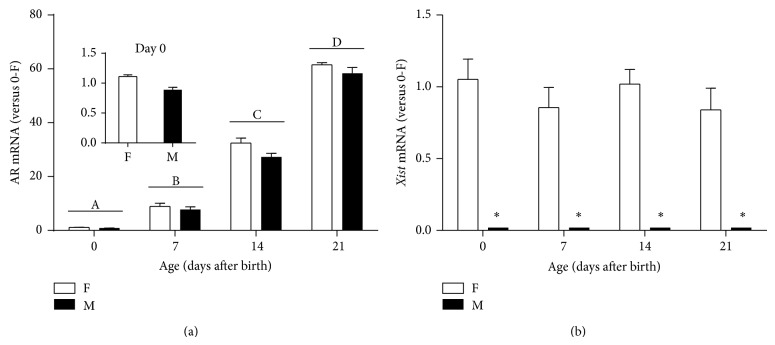
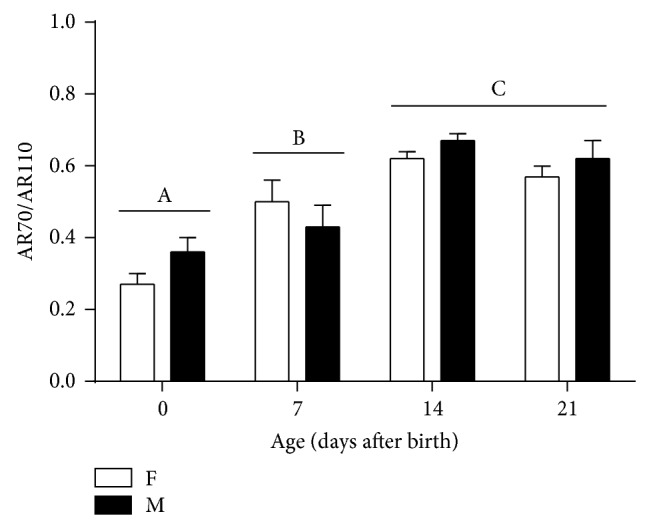
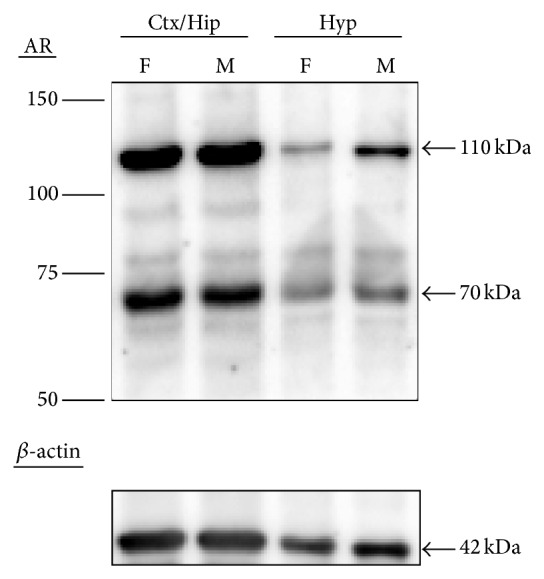
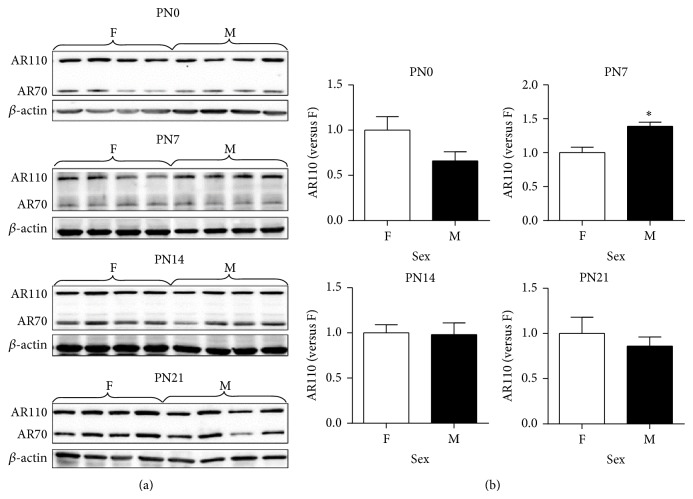
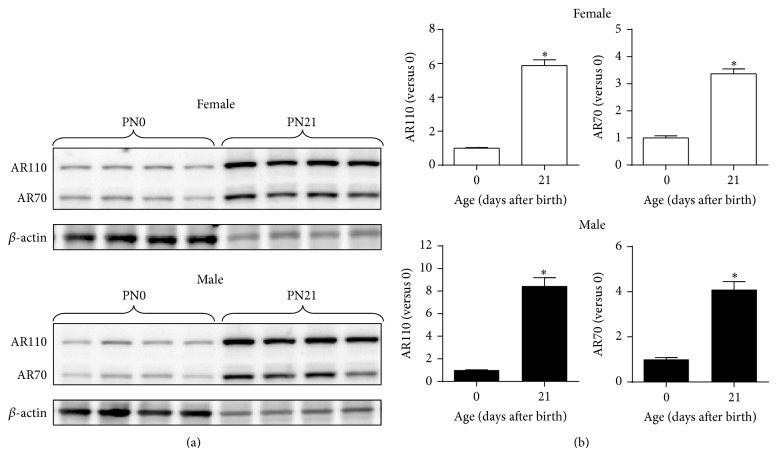
During the perinatal period, male mice are exposed to higher levels of testosterone (T) than females, which promotes sexual dimorphism in their brain structures and behaviors. In addition to acting via estrogen receptors after being locally converted into estradiol by aromatase, T also acts directly through androgen receptor (AR) in the brain. Therefore, we hypothesized that AR expression in the developing mouse cortex and hippocampus was sexually dimorphic. To test our hypothesis, we measured and determined AR mRNA and protein levels in mouse cortex/hippocampus collected on the day of birth (PN0) and 7 (PN7), 14 (PN14), and 21 (PN21) days after birth. We demonstrated that, as age advanced, AR mRNA levels increased in the cortex/hippocampus of both sexes but showed no sex difference. Two AR proteins, the full-length (110 kDa) and a smaller isoform (70 kDa), were detected in the developing mouse cortex/hippocampus with an age-dependent increase in protein levels of both AR isoforms at PN21 and a transient masculine increase in expression of the full-length AR protein on PN7. Thus, we conclude that the postnatal age and sex differences in AR protein expression in combination with the sex differences in circulating T may cause sexual differentiation of the mouse cortex/hippocampus.
在围产期,雄性小鼠接触到的睾酮(T)水平高于雌性,这促进了它们大脑结构和行为的性二态性。除了通过芳香化酶局部转化为雌二醇后经由雌激素受体发挥作用外,T还直接通过大脑中的雄激素受体(AR)起作用。因此,我们假设发育中小鼠的皮质和海马体中的AR表达存在性二态性。为了验证我们的假设,我们测量并确定了出生当天(PN0)以及出生后7天(PN7)、14天(PN14)和21天(PN21)收集的小鼠皮质/海马体中AR的mRNA和蛋白质水平。我们证明,随着年龄增长,两性皮质/海马体中的AR mRNA水平均升高,但无性别差异。在发育中小鼠的皮质/海马体中检测到两种AR蛋白,即全长(110 kDa)和较小的异构体(70 kDa),两种AR异构体的蛋白质水平在PN21时随年龄增加,且全长AR蛋白在PN7时出现短暂的雄性增加表达。因此,我们得出结论,出生后AR蛋白表达的年龄和性别差异与循环T的性别差异相结合,可能导致小鼠皮质/海马体的性分化。