Schmidt Robert L, Walker Brandon S, Cohen Michael B
Department of Pathology, University of Utah School of Medicine and ARUP Laboratories, Salt Lake City, Utah, United States of America.
ARUP Laboratories, Salt Lake City, Utah, United States of America.
PLoS One. 2015 Aug 28;10(8):e0135466. doi: 10.1371/journal.pone.0135466. eCollection 2015.
Rapid on-site evaluation (ROSE) can improve adequacy rates of fine-needle aspiration biopsy (FNAB) but increases operational costs. The performance of ROSE relative to fixed sampling depends on many factors. It is not clear when ROSE is less costly than sampling with a fixed number of needle passes. The objective of this study was to determine the conditions under which ROSE is less costly than fixed sampling.
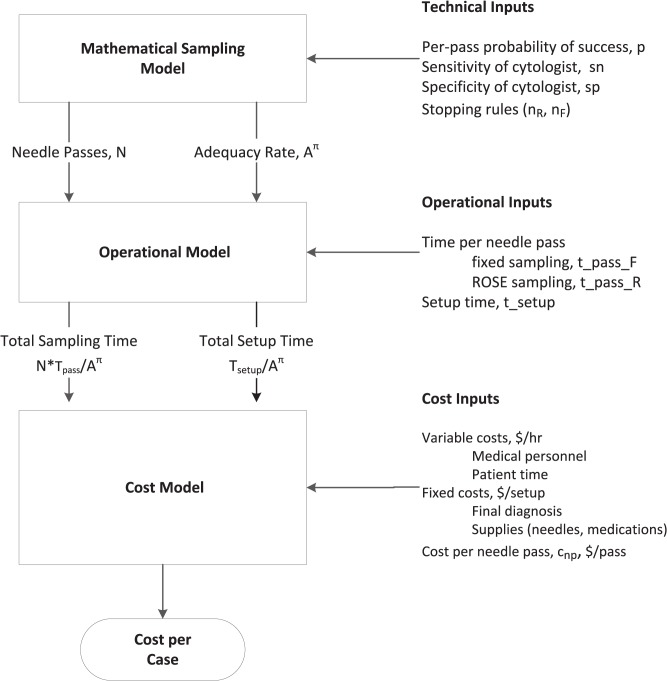
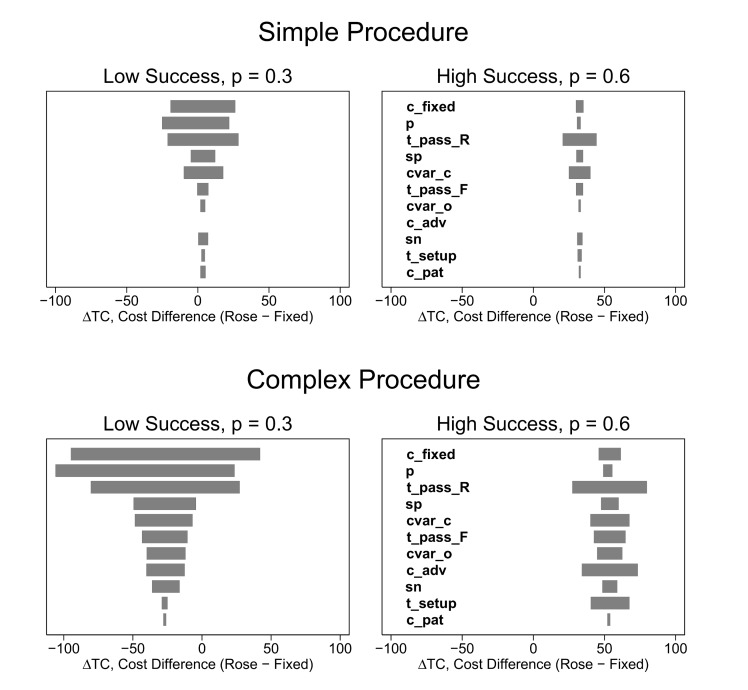
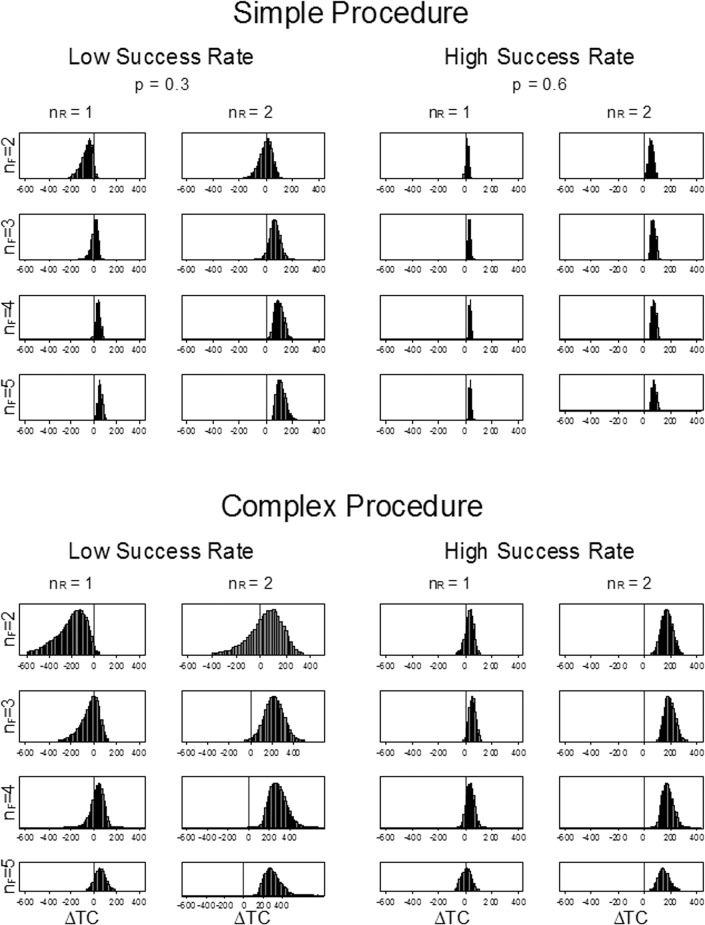
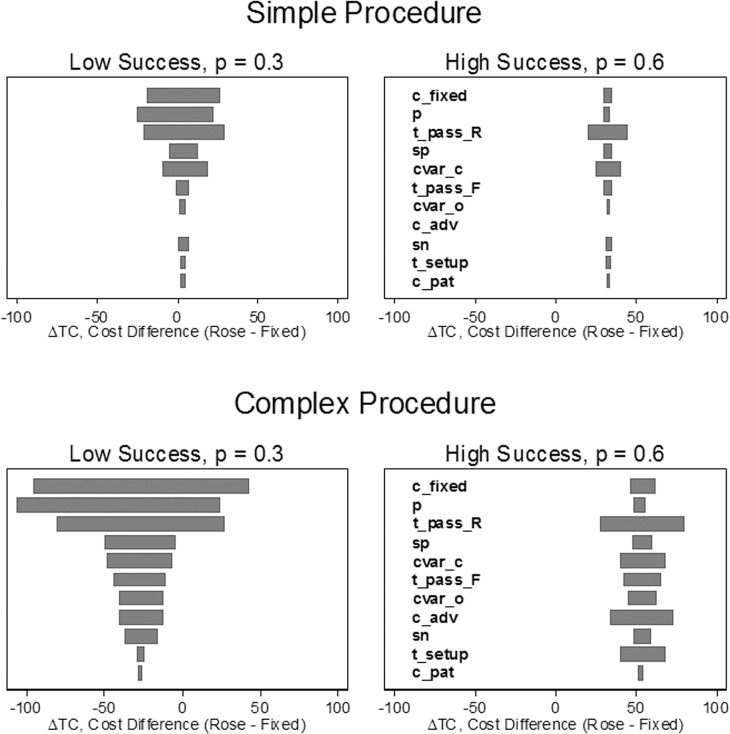
Cost comparison of sampling with and without ROSE using mathematical modeling. Models were based on a societal perspective and used a mechanistic, micro-costing approach. Sampling policies (ROSE, fixed) were compared using the difference in total expected costs per case. Scenarios were based on procedure complexity (palpation-guided or image-guided), adequacy rates (low, high) and sampling protocols (stopping criteria for ROSE and fixed sampling). One-way, probabilistic, and scenario-based sensitivity analysis was performed to determine which variables had the greatest influence on the cost difference.
ROSE is favored relative to fixed sampling under the following conditions: (1) the cytologist is accurate, (2) the total variable cost ($/hr) is low, (3) fixed costs ($/procedure) are high, (4) the setup time is long, (5) the time between needle passes for ROSE is low, (6) when the per-pass adequacy rate is low, and (7) ROSE stops after observing one adequate sample. The model is most sensitive to variation in the fixed cost, the per-pass adequacy rate, and the time per needle pass with ROSE.
Mathematical modeling can be used to predict the difference in cost between sampling with and without ROSE.
快速现场评估(ROSE)可提高细针穿刺活检(FNAB)的取材成功率,但会增加手术成本。ROSE相对于固定采样的表现取决于许多因素。目前尚不清楚ROSE何时比固定针数采样成本更低。本研究的目的是确定ROSE比固定采样成本更低的条件。
采用数学建模对有和没有ROSE的采样进行成本比较。模型基于社会视角,采用机械微观成本核算方法。使用每例病例的总预期成本差异比较采样策略(ROSE、固定采样)。场景基于操作复杂性(触诊引导或图像引导)、取材成功率(低、高)和采样方案(ROSE和固定采样的停止标准)。进行单向、概率和基于场景的敏感性分析,以确定哪些变量对成本差异影响最大。
在以下条件下,相对于固定采样,ROSE更具优势:(1)细胞病理学家准确;(2)总可变成本($/小时)低;(3)固定成本($/操作)高;(4)设置时间长;(5)ROSE每次进针之间的时间短;(6)每次进针的取材成功率低;(7)ROSE在观察到一个足够样本后停止。该模型对固定成本、每次进针的取材成功率和ROSE每次进针时间的变化最为敏感。
数学建模可用于预测有和没有ROSE采样之间的成本差异。