Wang Jiangang, Song Shiqiu, Xie Changqing, Han Jie, Li Yan, Shi Jiahai, Xin Meng, Wang Jun, Luo Tiange, Meng Xu, Yang Bo
Department of Cardiac Surgery, Beijing Anzhen Hospital, Capital Medical University, Beijing, 100029, P.R. China.
Department of Internal Medicine, Vidant Medical Center, Broody School of Medicine, East Carolina University, Greenville, North Carolina, 27834, USA.
BMC Cardiovasc Disord. 2015 Aug 29;15:97. doi: 10.1186/s12872-015-0085-2.
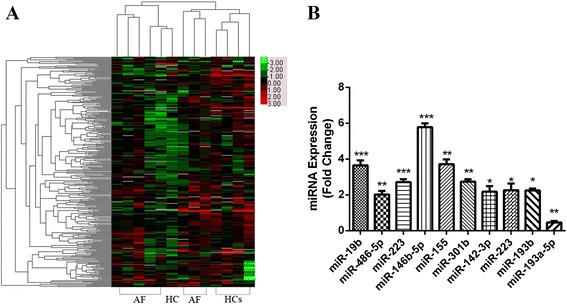
We aimed to identify the miRNA expression profiles in left atrial appendage, with the intention of identifying miRNAs that were significantly associated with non-valvular paroxysmal AF.
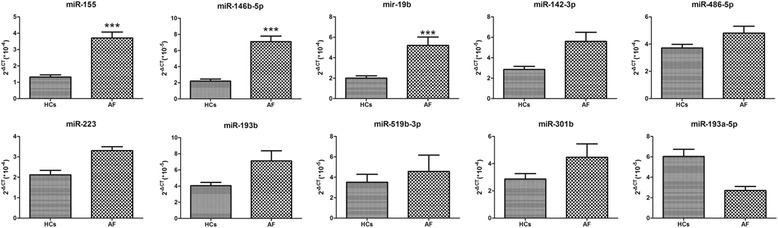
The RNA samples were isolated from healthy controls (n = 5) and patients with atrial fibrillation (n = 8). To confirm the findings obtained by analyzing the miRNA profile, we measured the expression of selected miRNAs in the entire cohort by quantitative PCR.
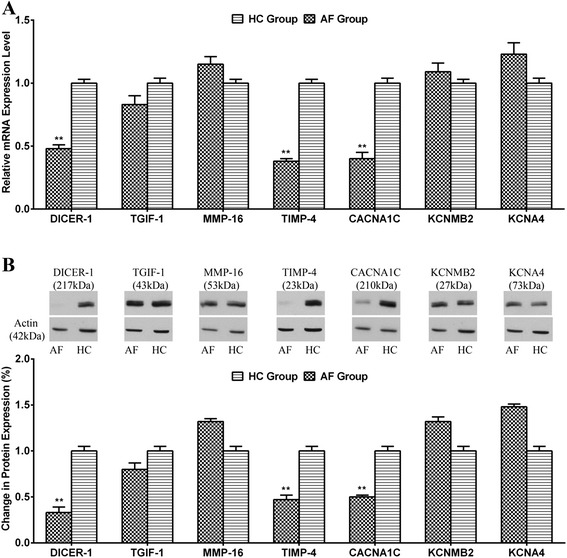
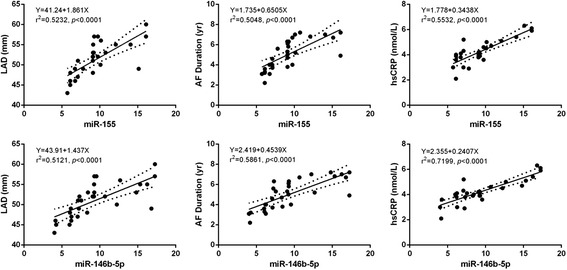
Ten specific miRNAs were found to be differentially expressed between atrial fibrillation and healthy controls with more than a 2-fold change (P < 0.05). Consistent with the data obtained for the profile, expression levels of miRNA-155, miRNA-146b-5p and miRNA-19b were significantly increased in patients with atrial fibrillation. Interestingly, levels of miRNA-146b-5p and miRNA-155, which are known to be associated with inflammation, were independently and positively associated with left atrium dimension, atrial fibrillation duration and high sensitivity C-reactive protein levels. By using four Databases (TargetScan, miRanda, Starbase Clip-seq and miRDB) to perform target gene prediction, there were four genes were related to the inflammatory response and fibrosis, and three others encoding cardiac ion channel proteins. As a result of TaqMan qPCR and Western analysis, the relative mRNA and protein expression level of three target genes (DIER-1, TIMP-4 and CACNA1C) were significantly lower in the atrial fibrillation group than that in the healthy control group.
Expression of inflammation-associated miRNAs is significantly up-regulated in the left atrial appendage of patients with non-valvular paroxysmal atrial fibrillation, which may play a significant role in electrical and structural remodeling.
我们旨在确定左心耳中的微小RNA(miRNA)表达谱,以识别与非瓣膜性阵发性房颤显著相关的miRNA。
从健康对照者(n = 5)和房颤患者(n = 8)中分离RNA样本。为了证实通过分析miRNA谱获得的结果,我们通过定量PCR测量了整个队列中所选miRNA的表达。
发现10种特定的miRNA在房颤患者和健康对照者之间差异表达,变化超过2倍(P < 0.05)。与miRNA谱数据一致,miRNA-155、miRNA-146b-5p和miRNA-19b在房颤患者中的表达水平显著升高。有趣的是,已知与炎症相关的miRNA-146b-5p和miRNA-155水平与左心房大小、房颤持续时间和高敏C反应蛋白水平独立且呈正相关。通过使用四个数据库(TargetScan、miRanda、Starbase Clip-seq和miRDB)进行靶基因预测,有四个基因与炎症反应和纤维化相关,另外三个基因编码心脏离子通道蛋白。通过TaqMan qPCR和Western分析,房颤组中三个靶基因(DIER-1、TIMP-4和CACNA1C) 的相对mRNA和蛋白表达水平显著低于健康对照组。
非瓣膜性阵发性房颤患者左心耳中炎症相关miRNA的表达显著上调,这可能在电重构和结构重构中起重要作用。