Seaman Kendra L, Stillman Chelsea M, Howard Darlene V, Howard James H
Department of Psychology, The Catholic University of America Washington, DC, USA.
Department of Psychology, Georgetown University Washington, DC, USA.
Front Psychol. 2015 Aug 11;6:1192. doi: 10.3389/fpsyg.2015.01192. eCollection 2015.
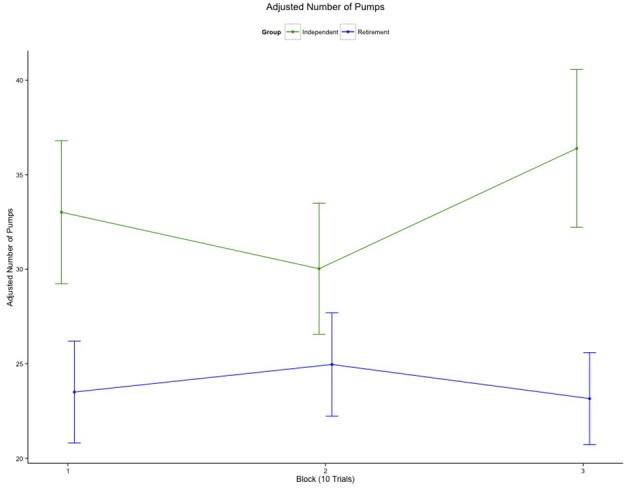
As our society becomes more mobile and people reside farther away from their immediate families, competent decision-making has become critical for the older adults wishing to maintain their independence. However, very little is known about the relationship between residential choice and decision-making. Here we use the Balloon Analog Risk Task (BART) to examine risk-taking in two samples of older adults, one living in a retirement community and another living independently. We also used a cognitive model to gain insight into the cognitive factors underlying decision-making in these groups. We found that older adults living in a retirement community were more risk averse than their independent counterparts. Furthermore, this difference appeared to be motivated by group differences in initial perception of risk. This study suggests an intriguing difference between these two residential groups, and also points to the utility of using laboratory methods in research on real-world problems.
随着我们的社会变得更加流动性,人们居住得离直系亲属更远,对于希望保持独立的老年人来说,做出明智的决策变得至关重要。然而,关于居住选择与决策之间的关系,我们所知甚少。在此,我们使用气球模拟风险任务(BART)来研究两组老年人的冒险行为,一组居住在退休社区,另一组独立生活。我们还使用了一种认知模型来深入了解这些群体决策背后的认知因素。我们发现,居住在退休社区的老年人比独立生活的老年人更厌恶风险。此外,这种差异似乎是由对风险的初始认知上的群体差异所驱动的。这项研究揭示了这两个居住群体之间一个有趣的差异,也指出了在研究现实世界问题时使用实验室方法的实用性。