Turini Marco, Piovesana Vittoria, Ruffo Pierfrancesco, Ripellino Claudio, Cataldo Nazarena
Helsinn Healthcare SA, Lugano/Pazzallo, Switzerland;
IMS Health Information Solutions Medical Research srl, Milan, Italy.
Drugs Context. 2015 Jul 28;4:212285. doi: 10.7573/dic.212285. eCollection 2015.
chemotherapy-induced nausea and vomiting (CINV) has been commonly reported as one of the most distressing adverse effects among treated patients with cancer. Inadequately treated, CINV can lead to increased resource utilization and severely impair patients' daily functioning and quality of life. Direct costs include acquisition cost of antiemetic drugs and rescue medication, administration devices, add-on treatments, such as hydration, and additional patient care, that is, nursing and physician time, unscheduled office visits, emergency room admissions, and, in some cases, extended hospitalization or readmission. There are many reports on the cost-effectiveness of antiemetic drugs, but information on the total cost per patient associated with CINV is limited. The costs associated with severe CINV episodes are considered responsible for the most significant part of the expenditures.
The aim of this study was to investigate the management of CINV episodes in three European health-care environments and to estimate direct costs associated with severe CINV episodes.
An online survey addressed to Italian, German, and French oncologists and oncology nurses was performed. The survey included 41 questions about the management and the resource utilization for patients experiencing any CINV episode during the 6-month period preceding the survey. Furthermore, the cost associated with severe CINV episode management was estimated by adopting the National Health Service's perspective.
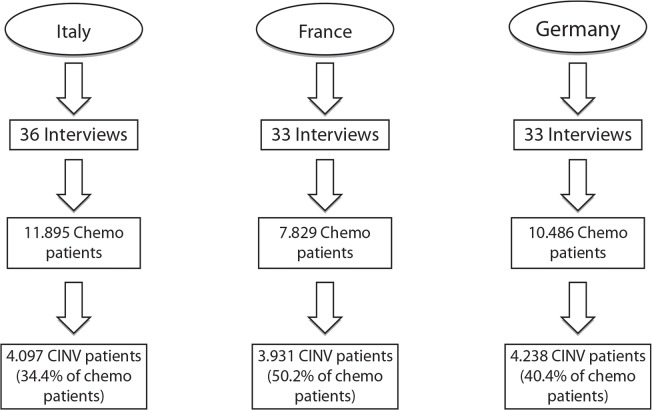
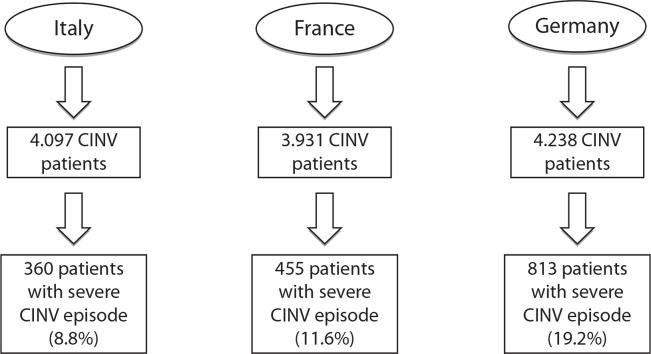
A large proportion of patients receiving chemotherapy experienced a CINV episode (34.4% in Italy, 50.2% in France, and 40.4% in Germany); among those, 8.8% in Italy, 11.6% in France, and 19.2% in Germany experienced a severe CINV episode. Compared with Italy, Germany and France presented a greater hospitalization rate following an unplanned visit to the oncology ward or an emergency room access due to CINV. In Italy, the mean cost per patient with a severe CINV episode resulted in approximately €389, about half of the mean cost in France (€750) and a third of the mean cost in Germany (€1,017).
Severe CINV episodes requiring hospitalization, day hospital, or hospitalization extension involve a significant cost for the National Health Services; additional studies should be conducted in order to evaluate potential ways to offset these expenses.
化疗引起的恶心和呕吐(CINV)是癌症治疗患者中最令人痛苦的不良反应之一。若治疗不当,CINV会导致资源利用增加,并严重损害患者的日常功能和生活质量。直接成本包括止吐药和救援药物的购置成本、给药装置、附加治疗(如补液)以及额外的患者护理,即护理和医生的时间、非计划的门诊就诊、急诊入院,在某些情况下还包括延长住院时间或再次入院。关于止吐药成本效益的报道很多,但与CINV相关的每位患者总费用的信息有限。与严重CINV发作相关的成本被认为是支出的最重要部分。
本研究的目的是调查欧洲三个医疗环境中CINV发作的管理情况,并估计与严重CINV发作相关的直接成本。
对意大利、德国和法国的肿瘤学家和肿瘤护理人员进行了一项在线调查。该调查包括41个关于在调查前6个月内经历任何CINV发作的患者的管理和资源利用情况的问题。此外,采用国民保健制度的视角估计了与严重CINV发作管理相关的成本。
接受化疗的患者中很大一部分经历了CINV发作(意大利为34.4%,法国为50.2%,德国为40.4%);其中,意大利为8.8%,法国为11.6%,德国为19.2%经历了严重CINV发作。与意大利相比,德国和法国因CINV计划外前往肿瘤病房就诊或进入急诊室后的住院率更高。在意大利,严重CINV发作患者的平均费用约为389欧元,约为法国平均费用(750欧元)的一半,德国平均费用(1017欧元)的三分之一。
需要住院、日间医院治疗或延长住院时间的严重CINV发作给国民保健制度带来了巨大成本;应进行更多研究以评估抵消这些费用的潜在方法。