Matsubara Keiko, Kagami Masayo, Nakabayashi Kazuhiko, Hata Kenichiro, Fukami Maki, Ogata Tsutomu, Yamazawa Kazuki
Department of Molecular Endocrinology, National Research Institute for Child Health and Development, 2-10-1 Okura, Setagaya, Tokyo 157-8535 Japan.
Department of Maternal-Fetal Biology, National Research Institute for Child Health and Development, 2-10-1 Okura, Setagaya, Tokyo 157-8535 Japan.
Clin Epigenetics. 2015 Aug 28;7(1):90. doi: 10.1186/s13148-015-0124-y. eCollection 2015.
5-Hydroxymethylcytosine (5hmC), converted from 5-methylcytosine (5mC) by ten-eleven translocation (Tet) enzymes, has recently drawn attention as the "sixth base" of DNA since it is considered an intermediate of the demethylation pathway. Nonetheless, it remains to be addressed how 5hmC is linked to the development of human imprinting disorders. In this regard, conventional bisulfite (BS) treatment is unable to differentiate 5hmC from 5mC. It is thus hypothesized that BS conversion-derived "hypermethylation" at imprinting control regions (ICRs), which may cause imprinting disorders, would in fact be attributable to excessively increased levels of 5hmC as well as 5mC. To test this hypothesis, we applied the newly developed oxidative BS (oxBS) treatment to detect 5hmC in blood samples from Kagami-Ogata syndrome (KOS14) patients caused by an epimutation (hypermethylation) of two differentially methylated regions (DMRs) functioning as ICRs, namely, IG-DMR and MEG3-DMR.
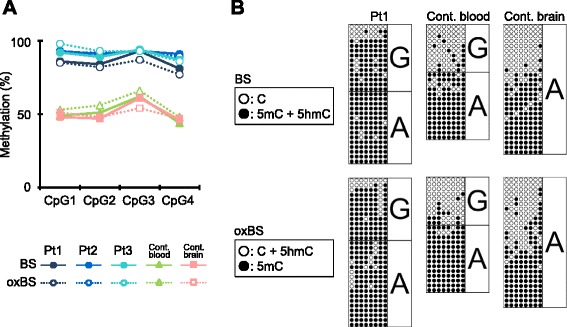
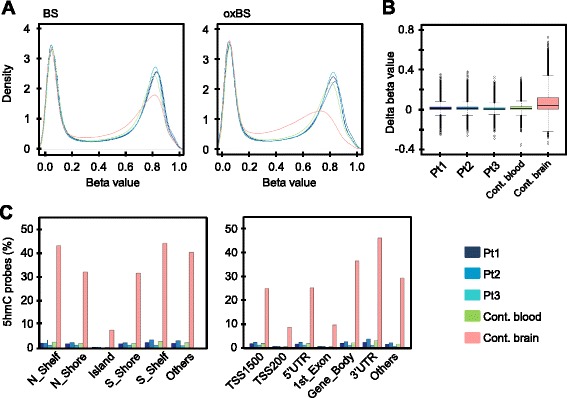
oxBS with pyrosequencing revealed that there were few amounts of 5hmC at the hypermethylated IG-DMR and MEG3-DMR in blood samples from KOS14 patients. oxBS with genome-wide methylation array demonstrated that global levels of 5hmC were very low with similar distribution patterns in blood samples from KOS14 patients and normal controls. We also confirmed the presence of large amounts of 5hmC in the brain sample from a normal control.
5hmC is not a major component in abnormally hypermethylated ICRs or at a global level, at least in blood from KOS14 patients. As the brain sample contained large amounts of 5hmC, the neural tissues of KOS14 patients are promising candidates for analysis in elucidating the role of 5hmC in the neurodevelopmental context.
5-羟甲基胞嘧啶(5hmC)由5-甲基胞嘧啶(5mC)经Tet酶转化而来,因其被认为是去甲基化途径的中间产物,近来作为DNA的“第六碱基”受到关注。然而,5hmC如何与人类印记紊乱的发生相关仍有待阐明。在这方面,传统的亚硫酸氢盐(BS)处理无法区分5hmC和5mC。因此推测,印记控制区(ICR)处由BS转化导致的“高甲基化”(可能引发印记紊乱)实际上可能归因于5hmC以及5mC水平的过度升高。为验证这一假设,我们应用新开发的氧化亚硫酸氢盐(oxBS)处理方法,检测了由两个作为ICR的差异甲基化区域(DMR)即IG-DMR和MEG3-DMR的表观突变(高甲基化)导致的加贺-绪方综合征(KOS14)患者血液样本中的5hmC。
焦磷酸测序法检测oxBS显示,KOS14患者血液样本中高甲基化的IG-DMR和MEG3-DMR处5hmC含量极少。全基因组甲基化芯片检测oxBS表明,KOS14患者血液样本中5hmC的整体水平非常低,且与正常对照具有相似的分布模式。我们还证实了正常对照的脑样本中存在大量5hmC。
至少在KOS14患者的血液中,5hmC不是异常高甲基化ICR或整体水平的主要成分。由于脑样本中含有大量5hmC,KOS14患者的神经组织有望成为阐明5hmC在神经发育背景下作用的分析对象。