Graham Uschi M, Tseng Michael T, Jasinski Jacek B, Yokel Robert A, Unrine Jason M, Davis Burtron H, Dozier Alan K, Hardas Sarita S, Sultana Rukhsana, Grulke Eric A, Butterfield D Allan
Center for Applied Energy Research and Catalysis Research and Testing Center, University of Kentucky, 2540 Research Park Drive, Lexington, KY 40511 (USA).
Department of Anatomical Sciences and Neurobiology, University of Louisville, Louisville, KY 40204 (USA).
Chempluschem. 2014 Aug;79(8):1083-1088. doi: 10.1002/cplu.201402080.
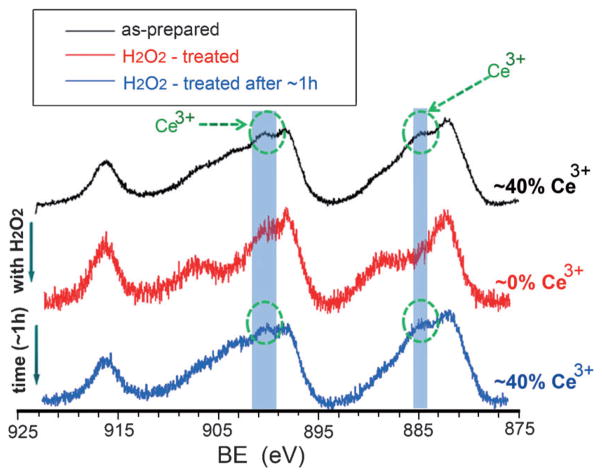
The cytotoxicity of ceria ultimately lies in its electronic structure, which is defined by the crystal structure, composition, and size. Despite previous studies focused on ceria uptake, distribution, biopersistance, and cellular effects, little is known about its chemical and structural stability and solubility once sequestered inside the liver. Mechanisms will be presented that elucidate the in vivo transformation in the liver. In vivo processed ceria reveals a particle-size effect towards the formation of ultrafines, which represent a second generation of ceria. A measurable change in the valence reduction of the second-generation ceria can be linked to an increased free-radical scavenging potential. The in vivo processing of the ceria nanoparticles in the liver occurs in temporal relation to the brain cellular and protein clearance responses that stem from the ceria uptake. This information is critical to establish a possible link between cellular processes and the observed in vivo transformation of ceria. The temporal linkage between the reversal of the pro-oxidant effect (brain) and ceria transformation (liver) suggests a cause-effect relationship.
二氧化铈的细胞毒性最终取决于其电子结构,而电子结构由晶体结构、组成和尺寸决定。尽管先前的研究聚焦于二氧化铈的摄取、分布、生物持久性和细胞效应,但对于其一旦被肝脏摄取后的化学和结构稳定性及溶解性却知之甚少。本文将阐述肝脏内体内转化的机制。体内处理后的二氧化铈显示出对超细颗粒形成的粒径效应,这些超细颗粒代表了第二代二氧化铈。第二代二氧化铈价态还原的可测量变化与自由基清除潜力的增加有关。肝脏中二氧化铈纳米颗粒的体内处理与源于二氧化铈摄取的大脑细胞和蛋白质清除反应在时间上相关。这些信息对于建立细胞过程与观察到的二氧化铈体内转化之间的可能联系至关重要。促氧化作用(大脑)的逆转与二氧化铈转化(肝脏)之间的时间联系表明存在因果关系。