Alexander Justine S, Gopalaswamy Arjun M, Shi Kun, Riordan Philip
The Wildlife Institute, School of Nature Conservation, Beijing Forestry University, Beijing, China.
Wildlife Conservation Research Unit, Recanati-Kaplan Centre, Department of Zoology, University of Oxford, Tubney, Abingdon, United Kingdom.
PLoS One. 2015 Aug 31;10(9):e0134815. doi: 10.1371/journal.pone.0134815. eCollection 2015.
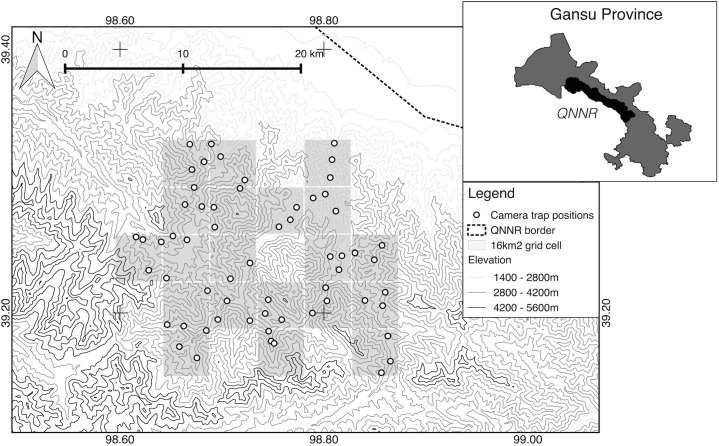
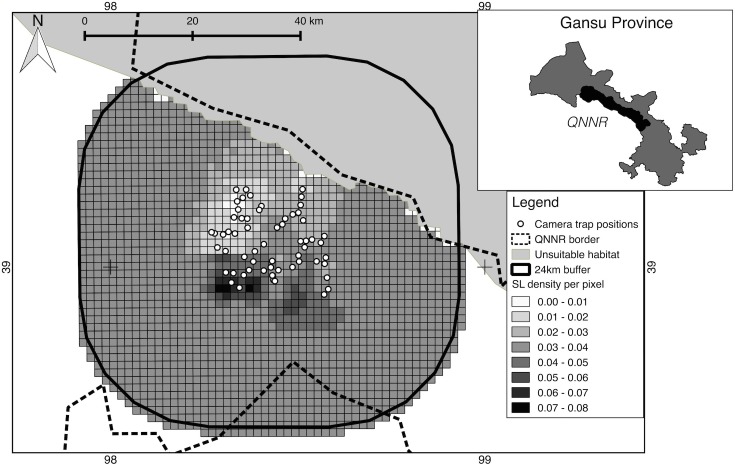
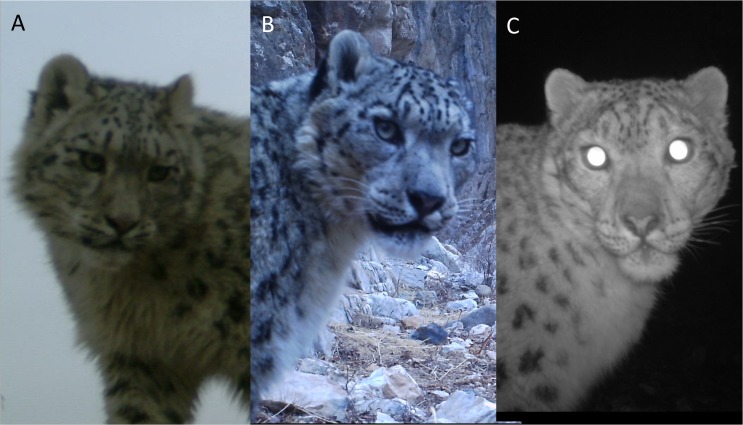
When densities of large carnivores fall below certain thresholds, dramatic ecological effects can follow, leading to oversimplified ecosystems. Understanding the population status of such species remains a major challenge as they occur in low densities and their ranges are wide. This paper describes the use of non-invasive data collection techniques combined with recent spatial capture-recapture methods to estimate the density of snow leopards Panthera uncia. It also investigates the influence of environmental and human activity indicators on their spatial distribution. A total of 60 camera traps were systematically set up during a three-month period over a 480 km2 study area in Qilianshan National Nature Reserve, Gansu Province, China. We recorded 76 separate snow leopard captures over 2,906 trap-days, representing an average capture success of 2.62 captures/100 trap-days. We identified a total number of 20 unique individuals from photographs and estimated snow leopard density at 3.31 (SE = 1.01) individuals per 100 km2. Results of our simulation exercise indicate that our estimates from the Spatial Capture Recapture models were not optimal to respect to bias and precision (RMSEs for density parameters less or equal to 0.87). Our results underline the critical challenge in achieving sufficient sample sizes of snow leopard captures and recaptures. Possible performance improvements are discussed, principally by optimising effective camera capture and photographic data quality.
当大型食肉动物的密度降至特定阈值以下时,可能会引发显著的生态效应,导致生态系统过度简化。由于这些物种密度低且分布范围广,了解它们的种群状况仍然是一项重大挑战。本文描述了如何使用非侵入性数据收集技术,并结合最新的空间捕获-重捕方法来估计雪豹(Panthera uncia)的密度。同时,还研究了环境和人类活动指标对其空间分布的影响。在中国甘肃省祁连山国家级自然保护区,一个面积为480平方公里的研究区域内,在三个月的时间里系统地设置了60个相机陷阱。在2906个陷阱日中,我们记录到76次单独的雪豹捕获事件,平均捕获成功率为每100个陷阱日2.62次捕获。我们从照片中识别出总共20只独特的个体,并估计雪豹密度为每100平方公里3.31只(标准误差=1.01)。我们模拟实验的结果表明,我们从空间捕获-重捕模型得出的估计值在偏差和精度方面并非最优(密度参数的均方根误差小于或等于0.87)。我们的结果突显了在获取足够数量的雪豹捕获和重捕样本方面所面临的严峻挑战。文中讨论了可能的性能改进方法,主要是通过优化相机的有效捕获能力和照片数据质量。