Zhang Junren, Ang Mu Liang, Kwek Ernest Beng Kee
Department of Orthopedic Surgery, Tan Tock Seng Hospital, Singapore, Republic of Singapore.
Geriatr Orthop Surg Rehabil. 2015 Sep;6(3):168-72. doi: 10.1177/2151458515583111.
Femoral neck fractures in elderly patients result in significant reduction in mobility. Deconditioning takes place quickly without early ambulation postsurgery. A recent Cochrane review found inconclusive evidence on the rehabilitation protocol required to effectively restore patients' prefracture mobility status. This study was conducted to determine the effects of different rehabilitation approaches on the functional and mobility outcomes of elderly patients after hip hemiarthroplasty for femoral neck fractures.
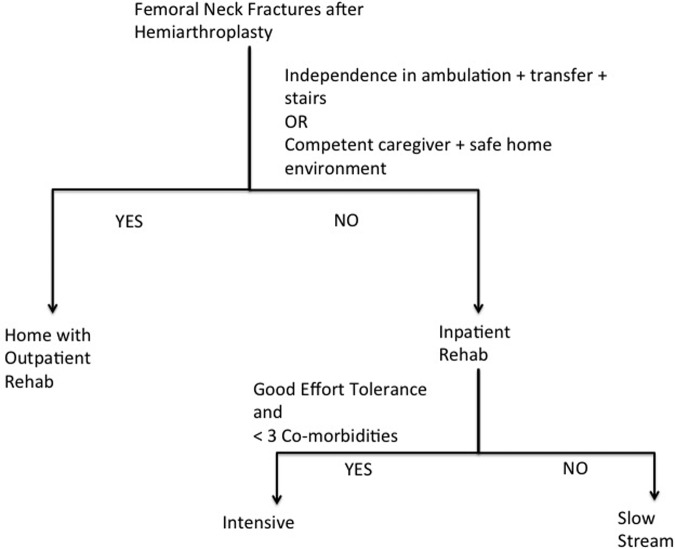
We enrolled consecutive patients aged >65 years, admitted into a tertiary orthopedic unit from January to December 2010, who had undergone hip hemiarthroplasty. They were divided into 3 cohorts: (a) home with outpatient rehabilitation, (b) intensive short rehabilitation, and (c) extended slow-stream rehabilitation. Clinical variables were collected along with outcome variables of Modified Harris Hip Score, Parker Mobility Score (PMS), and the return to near premorbid ambulatory status at 1 year (PMS decrease of ≤2).
A total of 133 patients were recruited and followed up for a year. The 3 cohorts were found to be comparable for prefall cardiovascular diseases, PMS, and Katz Index, although it was found that in the slow-stream cohort, there was a greater percentage of patients with previous cerebrovascular accidents. Patients in the intensive short rehabilitation cohort were found to have a higher proportion of patients returning to prefracture mobility, with the odds ratio of 2.3478 (95% confidence interval: 1.0667 to 5.1674; P = .042) after multivariate analysis.
Elderly patients >65 years who had undergone hemiarthroplasty would likely benefit most from an intensive inpatient rehabilitation program.
老年患者的股骨颈骨折会导致活动能力显著下降。若术后不及早进行活动,身体机能会迅速衰退。Cochrane最近的一项综述发现,关于有效恢复患者骨折前活动状态所需的康复方案,证据并不确凿。本研究旨在确定不同康复方法对老年股骨颈骨折患者行半髋关节置换术后功能和活动结果的影响。
我们纳入了2010年1月至12月在一家三级骨科病房收治的、年龄大于65岁且接受了半髋关节置换术的连续患者。他们被分为3组:(a) 居家并接受门诊康复,(b) 短期强化康复,(c) 长期慢流康复。收集临床变量以及改良Harris髋关节评分、帕克活动评分(PMS)等结果变量,以及1年后恢复至接近病前活动状态(PMS降低≤2)的情况。
共招募了133名患者并随访1年。发现3组在跌倒前心血管疾病、PMS和Katz指数方面具有可比性,不过在慢流组中,既往有脑血管意外的患者比例更高。在短期强化康复组中,发现恢复至骨折前活动状态的患者比例更高,多变量分析后的优势比为2.3478(95%置信区间:1.0667至5.1674;P = 0.042)。
65岁以上接受半髋关节置换术的老年患者可能从强化住院康复计划中获益最大。