Sucak Ayhan, Ozcan Sarp, Çelen Şevki, Çağlar Turhan, Göksu Gonca, Danışman Nuri
Department of Perinatology, Dr Zekai Tahir Burak Research and Training Hospital, Ankara, Turkey.
Department of Obstetrics and Gynecology, Acıbadem Hospital, Turan Güneş Bulvarı 630.sokak No:6 Or-an, Ankara, Turkey.
BMC Pregnancy Childbirth. 2015 Sep 2;15:202. doi: 10.1186/s12884-015-0637-6.
The present study aimed to investigate risk factors for expulsion in immediate postplacental IUD insertion. We specifically sought to determine whether cesarean delivery before or during labor have an impact on IUD expulsion.
The study included 160 pregnant women for immediate IUD insertion following vaginal or cesarean delivery. Three groups of patients were recruited: Patients who underwent pre-planned cesarean delivery (group 1, n: 51), patients who underwent cesarean delivery during active labor (group 2, n: 47), patients who delivered vaginally (group 3, n: 62).
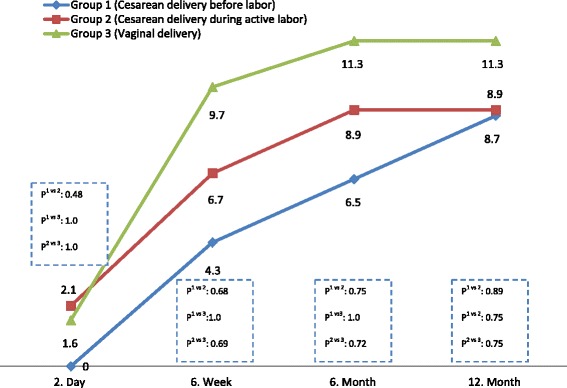
The cumulative expulsion rates were similar with a frequency of 8.7, 8.9 and 11.3% respectively in groups 1 to 3 (p > 0.05 in all pairwise comparisons). The rate of patients who had the IUD removed at 12th month was 4,3, 6.7 and 11.3% for groups 1, 2 and 3 respectively (p > 0.05 in all pairwise comparisons). Multiparity increased the risk of cumulative expulsion within 12 months by 2.1 fold (95% 1,03-4,37) in the logistic regression model. Previous vaginal deliveries or IUD use did not have an impact on the expulsion of the IUD. The risk of spontaneous expulsion was similar in patients whose IUD was placed after cesarean in the active and latent phase or after spontaneous vaginal delivery.
The rates of IUD expulsion are similar in patients who underwent cesarean section before and during labor and who delivered vaginally. Parity was the only factor independently associated with IUD expulsion.
本研究旨在调查胎盘娩出后立即放置宫内节育器(IUD)时发生排出的危险因素。我们特别试图确定剖宫产分娩发生在临产前还是产时是否会对IUD排出产生影响。
本研究纳入160例在阴道分娩或剖宫产术后立即放置IUD的孕妇。招募了三组患者:接受择期剖宫产的患者(第1组,n = 51)、在活跃期行剖宫产的患者(第2组,n = 47)、经阴道分娩的患者(第3组,n = 62)。
第1至3组的累积排出率相似,分别为8.7%、8.9%和11.3%(所有两两比较中p>0.05)。第1、2和3组在第12个月取出IUD的患者比例分别为4.3%、6.7%和11.3%(所有两两比较中p>0.05)。在逻辑回归模型中,经产妇使12个月内累积排出风险增加2.1倍(95% 1.03 - 4.37)。既往阴道分娩或使用IUD对IUD排出无影响。在活跃期和潜伏期剖宫产术后或自然阴道分娩后放置IUD的患者,其自发排出风险相似。
临产前和产时行剖宫产的患者以及经阴道分娩的患者中IUD排出率相似。产次是与IUD排出独立相关的唯一因素。