Rahimi Mehran, Vinciguerra Manlio, Daghighi Mojtaba, Özcan Behiye, Akbarkhanzadeh Vishtaseb, Sheedfar Fareeba, Amini Marzyeh, Mazza Tommaso, Pazienza Valerio, Motazacker Mahdi M, Mahmoudi Morteza, De Rooij Felix W M, Sijbrands Eric, Peppelenbosch Maikel P, Rezaee Farhad
Faculty of Medical Science, University Medical Center Groningen, University of Groningen, Groningen, The Netherlands.
Institute for Liver and Digestive Health, Division of Medicine, University College London (UCL), London, UK.
Oncotarget. 2015 Oct 6;6(30):29818-32. doi: 10.18632/oncotarget.4904.
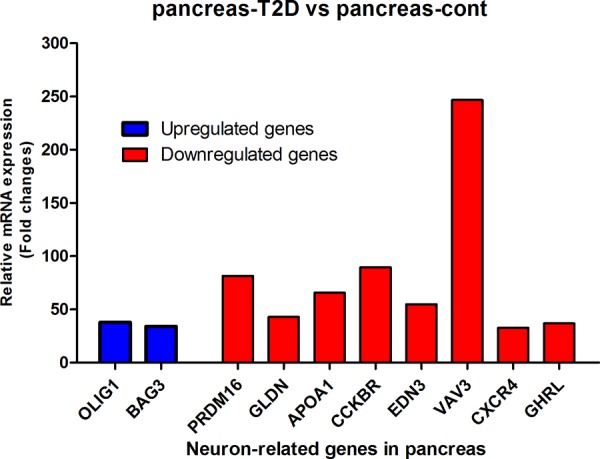
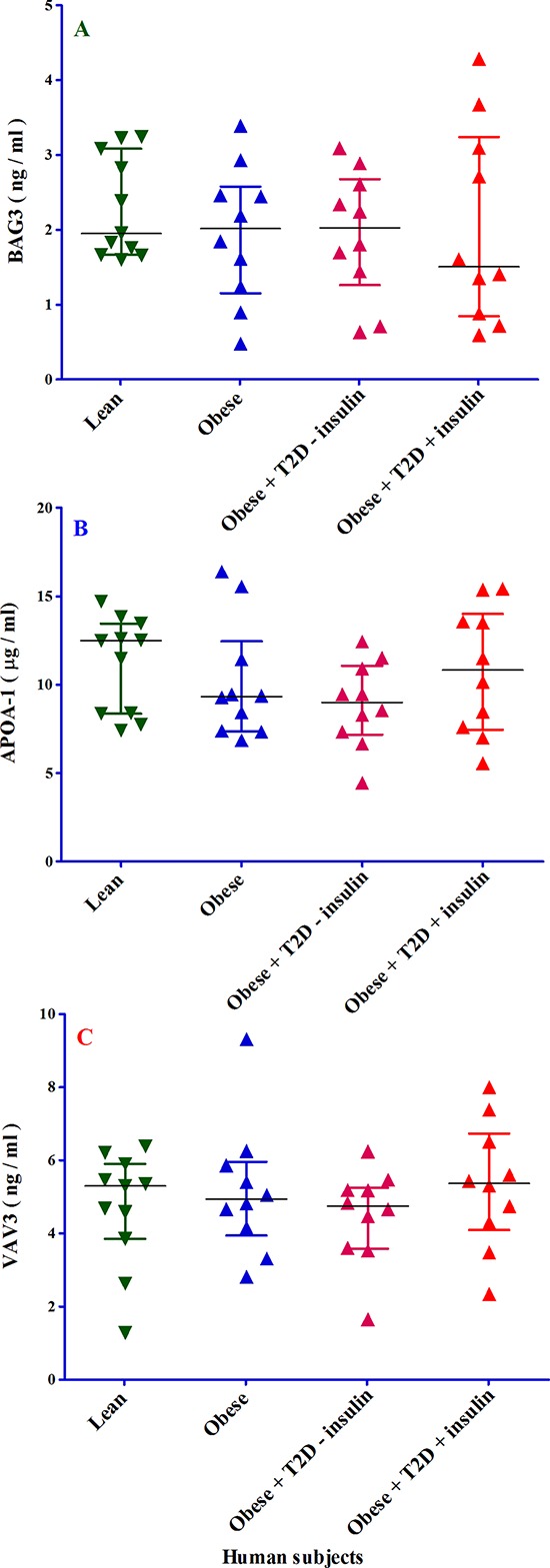
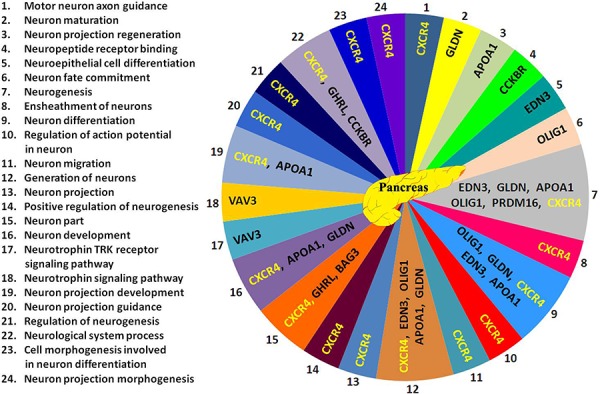
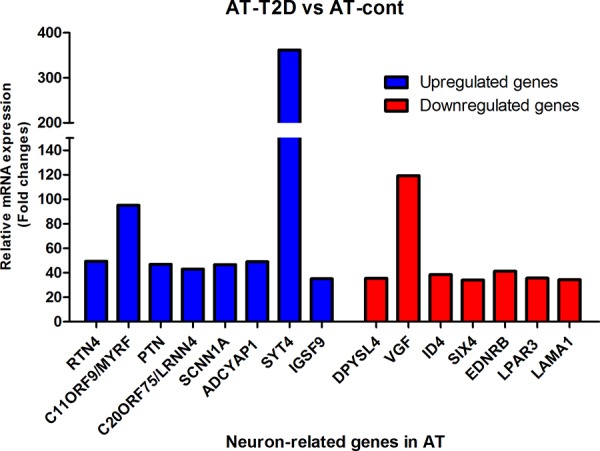
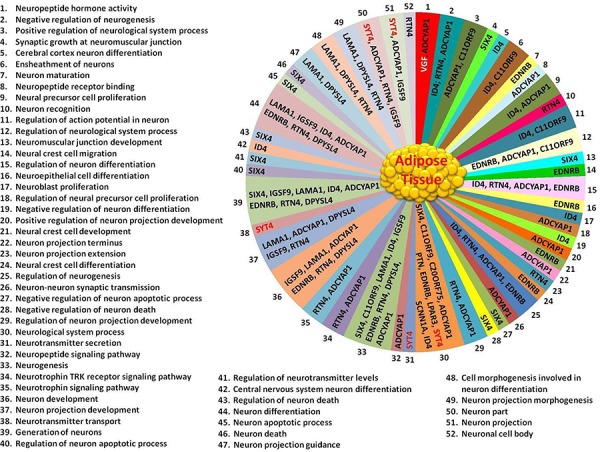
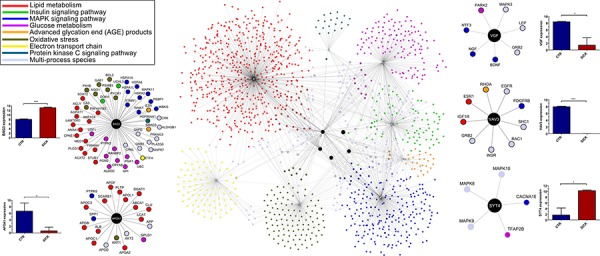
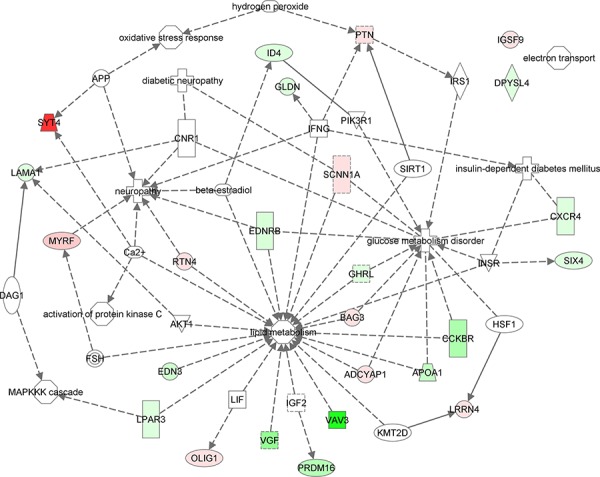
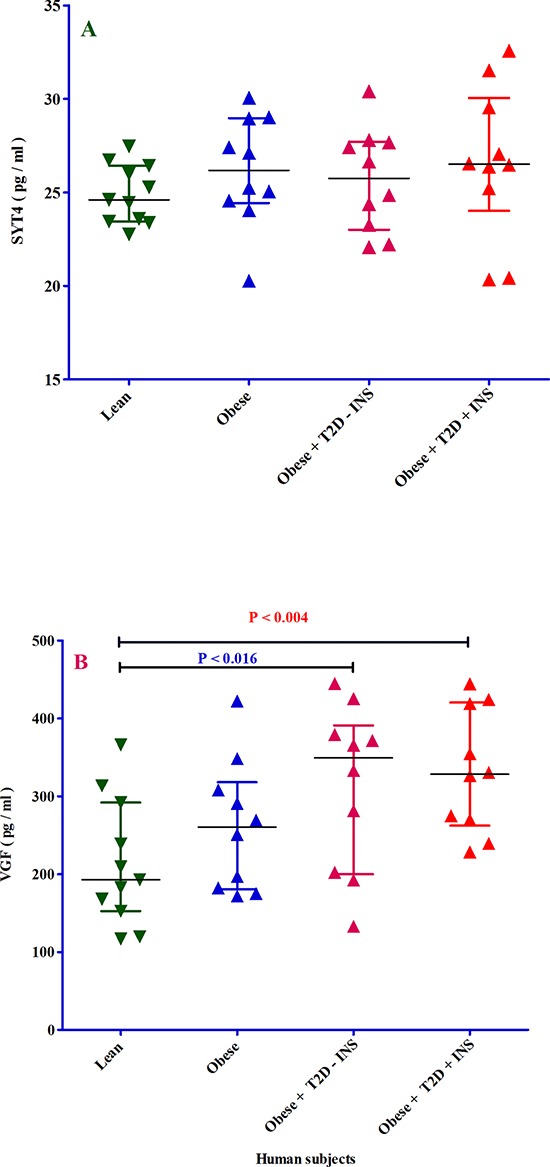
Despite numerous developed drugs based on glucose metabolism interventions for treatment of age-related diseases such as diabetes neuropathies (DNs), DNs are still increasing in patients with type 1 or type 2 diabetes (T1D, T2D). We aimed to identify novel candidates in adipose tissue (AT) and pancreas with T2D for targeting to develop new drugs for DNs therapy. AT-T2D displayed 15 (e.g. SYT4 up-regulated and VGF down-regulated) and pancreas-T2D showed 10 (e.g. BAG3 up-regulated, VAV3 and APOA1 down-regulated) highly differentially expressed genes with neuronal functions as compared to control tissues. ELISA was blindly performed to measure proteins of 5 most differentially expressed genes in 41 human subjects. SYT4 protein was upregulated, VAV3 and APOA1 were down-regulated, and BAG3 remained unchanged in 1- Obese and 2- Obese-T2D without insulin, VGF protein was higher in these two groups as well as in group 3- Obese-T2D receiving insulin than 4-lean subjects. Interaction networks analysis of these 5 genes showed several metabolic pathways (e.g. lipid metabolism and insulin signaling). Pancreas is a novel site for APOA1 synthesis. VGF is synthesized in AT and could be considered as good diagnostic, and even prognostic, marker for age-induced diseases obesity and T2D. This study provides new targets for rational drugs development for the therapy of age-related DNs.
尽管已经开发出许多基于葡萄糖代谢干预的药物用于治疗糖尿病神经病变(DNs)等与年龄相关的疾病,但1型或2型糖尿病(T1D、T2D)患者的DNs仍在增加。我们旨在确定2型糖尿病患者脂肪组织(AT)和胰腺中的新候选靶点,以开发用于DNs治疗的新药。与对照组织相比,AT-T2D显示出15个(如SYT4上调和VGF下调),胰腺-T2D显示出10个(如BAG3上调、VAV3和APOA1下调)具有神经元功能的高度差异表达基因。对41名人类受试者进行了酶联免疫吸附测定(ELISA)以检测5个差异最显著的基因的蛋白质。在1-肥胖和2-未使用胰岛素的肥胖-T2D中,SYT4蛋白上调,VAV3和APOA1下调,BAG3不变;在这两组以及3-接受胰岛素治疗的肥胖-T2D组中,VGF蛋白高于4-瘦人组。这5个基因的相互作用网络分析显示了几种代谢途径(如脂质代谢和胰岛素信号传导)。胰腺是APOA1合成的新位点。VGF在AT中合成,可被视为年龄诱导疾病肥胖和T2D的良好诊断甚至预后标志物。本研究为合理开发治疗与年龄相关的DNs的药物提供了新靶点。