Gül Ahmet, Ozdogan Huri, Erer Burak, Ugurlu Serdal, Kasapcopur Ozgur, Davis Nicole, Sevgi Serhan
Istanbul Faculty of Medicine, Department of Internal Medicine, Division of Rheumatology, 34093 Fatih, Istanbul, Turkey.
Cerrahpasa Faculty of Medicine, Department of Internal Medicine, Division of Rheumatology, Istanbul, Turkey.
Arthritis Res Ther. 2015 Sep 4;17(1):243. doi: 10.1186/s13075-015-0765-4.
This open-label pilot study aimed to investigate the efficacy of canakinumab in colchicine-resistant familial Mediterranean fever (FMF) patients.
Patients with one or more attacks in a month in the preceding 3 months despite colchicine were eligible to enter a 30-day run-in period. Patients who had an attack during the first run-in period advanced to a second 30-day period. At the first attack, patients started to receive three canakinumab 150 mg subcutaneous injections at 4-week intervals, and were then followed for an additional 2 months. Primary efficacy outcome measure was the proportion of patients with 50 % or more reduction in attack frequency. Secondary outcome measures included time to next attack following last canakinumab dose and changes in quality of life assessed by SF-36.
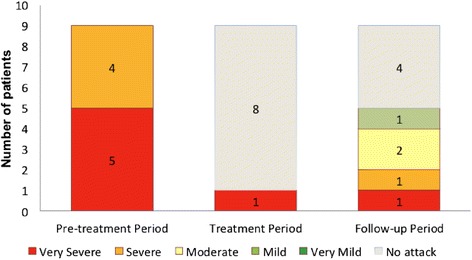
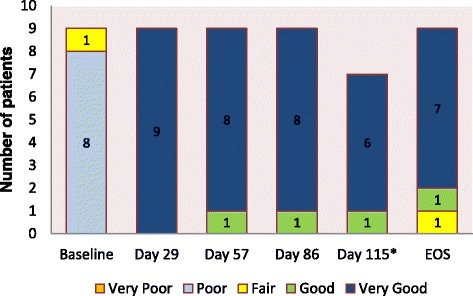
Thirteen patients were enrolled in the run-in period and 9 advanced to the treatment period. All 9 patients achieved a 50 % or more reduction in attack frequency, and only one patient had an attack during the treatment period. C-reactive protein and serum amyloid A protein levels remained low throughout the treatment period. Significant improvement was observed in both physical and mental component scores of the Short Form-36 at Day 8. Five patients had an attack during the 2-month follow-up, occurring median 71 (range, 31 to 78) days after the last dose. Adverse events were similar to those observed in the previous canakinumab trials.
Canakinumab was effective at controlling the attack recurrence in patients with FMF resistant to colchicine. Further investigations are warranted to explore canakinumab's potential in the treatment of patients with colchicine resistant FMF.
ClinicalTrials.gov NCT01088880 . Registered 16 March 2010.
本开放标签的试点研究旨在调查卡那单抗对秋水仙碱耐药的家族性地中海热(FMF)患者的疗效。
尽管服用了秋水仙碱,但在过去3个月中每月有一次或多次发作的患者有资格进入为期30天的导入期。在第一个导入期发作的患者进入第二个30天周期。在首次发作时,患者开始每4周皮下注射三次150mg卡那单抗,然后再随访2个月。主要疗效指标是发作频率降低50%或更多的患者比例。次要指标包括最后一剂卡那单抗后至下次发作的时间以及通过SF-36评估的生活质量变化。
13名患者进入导入期,9名进入治疗期。所有9名患者的发作频率均降低了50%或更多,且只有一名患者在治疗期间发作。在整个治疗期间,C反应蛋白和血清淀粉样蛋白A水平一直较低。在第8天,简短健康调查问卷-36的身体和心理成分得分均有显著改善。5名患者在2个月的随访期间发作,中位时间为最后一剂后的71天(范围31至78天)。不良事件与之前卡那单抗试验中观察到的相似。
卡那单抗对控制秋水仙碱耐药的FMF患者的发作复发有效。有必要进一步研究以探索卡那单抗在治疗秋水仙碱耐药的FMF患者中的潜力。
ClinicalTrials.gov NCT01088880。2010年3月16日注册。