Yan Chunling, He Yanlin, Xu Yuanzhong, Shu Gang, Wang Chunmei, Yang Yongjie, Saito Kenji, Xu Pingwen, Hinton Antentor Othrell, Yan Xiaofeng, Yu Likai, Wu Qi, Tso Patrick, Tong Qingchun, Xu Yong
Children's Nutrition ReseARHh Center, Department of Pediatrics, Baylor College of Medicine, Houston, Texas 77030.
Medical College of Qingdao University, Qingdao, China 266020.
Neuroendocrinology. 2016;103(5):476-488. doi: 10.1159/000439436. Epub 2015 Aug 25.
BACKGROUND/AIMS: Apolipoprotein A-IV (apoA-IV) in the brain potently suppresses food intake. However, the mechanisms underlying its anorexigenic effects remain to be identified.
We first examined the effects of apoA-IV on cellular activities in hypothalamic neurons that co-express agouti-related peptide (AgRP) and neuropeptide Y (NPY) and in neurons that express pro-opiomelanocortin (POMC). We then compared anorexigenic effects of apoA-IV in wild-type mice and in mutant mice lacking melanocortin 4 receptors (MC4Rs; the receptors of AgRP and the POMC gene product). Finally, we examined expression of apoA-IV in mouse hypothalamus and quantified its protein levels at fed versus fasted states.
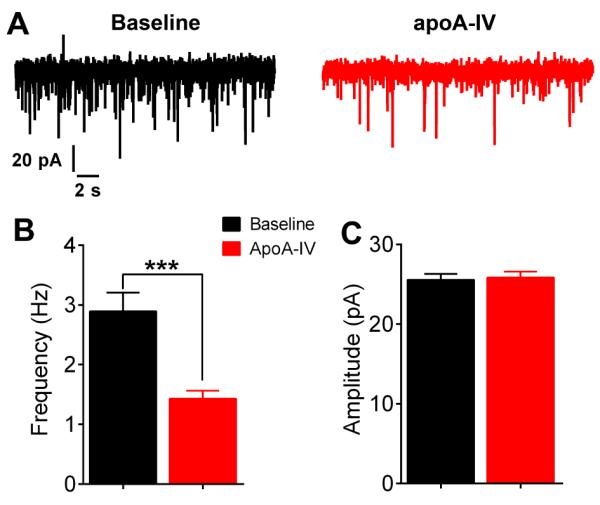
We demonstrate that apoA-IV inhibited the firing rate of AgRP/NPY neurons. The decreased firing was associated with hyperpolarized membrane potential and decreased miniature excitatory postsynaptic current. We further used c-fos immunoreactivity to show that intracerebroventricular (i.c.v.) injections of apoA-IV abolished the fasting-induced activation of AgRP/NPY neurons in mice. Further, we found that apoA-IV depolarized POMC neurons and increased their firing rate. In addition, genetic deletion of MC4Rs blocked anorexigenic effects of i.c.v. apoA-IV. Finally, we detected endogenous apoA-IV in multiple neural populations in the mouse hypothalamus, including AgRP/NPY neurons, and food deprivation suppressed hypothalamic apoA-IV protein levels.
Our findings support a model where central apoA-IV inhibits AgRP/NPY neurons and activates POMC neurons to activate MC4Rs, which in turn suppresses food intake.
背景/目的:大脑中的载脂蛋白A-IV(apoA-IV)能有效抑制食物摄入。然而,其厌食作用的潜在机制仍有待确定。
我们首先研究了apoA-IV对共表达刺鼠相关肽(AgRP)和神经肽Y(NPY)的下丘脑神经元以及表达阿黑皮素原(POMC)的神经元细胞活性的影响。然后,我们比较了apoA-IV在野生型小鼠和缺乏黑皮质素4受体(MC4Rs;AgRP和POMC基因产物的受体)的突变小鼠中的厌食作用。最后,我们检测了apoA-IV在小鼠下丘脑的表达,并对进食和禁食状态下的蛋白水平进行了定量。
我们证明apoA-IV抑制了AgRP/NPY神经元的放电频率。放电频率降低与膜电位超极化和微小兴奋性突触后电流减少有关。我们进一步利用c-fos免疫反应性表明,脑室内(i.c.v.)注射apoA-IV消除了禁食诱导的小鼠AgRP/NPY神经元的激活。此外,我们发现apoA-IV使POMC神经元去极化并增加其放电频率。此外,MC4Rs的基因缺失阻断了i.c.v. apoA-IV的厌食作用。最后,我们在小鼠下丘脑的多个神经群体中检测到内源性apoA-IV,包括AgRP/NPY神经元,食物剥夺会降低下丘脑apoA-IV蛋白水平。
我们的研究结果支持一种模型,即中枢apoA-IV抑制AgRP/NPY神经元并激活POMC神经元以激活MC4Rs,进而抑制食物摄入。