Görlach Agnes, Dimova Elitsa Y, Petry Andreas, Martínez-Ruiz Antonio, Hernansanz-Agustín Pablo, Rolo Anabela P, Palmeira Carlos M, Kietzmann Thomas
Experimental and Molecular Pediatric Cardiology, German Heart Center Munich, Technical University Munich, Germany; DZHK (German Centre for Cardiovascular Research), partner site Munich Heart Alliance, Munich, Germany.
Faculty of Biochemistry and Molecular Medicine, Biocenter Oulu, University of Oulu, Oulu, Finland.
Redox Biol. 2015 Dec;6:372-385. doi: 10.1016/j.redox.2015.08.016. Epub 2015 Aug 28.
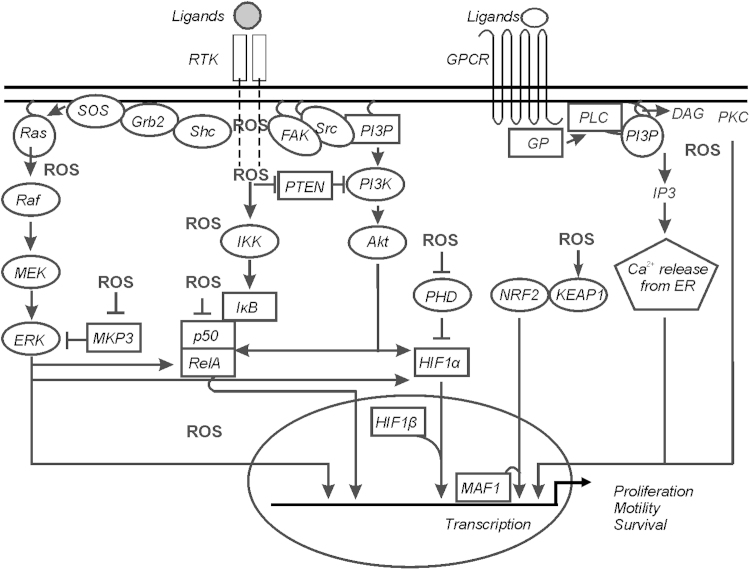
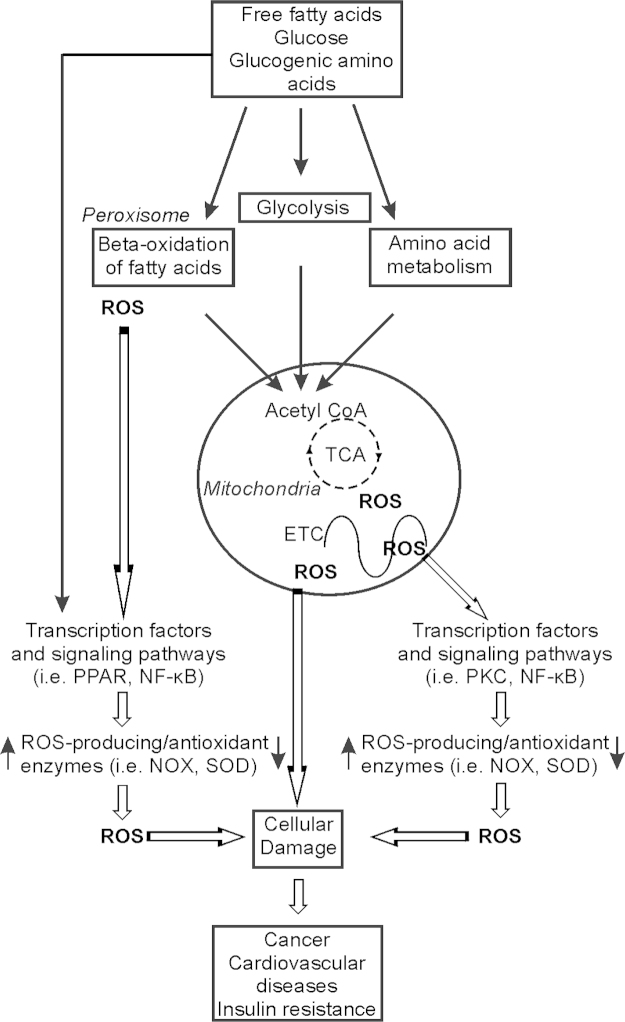
Within the last twenty years the view on reactive oxygen species (ROS) has changed; they are no longer only considered to be harmful but also necessary for cellular communication and homeostasis in different organisms ranging from bacteria to mammals. In the latter, ROS were shown to modulate diverse physiological processes including the regulation of growth factor signaling, the hypoxic response, inflammation and the immune response. During the last 60-100 years the life style, at least in the Western world, has changed enormously. This became obvious with an increase in caloric intake, decreased energy expenditure as well as the appearance of alcoholism and smoking; These changes were shown to contribute to generation of ROS which are, at least in part, associated with the occurrence of several chronic diseases like adiposity, atherosclerosis, type II diabetes, and cancer. In this review we discuss aspects and problems on the role of intracellular ROS formation and nutrition with the link to diseases and their problematic therapeutical issues.
在过去二十年中,人们对活性氧(ROS)的看法发生了变化;它们不再仅仅被认为是有害的,而且对于从细菌到哺乳动物等不同生物体的细胞通讯和体内平衡也是必需的。在后者中,ROS被证明可调节多种生理过程,包括生长因子信号传导的调节、缺氧反应、炎症和免疫反应。在过去的60至100年中,生活方式至少在西方世界发生了巨大变化。这在热量摄入增加、能量消耗减少以及酗酒和吸烟现象的出现中变得明显;这些变化被证明有助于ROS的产生,而ROS至少部分与肥胖、动脉粥样硬化、II型糖尿病和癌症等几种慢性疾病的发生有关。在这篇综述中,我们讨论了细胞内ROS形成和营养的作用方面及问题,以及它们与疾病及其治疗难题的联系。