Ge W-P, Jia J-M
Children's Research Institute, Department of Pediatrics, Department of Neuroscience, University of Texas Southwestern Medical Center, Dallas, TX 75390, USA.
Children's Research Institute, Department of Pediatrics, Department of Neuroscience, University of Texas Southwestern Medical Center, Dallas, TX 75390, USA.
Neuroscience. 2016 May 26;323:3-9. doi: 10.1016/j.neuroscience.2015.08.057. Epub 2015 Sep 4.
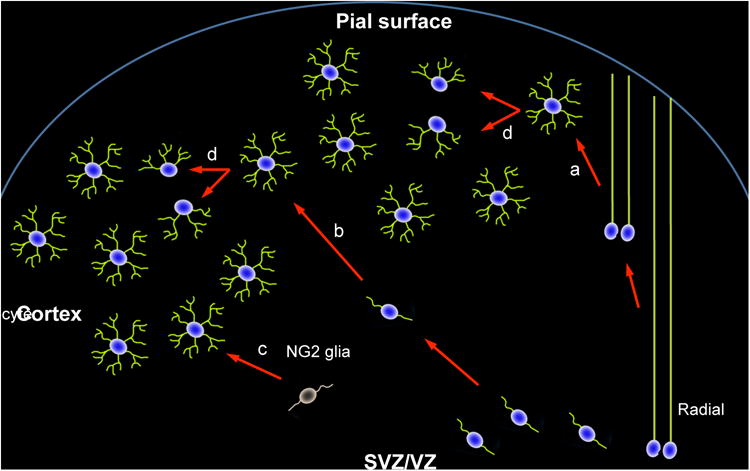
Astrocytes are the largest glial population in the mammalian brain. Astrocytes in the cerebral cortex are reportedly generated from four sources, namely radial glia, progenitors in the subventricular zone (SVZ progenitors), locally proliferating glia, and NG2 glia; it remains an open question, however, as to what extent these four cell types contribute to the substantial increase in astrocytes that occurs postnatally in the cerebral cortex. Here we summarize all possible sources of astrocytes and discuss their roles in this postnatal increase. In particular, we focus on astrocytes derived from local proliferation within the cortex.
星形胶质细胞是哺乳动物大脑中数量最多的神经胶质细胞群体。据报道,大脑皮层中的星形胶质细胞有四种来源,即放射状胶质细胞、脑室下区祖细胞(SVZ祖细胞)、局部增殖的胶质细胞和NG2胶质细胞;然而,这四种细胞类型在多大程度上导致了出生后大脑皮层中星形胶质细胞的大量增加仍是一个悬而未决的问题。在此,我们总结了星形胶质细胞所有可能的来源,并讨论它们在出生后增加过程中的作用。特别地,我们关注源自皮层内局部增殖的星形胶质细胞。