Cobbina Samuel J, Duwiejuah Abudu B, Quansah Reginald, Obiri Samuel, Bakobie Noel
Department of Ecotourism and Environmental Management, Faculty of Renewable Natural Resources, University for Development Studies, P.O. Box TL 1882, Nyankpala 233, Ghana.
School of the Environment and Safety Engineering, Jiangsu University, Xuefu Rd. 301, Zhenjiang 212013, China.
Int J Environ Res Public Health. 2015 Aug 28;12(9):10620-34. doi: 10.3390/ijerph120910620.
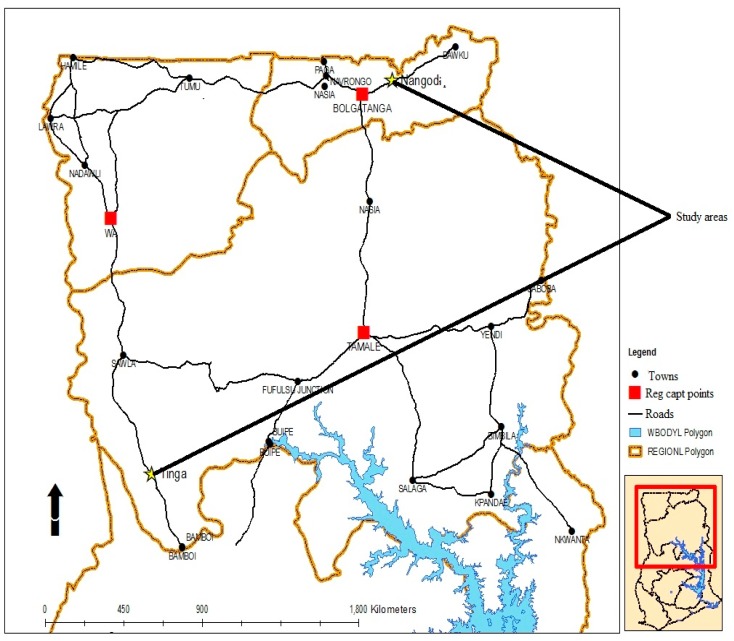
The study assessed levels of heavy metals in drinking water sources in two small-scale mining communities (Nangodi and Tinga) in northern Ghana. Seventy-two (72) water samples were collected from boreholes, hand dug wells, dug-out, and a stream in the two mining communities. The levels of mercury (Hg), arsenic (As), lead (Pb), zinc (Zn), and cadmium (Cd) were determined using an atomic absorption spectrophotometer (AAS). Mean levels (mg/l) of heavy metals in water samples from Nangodi and Tinga communities were 0.038 and 0.064 (Hg), 0.031 and 0.002 (As), 0.250 and 0.031 (Pb), 0.034 and 0.002 (Zn), and 0.534 and 0.023 (Cd), respectively, for each community. Generally, levels of Hg, As, Pb, Zn, and Cd in water from Nangodi exceeded the World Health Organisation (WHO) stipulated limits of 0.010 for Hg, As, and Pb, 3.0 for Zn and 0.003 for Cd for drinking water, and levels of Hg, Pb, and Cd recorded in Tinga, exceeded the stipulated WHO limits. Ingestion of water, containing elevated levels of Hg, As, and Cd by residents in these mining communities may pose significant health risks. Continuous monitoring of the quality of drinking water sources in these two communities is recommended.
该研究评估了加纳北部两个小规模采矿社区(南戈迪和廷加)饮用水源中的重金属含量。从这两个采矿社区的钻孔、手挖井、露天矿坑和一条溪流中采集了72份水样。使用原子吸收分光光度计(AAS)测定汞(Hg)、砷(As)、铅(Pb)、锌(Zn)和镉(Cd)的含量。南戈迪社区和廷加社区水样中重金属的平均含量(mg/l)分别为:汞0.038和0.064、砷0.031和0.002、铅0.250和0.031、锌0.034和0.002、镉0.534和0.023。总体而言,南戈迪水样中汞、砷、铅、锌和镉的含量超过了世界卫生组织(WHO)规定的饮用水汞、砷和铅0.010、锌3.0和镉0.003的限值,廷加记录的汞、铅和镉含量也超过了WHO规定的限值。这些采矿社区的居民摄入含有高浓度汞、砷和镉的水可能会带来重大健康风险。建议对这两个社区的饮用水源质量进行持续监测。