de Bartolomeis Andrea, Tomasetti Carmine, Iasevoli Felice
Unit of Treatment Resistant Psychosis, Laboratory of Molecular and Translational Psychiatry, Department of Neuroscience, University School of Medicine of Napoli "Federico II", Via Pansini, 5, Edificio n.18, 3rd floor, 80131, Naples, Italy.
CNS Drugs. 2015 Sep;29(9):773-99. doi: 10.1007/s40263-015-0278-3.
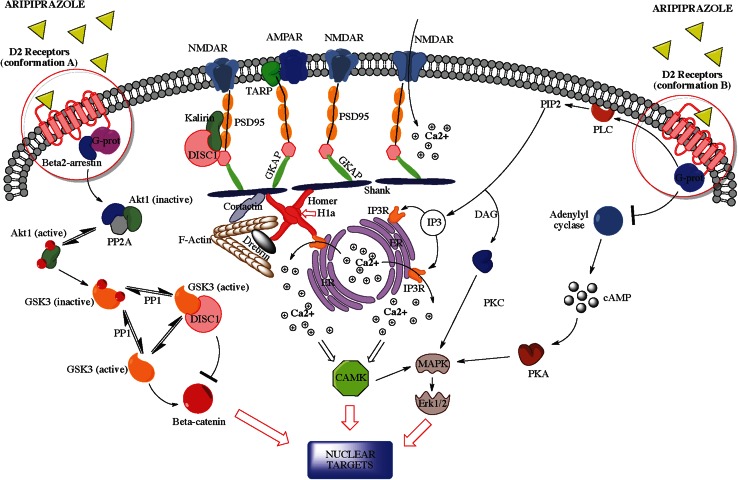
Dopamine partial agonism and functional selectivity have been innovative strategies in the pharmacological treatment of schizophrenia and mood disorders and have shifted the concept of dopamine modulation beyond the established approach of dopamine D2 receptor (D2R) antagonism. Despite the fact that aripiprazole was introduced in therapy more than 12 years ago, many questions are still unresolved regarding the complexity of the effects of this agent on signal transduction and intracellular pathways, in part linked to its pleiotropic receptor profile. The complexity of the mechanism of action has progressively shifted the conceptualization of this agent from partial agonism to functional selectivity. From the induction of early genes to modulation of scaffolding proteins and activation of transcription factors, aripiprazole has been shown to affect multiple cellular pathways and several cortical and subcortical neurotransmitter circuitries. Growing evidence shows that, beyond the consequences of D2R occupancy, aripiprazole has a unique neurobiology among available antipsychotics. The effect of chronic administration of aripiprazole on D2R affinity state and number has been especially highlighted, with relevant translational implications for long-term treatment of psychosis. The hypothesized effects of aripiprazole on cell-protective mechanisms and neurite growth, as well as the differential effects on intracellular pathways [i.e. extracellular signal-regulated kinase (ERK)] compared with full D2R antagonists, suggest further exploration of these targets by novel and future biased ligand compounds. This review aims to recapitulate the main neurobiological effects of aripiprazole and discuss the potential implications for upcoming improvements in schizophrenia therapy based on dopamine modulation beyond D2R antagonism.
多巴胺部分激动作用和功能选择性一直是精神分裂症和情绪障碍药物治疗中的创新策略,并且已将多巴胺调节的概念从既定的多巴胺D2受体(D2R)拮抗方法中拓展出来。尽管阿立哌唑在12多年前就已用于治疗,但关于该药物对信号转导和细胞内途径影响的复杂性,仍有许多问题尚未解决,部分原因与其多效性受体特征有关。作用机制的复杂性已逐渐将该药物的概念从部分激动作用转变为功能选择性。从早期基因的诱导到支架蛋白的调节以及转录因子的激活,阿立哌唑已被证明可影响多种细胞途径以及多个皮质和皮质下神经递质回路。越来越多的证据表明,除了占据D2R的后果之外,阿立哌唑在现有抗精神病药物中具有独特的神经生物学特性。长期服用阿立哌唑对D2R亲和力状态和数量的影响尤其受到关注,这对精神病的长期治疗具有重要的转化意义。阿立哌唑对细胞保护机制和神经突生长的假定作用,以及与完全D2R拮抗剂相比对细胞内途径[即细胞外信号调节激酶(ERK)]的不同作用,提示新型和未来的偏向性配体化合物可进一步探索这些靶点。本综述旨在概括阿立哌唑的主要神经生物学作用,并讨论基于D2R拮抗作用之外的多巴胺调节对精神分裂症治疗未来进展的潜在影响。