Sparre-Ulrich A H, Hansen L S, Svendsen B, Christensen M, Knop F K, Hartmann B, Holst J J, Rosenkilde M M
Department of Neuroscience and Pharmacology, Faculty of Health and Medical Sciences, The Panum Institute, University of Copenhagen, Copenhagen, Denmark.
NNF Center for Basic Metabolic Research, Copenhagen, Denmark.
Br J Pharmacol. 2016 Jan;173(1):27-38. doi: 10.1111/bph.13323. Epub 2015 Nov 20.
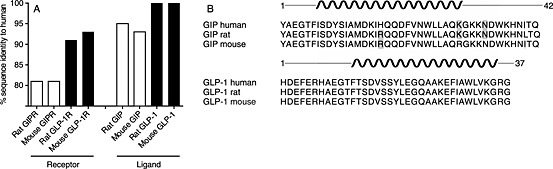
Specific, high potency receptor antagonists are valuable tools when evaluating animal and human physiology. Within the glucose-dependent, insulinotropic polypeptide (GIP) system, considerable attention has been given to the presumed GIP receptor antagonist, (Pro3)GIP, and its effect in murine studies. We conducted a pharmacological analysis of this ligand including interspecies differences between the rodent and human GIP system.
Transiently transfected COS-7 cells were assessed for cAMP accumulation upon ligand stimulation and assayed in competition binding using (125) I-human GIP. Using isolated perfused pancreata both from wild type and GIP receptor-deficient rodents, insulin-releasing, glucagon-releasing and somatostatin-releasing properties in response to species-specific GIP and (Pro3)GIP analogues were evaluated.
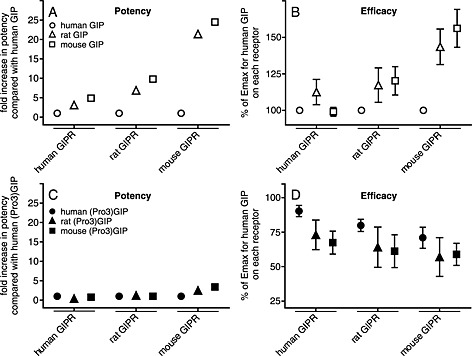
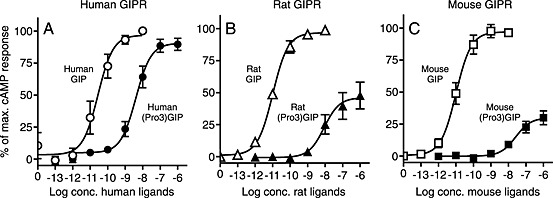
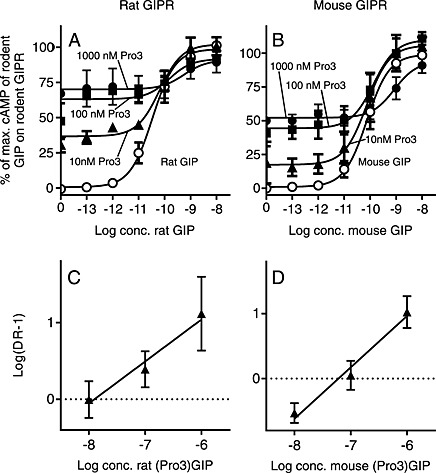
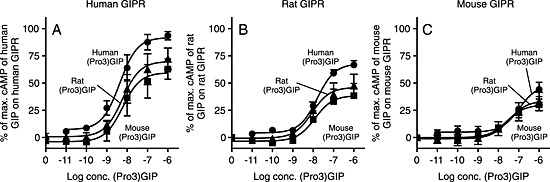
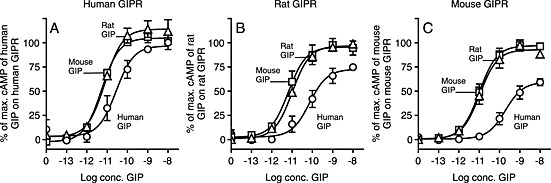
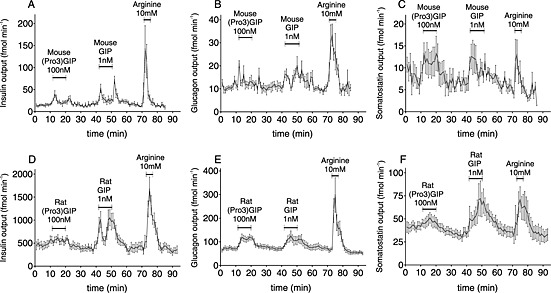
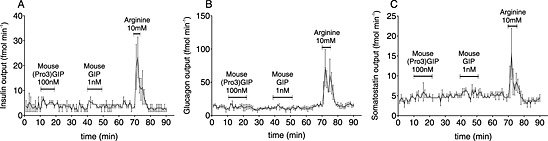
Human (Pro3)GIP is a full agonist at human GIP receptors with similar efficacy (Emax ) for cAMP production as human GIP, while both rat and mouse(Pro3)GIP were partial agonists on their corresponding receptors. Rodent GIPs are more potent and efficacious at their receptors than human GIP. In perfused pancreata in the presence of 7 mM glucose, both rodent (Pro3)GIP analogues induced modest insulin, glucagon and somatostatin secretion, corresponding to the partial agonist activities observed in cAMP production.
When evaluating new compounds, it is important to consider interspecies differences both at the receptor and ligand level. Thus, in rodent models, human GIP is a comparatively weak partial agonist. Human (Pro3)GIP was not an antagonist at human GIP receptors, so there is still a need for a potent antagonist in order to elucidate the physiology of human GIP.
在评估动物和人类生理学时,特异性、高效能的受体拮抗剂是很有价值的工具。在葡萄糖依赖性促胰岛素多肽(GIP)系统中,假定的GIP受体拮抗剂(Pro3)GIP及其在小鼠研究中的作用受到了相当多的关注。我们对这种配体进行了药理学分析,包括啮齿动物和人类GIP系统之间的种间差异。
对瞬时转染的COS-7细胞在配体刺激后进行cAMP积累评估,并使用(125)I-人GIP进行竞争结合测定。使用来自野生型和GIP受体缺陷型啮齿动物的离体灌注胰腺,评估对物种特异性GIP和(Pro3)GIP类似物的胰岛素释放、胰高血糖素释放和生长抑素释放特性。
人(Pro3)GIP是人类GIP受体的完全激动剂,其产生cAMP的效力(Emax)与人GIP相似,而大鼠和小鼠的(Pro3)GIP在其相应受体上均为部分激动剂。啮齿动物GIP在其受体上比人GIP更有效力和效能。在存在7 mM葡萄糖的灌注胰腺中,两种啮齿动物(Pro3)GIP类似物均诱导适度的胰岛素、胰高血糖素和生长抑素分泌,这与在cAMP产生中观察到的部分激动剂活性相对应。
在评估新化合物时,在受体和配体水平考虑种间差异很重要。因此,在啮齿动物模型中,人GIP是一种相对较弱的部分激动剂。人(Pro3)GIP不是人GIP受体的拮抗剂,因此仍需要一种强效拮抗剂来阐明人GIP的生理学。