Quan Rui-Chang, Li Huan, Wang Bo, Goodale Eben
Center for Integrative Conservation, Xishuangbanna Tropical Botanical Garden (XTBG), Chinese Academy of Sciences (CAS), Menglun, Mengla, Yunnan, 666303 China.
College of Forestry, Guangxi University, 100 Daxue Road, Nanning, Guangxi 530005 China.
Front Zool. 2015 Sep 11;12:21. doi: 10.1186/s12983-015-0116-y. eCollection 2015.
Adult birds clean the nest by consuming or transporting feces, which is thought to be important in order to lower the levels of parasites, pathogens and predation at the nest. If nestlings were to defecate when parents were absent, however, feces could accumulate in the nest.
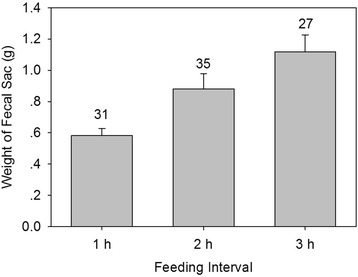
To understand the mechanism by which nest sanitation is maintained, we studied the timing of defecation in nestling birds of common passerine species in southwest China. In 159 nests of 8 species at the nestling stage during 779 randomly timed observations, we never found fecal sacs present. Video recordings, totaling 455 h at five Pycnonotus jocosus nests in the field, showed almost all defecation after feedings, and only nestlings that were fed defecated. Six translocated P. jocosus nests were taken into captivity in order to manipulate the frequency of feeding. These nestlings defecated only after feeding, even when feeding intervals were extended to 60 and 120 min. The fecal sac weight also increased with extended feeding intervals, demonstrating a remarkable plasticity for nestlings to wait for feedings.
The evidence allows two major conclusions: 1) defecation in the nest occurs at a time that ensures nest sanitation, stimulated by feeding, rather than there being a set time of gut processing between feeding and excretion; 2) the strong plasticity in the timing of defecation and the possibility of negative repercussions (if defecation occurs when parents are absent) are important mechanisms underlying the efficiency of the feeding-defecation system.
成年鸟类通过消耗或运送粪便来清洁巢穴,这被认为对于降低巢穴中的寄生虫、病原体水平以及减少被捕食的风险非常重要。然而,如果雏鸟在亲鸟不在时排便,粪便可能会在巢穴中积累。
为了了解维持巢穴卫生的机制,我们研究了中国西南部常见雀形目雏鸟的排便时间。在对8种鸟类的159个巢穴进行的779次随机定时观察中,我们从未发现有粪便囊。在野外对5个红耳鹎巢穴进行的总计455小时的视频记录显示,几乎所有排便都发生在喂食后,并且只有被喂食的雏鸟才会排便。为了控制喂食频率,将6个迁移的红耳鹎巢穴带入圈养环境。这些雏鸟即使在喂食间隔延长至60分钟和120分钟时,也只在喂食后排便。粪便囊的重量也随着喂食间隔的延长而增加,这表明雏鸟等待喂食具有显著的可塑性。
这些证据可以得出两个主要结论:1)巢穴中的排便发生在由喂食刺激而确保巢穴卫生的时间,而不是在喂食和排泄之间存在固定的肠道处理时间;2)排便时间的强可塑性以及(如果在亲鸟不在时排便)可能产生的负面影响是喂食 - 排便系统效率的重要机制。